

Welcome to the Node
The Node is a place to read, write and interact with a global community of developmental and stem cell biologists. This is your site: once you’ve registered, you can freely share your blog post, job advert or event notice with the community.


Recent posts
BiO Global South Travel Grants for EZM2026
Posted by Andrea Murillo, on 18 February 2026
Biology Open is proud to partner with the European Zebrafish Society (EZS) to offer travel grants for the 13th European Zebrafish Meeting (EZM2026) to be held 7-11 July 2026 in Vienna, Austria. …Development presents… neural development
Posted by the Node, on 16 February 2026
In February, we hear from three early-career researchers studying neural development. Chaired by one of Development’s first Pathway to Independence fellows, Polina KamenevaSelf assessing your progress as a developing scientist
Posted by David Fay, on 12 February 2026
As scientists, we are all are works in progress and continually developing in our own ways. Each of us brings unique strengths and skills along with challenges, and these can …SciArt profile: Craig Zuckerman
Posted by the Node, on 11 February 2026
Here we showcase work from Craig Zuckerman, a digital fine artist whose work draws on scientific imagery to create immersive visual environments. With a background in medical illustration and animation, …Epigenetic inheritance of acquired traits via stem cells dedifferentiation/differentiation or transdifferentiation cycles
Posted by Arshak Alexanian, on 8 February 2026
Do cells carry memories of the whole body into the next generation? For more than two millennia, biologists and philosophers have debated whether traits acquired during life can be inherited. …January in preprints
Posted by the Node, on 5 February 2026
Welcome to our monthly trawl for developmental and stem cell biology (and related) preprints. The preprints this month are hosted on bioRxiv.Catch up on Development presents… webinar on the environment and evolution
Posted by the Node, on 29 January 2026
Our January webinar featured two early-career researchers working on development, evolution and the environment. Here, we share the talks from Chee Kiang (Ethan) Ewe (Tel Aviv University) and Max Farnworth …Behind the paper: “Spatially organized cellular communities shape functional tissue architecture in the pancreas”
Posted by Alejo Torres Cano, on 28 January 2026
Alejo Torres Cano’s story on their recent paper describing how spatially organized cellular communities shape…Lab meeting with the Ditadi lab
Posted by the Node, on 27 January 2026
Meet the Ditadi lab, based at the Ospedale San Raffaele, as part of the San Raffaele Telethon Institute for Gene Therapy, in the north-east corner of Milan, Italy.Why Seeing Still Matters in Biology
Posted by Helena Jambor, on 26 January 2026
or, Why all biologists needs data visualization Biology probes form and function of Life. Form is easy to grasp: cells under a microscope, subcellular structures in electron micrographs, or organisms …Subscribe to our mailing list
Weekly digests highlighting our latest blog posts and job adverts
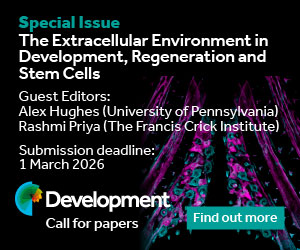
Call for papers
Read the latest Development issue
Do you have something to share?
From behind the paper stories, meetings reports, to featured resources, we have a list of the different series on the Node that your story might fit into. We also welcome any type of content relevant to the developmental and stem cell biology community.
The Node Network

Join our global directory of developmental and stem cell biologists
Most-read posts in December
Our sister community sites


Grants from The Company of Biologists
Development presents…
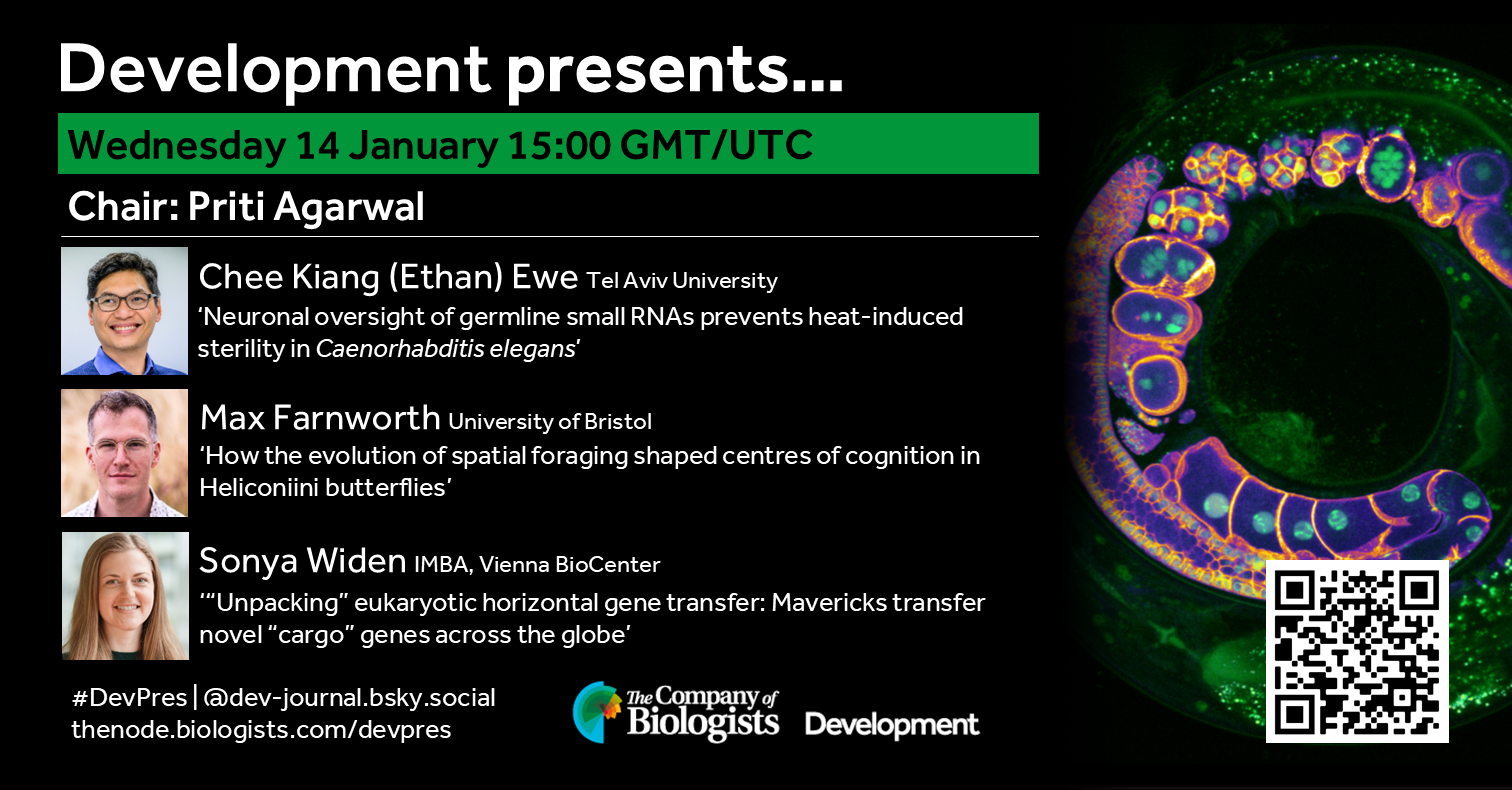
Watch the recordings from our webinar featuring two early-career researchers working on development, evolution and the environment. Unfortunately, Sonya Widen was unable to present at this webinar.
Development presents… webinars
You can view all the previous Development presents… talks on-demand
Development presents… mailing list
Subscribe to the Development presents… mailing list to receive details about upcoming webinars as they are announced.