

Embryonic stem cell origin — food for thought
Posted by Erin M Campbell, on 9 February 2011
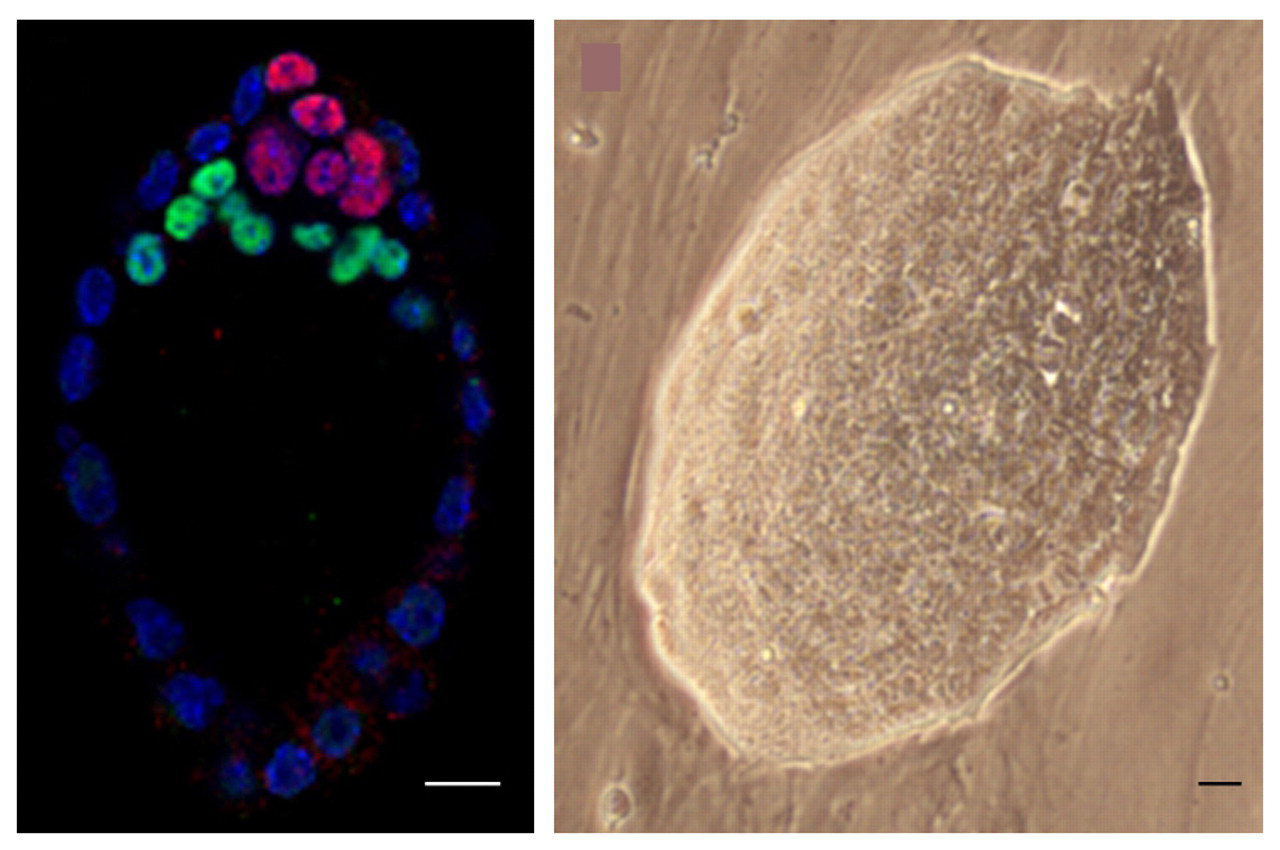 What I love about developmental biology is the collaborative nature of the field. The vast majority of biologists feel that by sharing ideas, data, and reagents, we can learn more than if we were all to work alone with blinders on our heads. A recent paper in Development puts forth a hypothesis about embryonic stem cell origin. Hopefully, the ideas presented will serve as food for thought for the stem cell field and lead to a new understanding about ES cells.
Embryonic stem (ES) cells are valuable in the study of human diseases and development due to their pluripotent nature, and have the potential for treating disease and replacing damaged tissue. Because of their amazing potential, it is crucial to understand how and when pluripotency occurs, and how stem cells can be cultured. Naïve pluripotency occurs twice during development—first in early epiblast tissue and again in the germ cell lineage—and this reflects the relationship between pluripotency and the mammalian germ line. The recent Hypothesis paper by Nichols and Smith suggests that ES cells could be cultured via two routes to reach naïve pluripotency—directly from early epiblast tissue or during the specification of primordial germ cells in culture.
Images above show an early mouse embryo (left) and a colony of ES cells growing on a layer of fibroblast cells (right). In the embryo, epiblast cells are red, hypoblast cells are green, and trophectoderm is blue.
For a more general description of this image, see my post on EuroStemCell, the European stem cell portal.
 Nichols, J., & Smith, A. (2010). The origin and identity of embryonic stem cells Development, 138 (1), 3-8 DOI: 10.1242/dev.050831
 (4 votes)
 Loading...
Get involved
Create an account or log in to post your story on the Node.
Sign up for emails
Subscribe to our mailing lists.
Read the latest Development issue
Most-read posts in May
- From comparison to mechanism: decoding heart regeneration
- A day in the life of a Reviews Editor (at Development)
- What does a Reviews Editor do?
- New evo-devo textbook ‘Eco-Evo-Devo: The Environmental Regulation of Development, Evolution, and Health’
- preLighters’ choice – A curated selection of recent preprints