

This Month on the Node – August 2012
Posted by the Node, on 31 August 2012
A detailed view of mice and fish
Michael Wong wrote about the 3D mouse embryo atlas he has worked on. The high-resolution atlas of an E15.5 mouse embryo allows for easier phenotyping of mutant strains, which can then be compared to the wildtype.
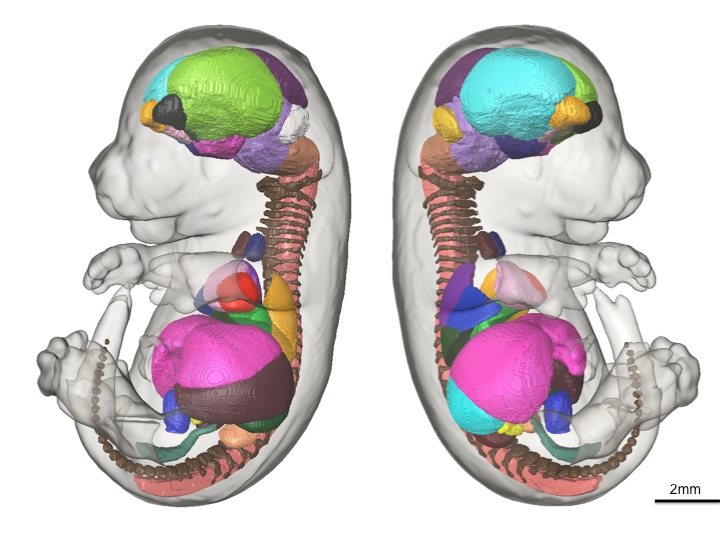
“If you have two groups of mouse embryos, one wild-type and one mutant, with a single gene knockout, how do you find out what’s different about them? How do you get clues to the function of the knocked out gene and its role in mouse embryo development? The most intuitive answer would be to look at the two groups of mouse embryos with a microscope and see if you can find any gross differences in morphology in the mutant group. You could hypothesize that the organ or structure that shows an aberration in comparison with the wild-type group is an area where that particular gene function is important and carry on with more focused phenotyping assays from there. This is the exact premise of our recent paper in Development.”
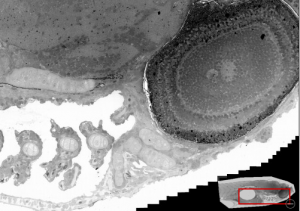
Mice were not the only animals that we’ve looked at in high-resolution detail. A recent paper in JCB described “virtual nanoscopy”, a method to collate multiple EM images to create a detailed map of a zebrafish embryo.
Gene rearrangement
Kalin Narov introduced us to recent work on gene rearrangement in the lamprey.
“…according to the authors, it is the first known example of a genome rearrangement of such scale in vertebrates, which makes it especially important for better understanding the evolution and mechanisms of vertebrate gene regulation.”
Conferences:
The Santa Cruz Developmental Biology Meeting took place earlier this month, and Katherine Brown wrote a summary for the Node.
Last month, at the SDB meeting, we continued our chain of poster winner interviews, as BSDB poster award winner Stephen Fleenor interviewed SDB poster award winner John Young.
Also on the Node:
– We’re going to make author biographies public on the Node. Make sure to check that yours is up to date!
– The culture medium used for preimplantation cultures in IVF labs may have long-term effects on development.
– Several new jobs have been posted on the site.
 (No Ratings Yet)
 Loading...
Get involved
Create an account or log in to post your story on the Node.
Sign up for emails
Subscribe to our mailing lists.
Read the latest Development issue
Most-read posts in May
- From comparison to mechanism: decoding heart regeneration
- A day in the life of a Reviews Editor (at Development)
- What does a Reviews Editor do?
- New evo-devo textbook ‘Eco-Evo-Devo: The Environmental Regulation of Development, Evolution, and Health’
- preLighters’ choice – A curated selection of recent preprints