

This section contains a collection of audio-visual resources that can be browsed to learn more about development and biology. This page is part of the redeveloped resources section on the Node, you can find out more about the update here.
Videos
Links to some interesting videos teaching about biology.
Posters
Posters can be a great tool to convey developmental biology, both in terms of practical information and concepts.
Audio
Audio resources including podcasts to further interest and understanding in biology.
SciArt
This section contains links to some examples of the pairing of art and science. Development is such a beautiful part of biology, and turning experimental images into art is an easy way to tell a story to the public.
Videos
- Seminars on development and stem cells from iBiology.
- Stated Clearly videos explaining biological concepts to lay audiences.
- Suggested YouYube channels from the popular IFLS.
- The Company of Biologists YouTube channel, including a Development playlist.
- Acapella Science explaining science in pop songs.
- Minute lectures on a range of biology topics.
- YouTube video on the importance of funding basic science.
- Movie about Antonie van Leeuwenhoek and bacteria.
- Video to illustrate the problem of image resolution.
- Learn about blood stem cell development.
- Video explaining the cytoskeleton.
- Videos explaining the process of transcription.
- SDB CoRE: database of reference images, movies and diagrams.
- The Journal of Visual Experiments (JoVE) makes videos of scientific experiments from the top labs around the globe. They have over 500 videos in their Developmental Biology collection.
- EuroStemCell highlights animated videos from the Institut Pasteur explaining Muscle and Stem Cells
- Nicole Theodosiou shares her experience of teaching evo-devo to, and promoting creativity in, university students
- The UNSW Embryology page has collated hundreds of embryology movies, including human and model organisms as well as computer models
- If you want to introduce students (or anyone for that matter) to the beauty of developmental biology, this movie of newt development by Jan van IJken is a good place to start.
- Our own YouTube channel includes playlists devoted to animal and development, specific model organisms, history of the field, talks and interviews, education and science art, and advice for scientists. Get in touch if you see anything we’ve missed!
Posters
- Model organism staging and phenotyping. Developmental Dynamics has put together a series of staging posters for some of the main model organisms of developmental biology (plus humans). You can find them here.
- How to fish and how to fly. The journal genesis also has two wonderful posters on zebrafish developmental stages and phenotypic markers in Drosophila (which adorns the walls of many a fly lab). You can find them here.
- Drosophila phenotyping. Flybase and Thomas Kaufman’s lab have put together a comprehensive, high resolution collections of commonly used fly mutants. Check them out here.
- Development’s ‘Development at a glance’ series. Since 2012 Development has run a series of posters and accompanying articles visually exploring some of the topical aspects of the field. You can find the whole series here. (Also check out Journal of Cell Science’s Cell Science at a Glance and Disease Models and Mechanisms’ At a Glance series, which both contain lots of relevance to developmental biologists.)
- Nature Reviews Molecular Cell Biology has since 2002 produced posters on various topics relevant to developmental biology. Check them out here.
- Abcam’s poster library mainly focuses on pathways but also some processes and concepts (some posters require registration to view). Check it out here.
- Microscopy aides. Zeiss has a useful collection of microscopy posters – check them out here.
- Levin lab posters. Michael Levin’s lab at Tufts has had two poster made for them by the graphic designer Ben Oldroyd (with support of the Templeton World Charity Foundation) covering interesting concepts in developmental biology.
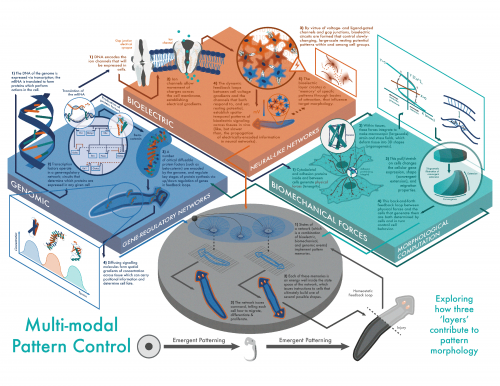
Dynamic control of complex anatomical pattern is a multi-scale process that occurs during embryogenesis, regeneration, metamorphosis, remodeling, and cancer suppression. Individual cells and cell networks must coordinate their activity toward specific tissue- and organ-level morphological outcomes. These processes take place through three integrated layers: 1) gene-regulatory networks comprised of transcriptional circuits and diffusible biochemical signals, 2) physical forces – biomechanical processes by which tensions and stresses implement morphological computation, and 3) bioelectric networks – neural-like dynamics in gap junction-coupled tissues expressing ion channels and pumps. Each of these layers processes information and implements emergent complexity at cell, tissue, organ, and whole body axis levels. They are coupled, with bi-directional functional links between each, and unique roles in decision-making and implementation of pattern control. In this way, physics, chemistry, and computer science interplay to enable biological systems to regulate their own structure and function with a high degree of adaptive robustness. PDF Link.
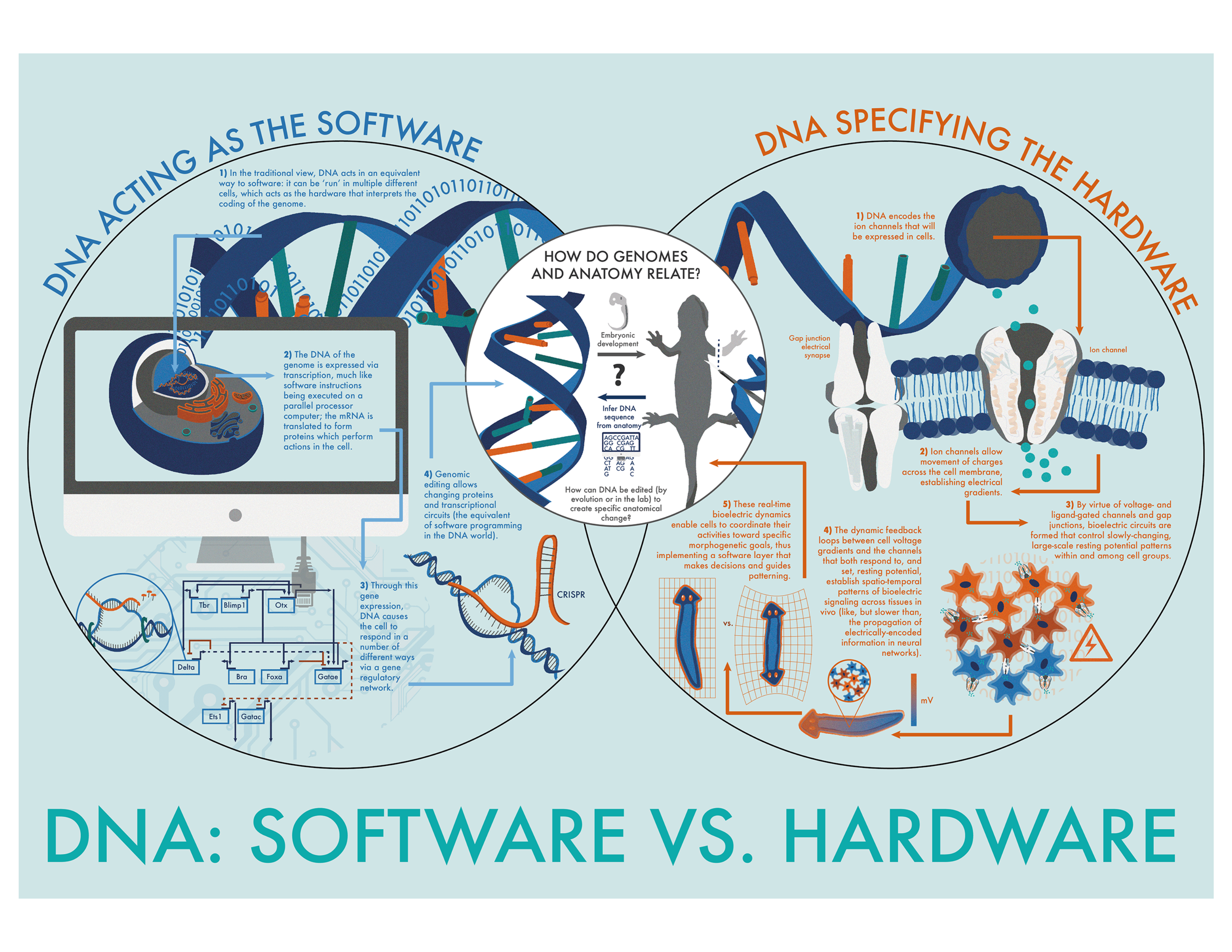
Multi-scale pattern control (during regulative development, metamorphosis, cancer suppression, and regenerative repair) requires living systems to predictably reach invariant goal states from a diverse range of starting conditions and perturbing influences. This is implemented by a set of computational processes in which cells and tissues need to make decisions about current anatomical state and stop remodeling when the correct target morphology has been reached. Computational systems can be described via two components: the software (a set of dynamic processes including communication among subunits, information processing, and memory) and the hardware (the physical components whose dynamical interactions implement the software). A traditional view sees the cell as the hardware that interprets DNA sequences as the software. A different view is that the genome encodes the hardware, providing each cell with versatile computational elements such as ion channels. The software in this case is the electrophysiological dynamical system formed by coupled cells. Such bioelectrical networks can form among all cell types, although they are best known in the brain. Much as the ion channel and synaptic hardware allow the brain to implement numerous kinds of computational behaviors (e.g., goal-seeking and memory circuits), the same hardware in other cell types is a much more ancient system which tissues use to execute the computations needed for anatomical control (pattern memory and global integration of cells toward the correct complex outcome). PDF Link.
Audio
- CellPress podcast webpage.
- A wide range of science podcasts for many levels.
- Plantae’s The Taproot is a podcast devoted to the stories behind papers in plant science
- Genetics Unzipped is a podcast from The Genetics Society hosted by Kat Arney.
- En Fase Experimental is the science podcast of the Society of Spanish Researchers in the United Kingdom, covering current advances in science but also the role and challenges that STEM research faces in the current world, in Spanish.
SciArt
- WelcomeTrust page on art and science
- Work by the University of Southampton on neuro diseases and fashion.
- Cheeky neurons using art to explain epilepsy to children.
- Microetchings of the nervous system.
- Interstellate – beautiful neuro science art.
- Natalya Zahn’s website containing beautiful science drawings.
- Beata Science Art website with many different forms of science art.
Back to top
Have we missed a useful link? Get in touch!