

Patterned Reality: The Common Pursuit of Science and Art
Posted by the Node, on 1 September 2026
Written by R. Friedrich Bliem
Keywords: Interdisciplinarity, art, science, creative practice
Abstract
Science abstracts regularities in the world to model and predict outcomes, while art renders similar structures in material form; in both intuition plays a central role in shaping understanding and practice. Cognition and perception resonate with underlying patterns, which we experience as intuition: science formalizes these patterns, art makes them perceptible and cognition enacts them through perception itself. Across these domains, patterns function as a shared structural logic linking matter, mind and meaning, functioning as an epistemic bridge between scientific, cognitive and artistic processes.
Introduction
While patterns pervade the natural and human-made world, they are rarely treated as foundational elements of reality. Across physics, biology, cognition and artistic practice, patterns are typically understood as emergent properties, descriptive features or aesthetic compositions rather than as ontologically primary structures. This disciplinary fragmentation leaves a conceptual gap: science formalizes patterns as laws and models, art materializes them perceptually and cognitive theory interprets them internally, but no framework integrates these perspectives into a coherent account of reality as fundamentally patterned.
Although such patterns are widely observed in phenomena such as ocean waves, river networks, crystalline structures, neural activity, motor routines or artistic composition, their foundational role in structuring reality, however, remains insufficiently theorized.
This study advances a pattern-based ontology in which reality, life, cognition and creative practice are expressions of structured relational principles. In this view, patterns are generative at a fundamental level; the patterns that emerge from them form the observable structures of the world. These structures can combine and recombine, generating further patterns across scales. I contend that these dynamics arise from more fundamental forms, which I call proto-patterns, such as the dynamic interplay of order and chaos, which produces structures that are simultaneously stable and adaptable across scales.
From a physical and biological perspective, patterns not only describe but actively organize matter, as reflected in symmetry principles and self-organizing dynamics far from equilibrium, thus preserving the generative character of the proto-patterns throughout this process. Evolution illustrates this: random change generates novelty, while order stabilizes the resulting forms, enabling the emergence of complexity across levels of organization.
Artistic practice engages this generative logic not only representationally but epistemically, through material and rule-based exploration. By working with patterns, art can anticipate structural principles later formalized in mathematics. This is exemplified in the geometric ornamentation of the Alhambra, where systematic constraints and variations generate complex symmetry relations centuries before their formal classification. Across domains, patterns function as an epistemic bridge, revealing the relational logic underlying matter, life, mind and aesthetic experience.
The central questions guiding this work are: Can patterns serve as a universal principle bridging matter, mind and art? How do order and chaos, as a special case, manifest consistently across domains? How can artistic practice materialize the same generative dynamics observed in natural systems?
Patterns in Nature and Science
Fundamental physical laws reflect underlying patterns that constrain which forms and interactions are possible. Symmetries formalized by Noether (1918) govern conservation laws and particle interactions. Matter crystallizes within these relational possibilities rather than generating structure independently. Systems far from equilibrium spontaneously form stable patterns through dynamic instability rather than static balance (Prigogine, 1980). For example, water’s hydrogen bonds constantly break and reform, creating fleeting order maintained through continuous fluctuation.
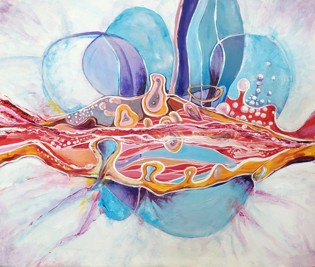
Patterns are not fixed. They emerge, stabilize, dissolve and reconfigure. The interplay between constraint and variability, that is, order and chaos, provides the generative dynamics that enable complex systems to arise (Bliem, 2025; Kauffman, 1993). Local interactions among system components give rise to global patterns, a process termed emergence. Emergence unfolds gradually, rather than abruptly, through the coupling of material processes. Each level of organization introduces novel properties that are irreducible to their constituents, from molecules and cells to neural circuits and consciousness (Fig. 1).
Fig. 1: Organisation of life from simplest to most complex scale: cell → tissue → organ → organ system → organism → population → ecosystem. Painting by R.F.Bliem, Oil on Panel, 60×70 cm
Darwinian selection is fundamentally a pattern-filtering process: variations appear, some persist, others fade (Darwin, 1859). Genes act as pattern-encoding structures whose arrangements shape phenotypes (Dawkins, 1976). Stochastic gene expression introduces variability even among genetically identical cells, enabling populations to diversify responses to environmental uncertainty (Elowitz, Levine, Siggia and Swain, 2002). The balance of order and variability allows differentiation, robustness and the rise of higher-order organization. Consciousness itself can be understood as an emergent property of regulated variation acting across biological scales.
Patterns in Mind, Perception and Behaviour
All sensory modalities evolved to detect regularities. Vision extracts edges, textures, symmetries and motion; hearing organizes vibrations into rhythm and harmony; taste and smell cluster chemical signatures; touch identifies spatial gradients and pressure patterns. Perception is predictive, actively matching incoming signals against internal models (Clark, 2013; Friston, 2010). Sensory order emerges from the interaction between environmental inputs and anticipatory structures, mirroring the adaptive persistence of patterns in physical and biological systems.
Human behavior unfolds through layered sequences such as motor routines, habits, schemas or social scripts (Kahneman, 2011). Actions that violate recognizable patterns are often perceived as erratic, indicating the nervous system’s reliance on predictable structure. Consciousness emerges as a structured configuration of neural patterns (Tononi, 2004; Dehaene, 2014; Tegmark, 2015), integrating and updating layered patterns across scales and producing experience as an emergent property rather than a discrete substance.
Patterns in Art
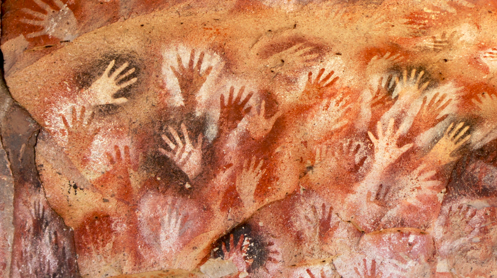
Art externalizes perceptual and cognitive patterns. Some cave drawings illustrate the use of rhythm and symbolic condensation (Lewis-Williams, 2002), such as in Cueva de las Manos, Río Pinturas, in Argentina (Fig. 2).
Fig. 2: Cueva de las Manos, Río Pinturas, Argentina. Photograph by Pablo Gimenez (PabloGimenez.ar), licensed under Creative Commons Attribution-ShareAlike 2.0 (CC BY-SA 2.0).
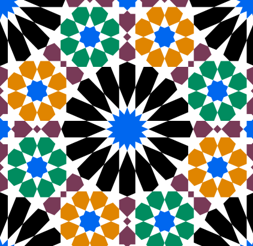
Historical symbolic systems, such as the geometric ornamentation of the Alhambra, exemplify fully formalized explorations of structure. Artisans implemented precise geometric constructions, modular repetition and symmetry rules to generate complex visual orders (Arnheim, 1974; Lewis-Williams, 2002). Many of the seventeen two-dimensional crystallographic (“wallpaper”) groups were effectively realized in these designs centuries before their formal identification and mathematical classification (Fedorov, 1891) (Fig. 3).
Fig. 3: Rule-based geometric pattern systems forming the foundation of Andalusian patterns
Algorithmic, generative and human–robot collaborations extend these principles into experimental contexts, showing continuity between historical, cognitive and computational patterning (Bliem, 2025).
Science and Art: Unified Pattern Logic
Science abstracts regularities in the world in order to model and predict outcomes. Art engages with similar regularities not by formalisation but by perceiving and rendering them in material form. In both domains intuition plays a central role. In the arts it is often treated as a self evident instrument of making and judgment, while in science it is frequently obscured by formal reasoning despite its role in shaping hypotheses and research trajectories. I propose that intuition can be understood as a form of resonance with underlying structures that both disciplines encounter in different ways: structures that science analyses and that art makes perceptible through form.
Both engage relational structures, constraints, variation and emergence (Arnheim, 1974; Wilson, 2010; Noether, 1918). Patterns function as the epistemic bridge, making relations visible and operative and enabling knowledge across multiple domains.
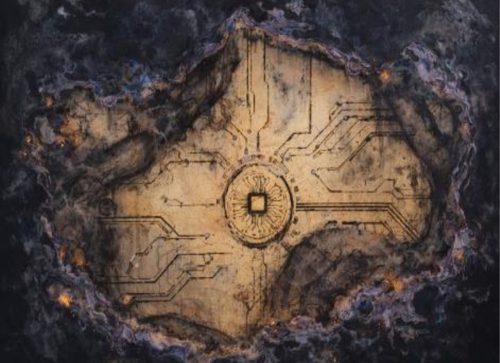
Bliem put this concept into practice by applying the pattern or chaos and order. In a human–robot art project (Bliem, 2025), machine precision produced order, while the human artist introduced curvilinear variation („chaos“). Iterative interaction merged both modes, illustrating visually how constraint and variability jointly shape structure (Fig. 4).
Conclusion
Patterns are not mere descriptors but the generative principles underlying physical, biological, cognitive and artistic systems. Across domains, order and variability interact to produce emergent complexity, enabling consciousness, adaptive behavior and aesthetic expression. Science and art participate in the same generative logic, making patterns not only observable but actionable. Reality is thus a relational, dynamic, pattern-based process and human creativity allows conscious engagement with the principles that bring the universe into being (Tegmark, 2014; Prigogine, 1980).
Fig. 4: Joint Painting with a Robot Printer — exploring elements of cellular evolution in a human–robot collaboration Cocreation No. 5, Stage 2; Painting by R.F. Bliem, Oil on Canvas, 105×130 cm
Bibliography
Arnheim, R. (1974). Art and visual perception: A psychology of the creative eye. University of California Press.
Bliem, R. F. (2025). Chaos and order as design elements in evolutionary biology and the visual arts: A case study of human–robot artistic collaboration.
https://www.interaliamag.org/audiovisual/rudolf-friedrich-bliem-chaos-and-order-as-design-elements-in-evolutionary-biology-and-the-visual-arts-a-case-study-of-human-robot-artistic-collaboration/
Clark, A. (2013). Whatever next? Predictive brains, situated agents, and the future of cognitive science. Behavioral and Brain Sciences, 36(3), 181–204. https://doi.org/10.1017/S0140525X12000477
Darwin, C. (1859). On the origin of species by means of natural selection. John Murray.
Dawkins, R. (1976). The selfish gene. Oxford University Press.
Dehaene, S. (2014). Consciousness and the brain: Deciphering how the brain codes our thoughts. Viking.
Elowitz, M. B., Levine, A. J., Siggia, E. D., & Swain, P. S. (2002). Stochastic gene expression in a single cell. Science, 297(5584), 1183–1186. https://doi.org/10.1126/science.1070919
Fedorov, E. S. (1891). The symmetry of regular systems of figures. Proceedings of the Imperial St. Petersburg Mineralogical Society, 28, 1–146. in Minerals 2020, 10(2), 181 https://doi.org/10.3390/min10020181
Friston, K. (2010). The free-energy principle: A unified brain theory? Nature Reviews Neuroscience, 11(2), 127–138. https://doi.org/10.1038/nrn2787
Kahneman, D. (2011). Thinking, fast and slow. Farrar, Straus and Giroux.
Kauffman, S. A. (1993). The origins of order: Self-organization and selection in evolution. Oxford University Press.
Lewis-Williams, D. (2002). The mind in the cave: Consciousness and the origins of art. Thames & Hudson.
Noether, E. (1918). Invariante Variationsprobleme. Nachrichten von der Gesellschaft der Wissenschaften zu Göttingen, Mathematisch-Physikalische Klasse, 235–257.
Prigogine, I. (1980). From being to becoming: Time and complexity in the physical sciences. W. H. Freeman.
Tegmark, M. (2014). Our mathematical universe: My quest for the ultimate nature of reality. Knopf.
Tegmark, M. (2015). Consciousness as a state of matter. Chaos, Solitons & Fractals, 76, 238–270. https://doi.org/10.1016/j.chaos.2015.03.014
Tononi, G. (2004). An information integration theory of consciousness. BMC Neuroscience, 5, Article 42. https://doi.org/10.1186/1471-2202-5-42
Wilson, S. (2010). Art + science now. Thames & Hudson.
Get involved
Create an account or log in to post your story on the Node.
Sign up for emails
Subscribe to our mailing lists.