

Oh my, what big feet you have…
Posted by Kim Cooper, on 10 September 2010
Hello Node folks. My name is Kim Cooper, and I’m a postdoctoral fellow with Cliff Tabin at Harvard Medical School. I recently spoke at the SDB meeting in Albuquerque, and Eva Amsen approached me about contributing to the Node. The primary reason is because I’m working on a fun animal that takes me off to China for field collections and has sent me down a rough road of learning to breed an exotic in captivity. The animal is a jerboa. It’s a bipedal desert rodent related to rats and mice. They’re native to northern Africa through the Middle East, Central Asia, and northern China.
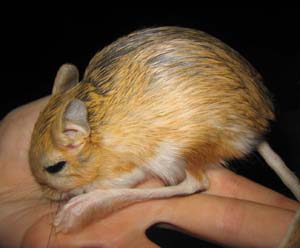
I’m interested in this adorably bizarre animal because it is an excellent model for evolutionary novelty in the limbs. They have elongated hindlimbs with enormous feet that have only three toes and metatarsals that are fused into a single bone. This gives them a long bounding stride upright on their hindlimbs, and they really only use their forepaws for feeding, digging, and grooming. They are very efficient movers – they can hop three meters in a single leap and a meter straight in the air when startled.
The gist of what I’m doing with these animals involves collecting embryos from pregnant females soon after the come out of hibernation and breed more or less synchronously in northern China. The embryos are fixed and preserved in methanol and then shipped back to Boston for further developmental studies. I’m taking a two-pronged approach by candidate gene analysis and RNASeq to identify genes that are expressed differently in the three-toed hindlimb of the jerboa compared to the five-toed forelimbs and fore and hindlimbs of a near relative – the mouse.
I’m excited to share field collection stories from China and experiences with starting the colony. The field stories are easy since I’ve been keeping a travel blog for about 5 years now and can cross post from previous years until the next field season starts again in the spring. So stay tuned. As a teaser I can tell you I’ve been chased by camel ticks in the desert, slept in a yurt near the border with Pakistan, and come home with typhoid. But I’ve had some great times and met a lot of wonderful people along the way. And collected a lot of jerboas.
 (5 votes)
 Loading...
3 thoughts on “Oh my, what big feet you have…”
Leave a Reply
Get involved
Create an account or log in to post your story on the Node.
Sign up for emails
Subscribe to our mailing lists.
Hi Kim! Good to see you found your way here! I’m looking forward to jerboa-catching stories…
Dear Kim,
Jerboas look very interesting; do you know at the molecular level what contributes to the extension of their hindlimb ? Is there any mutations (absent in others rodents) that could explain why the hindlimb is so developed compared to the forelimb ?
Best,
Alex
Hi Alex – You’ve hit right on my research interests. I’m currently investigating mechanisms of elongation by taking a comparative approach to mice (nearest relative of the research models). The plan is to identify genes with differential expression patterns/levels in cell types of interest in the developing skeleton and then investigate functional/regulatory changes that have occurred over the course of evolution. To date I’ve spent the bulk of my time establishing the system, but I’m planning to start some deep sequence analysis in the very near future. Cheers!