

Meeting report: 2026 Crick and Partner Universities PhD Student Summer Symposium
Posted by Juliette Gracia, on 30 June 2026
Written by Ella Knüpling, Juliette Gracia and Jiaming Bi
On the 23rd of June 2026, The Crick and Partner Universities PhD Student Summer Symposium took place at The Francis Crick Institute, UK. More than 165 PhD students from Imperial College London, University College London, King’s College London and The Crick came together to share their research, build new connections and listen to an inspiring keynote lecture and thought-provoking panel discussion.
The student-led symposium showcased an impressive breadth of research. Sixteen PhD students gave oral presentations, while more than 65 students presented posters. Covering topics from neuroscience and developmental biology to cellular and computational biology, attendees gained insight into the outstanding research being conducted at The Crick and its partner universities.
Themed talk sessions
The day started off with four themed talk sessions, each featuring presentations from four students working in related research areas.
The Neuroscience and Behavioural Biology session explored the effects of anxiety disorder in learning patterns, the mapping of myelination dynamics using nanoneedle-based multi-omics, the epigenetic landscapes of different cell types in the Alzheimer’s disease brain, and how layer 5 of the visual cortex receives and interprets inputs.
The Cancer, Immunology and Disease Biology session covered how different diets cause compartment-specific modulation of the gut, a novel intronic enhancer that drives a MYC-dependent feedback loop in leukaemia, nanoneedle medical devices to deliver miRNA, as well as functionally isolating Myc from the broader Myc network.
In the Computational and Quantitative Biology session, attendees learnt about lymph node ECM changes via vertex modelling, different spatial distributions of homologous recombination deficiency in breast cancer, machine learning transformer models to infer differentiation trajectory, and an integrative multi-omics study that linked hepatic steatosis to carotid atherosclerosis.
Finally, the Developmental, Cell and Molecular Biology session included presentations about the development of the inner ear, double-strand break repair mechanisms, tools to study extracellular vesicles and the early protein aggregates involved in Alzheimer’s disease.
At the end of each session, the audience voted for their favourite talks. Congratulations to the talk prize winners for their outstanding work:
- Cancer, Immunology & Disease Biology: Kaoutar Abaakil (Imperial College London) – Dietary pattern shapes gut physiology along a proximal-to-distal axis: a multi-omics study in mice.
- Neuroscience & Behavioural Biology: Tinya Chang (University College London) – The inputs to layer 5 of the visual cortex.
- Computational & Quantitative Biology: Emma Champneys (University College London) – Spatially Resolved and Evolutionarily Dynamic Homologous Recombination Deficiency in Breast Cancer.
- Developmental, Cell & Molecular Biology: Bowen Chen (King’s College London) – Shaping the Ear: Exploring the Physical and Mechanical Cues.
Poster sessions and short talks
Following the lunch break, students at all stages of the PhD presented their research projects and discussed their work with fellow attendees across two separate poster sessions. Eight poster presenters furthermore had the chance to showcase exciting 3-minute snapshots of their research during the short talk session, demonstrating their ability to communicate complex science in a concise and accessible way.
Poster prizes were awarded to one student from each year group:
- 1st year: Justine Sansom (King’s College London)
- 2nd year: Wentao Wang (King’s College London)
- 3rd year: Leah Zerlin (The Francis Crick Institute, University College London)
- 4th year: Andria So (University College London)
Keynote speaker and panel discussion
A highlight of the day was the keynote lecture delivered by Dr James Lee, Clinician Scientist Group Leader at The Francis Crick Institute. Stepping in at short notice following a cancellation, James gave a fantastic talk entitled What I Wish I Knew as a PhD Student. Highlighting the lessons he has learned during his scientific career, he offered valuable advice that resonated strongly with the student audience. What stood out was James’ emphasis on the importance of addressing research questions that are motivated by genuine curiosity and personal interest, which is required to persevere through challenging times when experiments may not be working. We are incredibly grateful to James for his time and insights!
The symposium concluded with a panel discussion on Communicating Science in an Era of Public Mistrust. The diverse and distinguished panel featured Dr Wendy Barclay, Professor of Infectious Disease at Imperial College; Dr Leslie McIntosh, VP of Research Integrity and Security at Digital Science; Catriona Clarke, Engagement Editor at Nature; and Vicky Maskell, Strategic Communications and Engagement Consultant. Chaired by Dr Kate Bishop, Senior Group Leader at The Crick, the panel explored how scientists and institutions can build trust and communicate effectively with the public at times in which misinformation, conspiracy theories, extremism and digital media are decreasing public trust in science. The lively audience participation made for a particularly engaging conversation, providing plenty of food for thought. Our thanks go to all the panellists and Kate!
Student Social
The day was rounded off with a social, allowing attendees to enjoy pizza and drinks while making new connections. Juliette and Irmak furthermore led a badge-making activity, repurposing scientific magazines that had been accumulating at the Crick. The activity was well-received, quickly gathering a crowd of students browsing through pages of journal magazines to find the perfect image for a badge.
Acknowledgements
We would like to acknowledge the symposium organising committee: Emily Harders, Ella Knüpling, Jiaming Bi, Irmak Toksoz and Juliette Gracia. This event was funded by The Crick and University Partnership Networking Fund. We would also like to highlight the key administrative support of Anna Lakey and the rest of the Academic Training Team at The Francis Crick Institute for making this event possible.
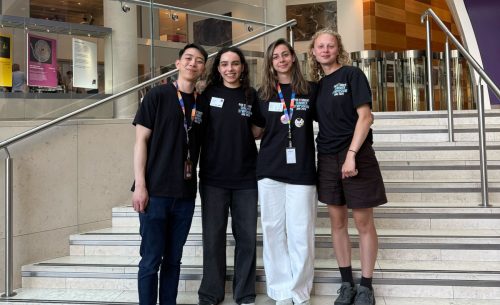
Finally, we would like to thank all the students whose scientific contributions, participation and enthusiasm made the symposium such a success. We hope to welcome you back next year!
Get involved
Create an account or log in to post your story on the Node.
Sign up for emails
Subscribe to our mailing lists.