

Celebrating the Centenary of The Theory of the Gene Through Cinema and Public Outreach
Posted by Guilherme Oliveira Barbosa, on 23 October 2026
This post is co-authored by Dante Albino Idesti and Larissa de Moraes Chiarelli
One hundred years ago, in 1926, Thomas Hunt Morgan published The Theory of the Gene, a landmark work that consolidated the physical basis of heredity and forever changed the landscape of modern biology. To celebrate this centenary, researchers and students gathered with the public on the evening of October 22, 2026, at the Exploratory Science Museum of the University of Campinas (UNICAMP), in Campinas, Brazil, for a special outreach event combining science, history, and cinema.
Designed as an open and free Cine-Debate for the general public, the initiative built a bridge across three core pillars: the historical centenary of the gene concept, the enduring legacy of Drosophila melanogaster as a model organism, and the role of science museums as democratic spaces for public engagement.
Bringing the “Fly Room” to the Science Museum
For many outside academia, genetics can feel abstract and distant from everyday life. Hosting the event at UNICAMP’s Exploratory Science Museum allowed us to step outside the traditional walls of our research laboratories and invite the local community into an interactive, welcoming environment and open conversation (UNICAMP news).
The evening began at 7:00 PM with a brief historical contextualization introducing Thomas Hunt Morgan, the early days of chromosomal research, and the tiny fruit fly that became one of biology’s most powerful allies. This set the stage for the screening of Alexis Gambis’s feature film The Fly Room (2014).
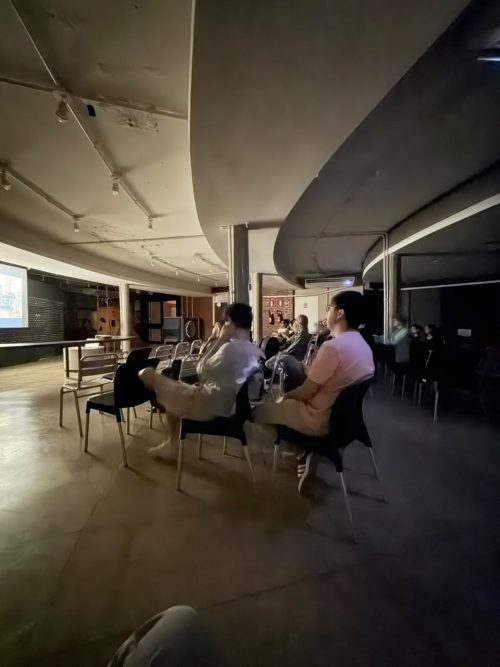
Told through the eyes of ten-year-old Betsey as she spends a day in the genetics laboratory of her father, Calvin Bridges (one of the key pioneers in Morgan’s group at Columbia University) the film offered the audience an intimate look into both the scientific breakthroughs and the complex human dynamics behind the birth of modern genetics. Throughout the screening, the sensory imagery of the flies and the delicate father-daughter narrative captivated attendees, bridging the gap between historical science and everyday emotion.
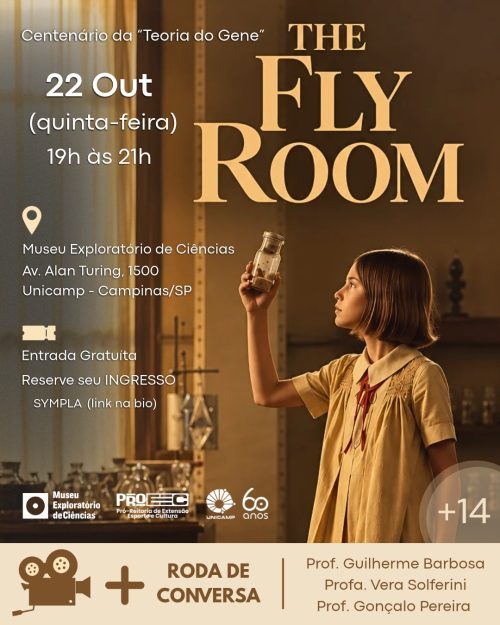
“From Flies to Genes: 100 Years of a History That Transformed Biology”
Following the screening, the evening transitioned into a lively roundtable discussion. The panel was intentionally assembled to reflect how the foundations laid in Morgan’s fly room have branched out across generations, model organisms, and biological scales at UNICAMP:
Prof. Dr. Guilherme Oliveira Barbosa, a researcher in the Fly Lab at UNICAMP’s Institute of Biology. Holding a PhD in Cell Biology, Guilherme investigates morphogenesis using Drosophila melanogaster and actively works in science education and public outreach. He anchored the discussion in the day-to-day reality of working with fruit flies today and how basic developmental questions continue to drive discovery.
Prof. Dr. Vera Nisaka Solferini, a leading reference in genetics and evolutionary biology in Brazil. Whose research explores the historical biogeography of Neotropical biomes and the adaptive processes driving biological diversification, Vera expanded the conversation from the classic laboratory bottle to natural populations and evolutionary history.
Gustavo Seguchi, a Master in Genetics and Molecular Biology from UNICAMP and current PhD candidate at the Laboratory of Genomics and bioEnergy (LGE), where he studies the potential of non-conventional yeasts for biofuel production from diverse biomasses. Gustavo brought the perspective of early-career researchers applying century-old genetic principles to modern genomic and biotechnological challenges.
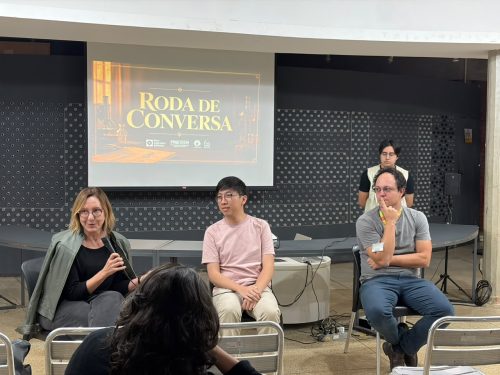
Bridging Past and Present: The Human Side of Science
During the conversation, the speakers unpacked the scientific and historical nuances portrayed in The Fly Room, sharing behind-the-scenes curiosities of working with Drosophila and tracing how the concept of the gene evolved over the last century — from classical linkage maps to modern developmental biology, evolutionary ecology, and synthetic genomics. The dialogue with the audience flowed naturally, sparked by curiosity about how routine work with tiny model organisms translates into major biological concepts.
Towards the end of the discussion, Dr. Guilherme Barbosa offered a poignant reflection that captured the spirit of the entire evening. He highlighted how powerfully the film portrays the human side of scientists, reminding everyone that researchers are not detached figures isolated in lab coats, but ordinary people driven by the same wishes, passions, insecurities, and desires as anyone else, and that these personal realities inevitably intertwine with and shape their scientific work.
Looking back on the evening, celebrating the centenary of The Theory of the Gene through cinema proved to be an inspiring way to demystify academic research. By bringing Drosophila out of the lab and onto the big screen at the Exploratory Science Museum, the event reminded both seasoned researchers and first-time visitors that the history of genetics is not just a collection of textbook facts, but an ongoing, deeply human story fueled by curiosity.
Get involved
Create an account or log in to post your story on the Node.
Sign up for emails
Subscribe to our mailing lists.