

A day in the life of a sea cucumber lab
Posted by Margherita Perillo, on 20 July 2026
The adventure of a brave ENGAGE-Bio post-bac scholar at the MBL who set up a new sea cucumber species in the Perillo lab.
Who are we?
Hi, we are a group of scientists who believe establishing new research systems is key to discover new biological features. We work at the Marine Biological Laboratory (MBL) in Woods Hole (MA, USA) in the Perillo lab. Talia (now a graduate student at the University of Virginia) was an ENGAGE BIO post-bac scholar who spent a year establishing the sea cucumber Leptosynapta tenuis as a new lab system.
What are sea cucumbers?
Sea cucumbers are marine invertebrates with amazing abilities: these animals can undergo whole body regeneration, spit out their internal organs if threatened -and completely regenerate them! – change skin strength and elastic stiffness within a timescale of seconds and are rich in novel active bioactive compounds -just to cite a few.
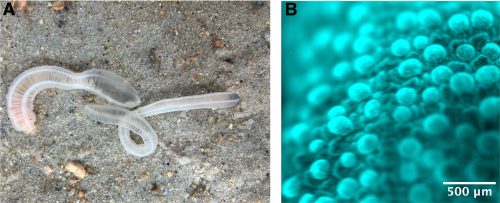
Almost all species of adult sea cucumbers have dark, thick skin and studying their organs in vivo is a challenge. Moreover, the most common species can only be studied close to their collection site, as these animals do not ship well. However, thanks to the knowledge of the Marine Resource Center at the MBL we have access to a local sea cucumber species that has transparent skin and that we found can be easily kept in any lab. These new species is the sea cucumber L. tenuis, a small and clear sea cucumber from the North Atlantic Ocean (Fig. 1A). They feed in the sand and use their tentacles to quickly dig and hide. Not much is known about the organism in terms of its characteristics and behaviors and we are excited to discover new aspects of their biology every day. How do they navigate in space inside the sand? How is the nervous system controlling their behaviors? How do they reproduce? How does a hermaphrodite gonad work? How do their larvae develop? These are some of the questions we are investigating in the lab.
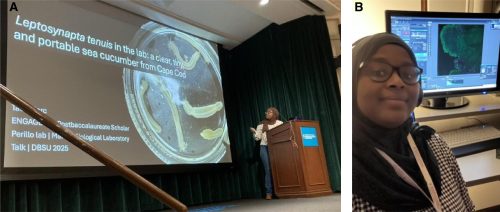
Talia worked on some of these questions and had a chance to present her work at the developmental Biology of the Sea Urchin and Other Marine Invertebrates (DBMUMI) conference (Fig. 2A). In 2026 Aly Rodger, new Research Assistant in the lab, took over the sea cucumber project.
Talia’s experience working with sea cucumbers
Due to the niche of this animal, I was interested in Margherita’s project to characterize its structures. When we received a collection for the month, we would dissect and image to understand different structures. We can conduct living imaging of their skin because it is transparent (Fig. 1B). Through this, we were able to observe structures on the skin that we could have seen if they had pigment, as most sea cucumbers do. I spent time staining phalloidin and tubulin to understand the morphology of the skin, intestine, tentacles, and the gonads. While imaging new structures, I was amazed by the amount of muscle and neurons that these small sea cucumbers had (Fig. 2B, Talia working). L. tenuis is a hermaphrodite species, how do they develop both testis and ovaries in the same tube? To understand their oocyte growth, I would image them monthly and measure their size to figure out their seasonal patterns and compare it to testis maturation. Being the first to see these structures through fluorescence microscopy only made me question their development more.
A challenging part of working with these animals is that little is known about their development or their behaviors. Margherita and I spent a lot of time troubleshooting how to house them at the MBL and within our lab. We came up with a water bubbling system to cycle the sand for oxygen flow within their habitat and a sand collection system to ensure their environment has nutrients. Even though trying to understand how to maintain them is difficult, it is exciting to be able to lay the groundwork for a new model system in developmental biology.
Why do we need this for developmental biology?
Sometimes in research, we cannot answer a question because we don’t have the tools or the right model. But the sea cucumber has the possibility to be used in different fields; it is worth investigating and conducting groundwork research for future research to answer larger questions with this organism. Similarly, groundbreaking science came from taking a chance and investing resources in what are now considered traditional research organisms, such as mice, flies, bacteria, and zebrafish. I believe that many research questions, such as neurodevelopment, axis elongation, and body plan development, could be answered by using L. tenuis.
Get involved
Create an account or log in to post your story on the Node.
Sign up for emails
Subscribe to our mailing lists.