
Bringing science to developing minds!
Posted by Zainab Afzal, on 22 June 2026
Development is plastic, meaning it has the capacity to mold, to allow for change in behavior and physical traits, usually until its form reaches a certain point. The field of developmental biology is fascinating, such that a single cell knows how to make a whole species with a distinct body pattern and shape. Watching the development of a human child in real time is even more astounding. A delicate, not able to do anything form, then watches and learns as it grows, and develops into a capable being. Growing and evolving through school and work, to then become fully equipped with the capacity to be chasing whatever fascinates and supports its being. There is also beauty in watching people grow through school and the workplace. It is reflected in how communities come together to support its young, how individuals share their experiences so others can learn through stories, and especially in how mentors invest their time and guidance in others, often getting little in return.
In recounting how one is constantly learning as a human, I feel happy that at North Carolina Central University (NCCU), I get to make small contributions towards both sides of the development coin. On one side, I study how processes of embryonic development get disrupted with environmental toxins, and on the other side I also get to share some fun science activities with young minds as they are developing. While I have recently celebrated seeing our manuscripts on BioRxiv while they are in review, here I want to share the other side of this development coin. The humbling experience of working with high school students, and the rewarding experience of their recent field trip to our institute.
An hour is not a long drive, but when we consider the exposure and experiences available to high school students, that one-hour distance can sometimes become astronomical. It can mean that while one school has access to resources and opportunities to explore science, another misses out without even realizing the extent of what they are missing. With support from Dr. Kumar and community partners, including Ms. Ruby, we have started a science lab activity initiative that aims to reduce the distance created by that one-hour drive. In alignment with the STEM curriculum, we have designed hands-on activities that high school students can participate in during their classes, learning everything from handling basic laboratory equipment and conducting fun experiments to listening to guest lectures from scientists sharing their current research and practicing the skill of presenting what they have learned.
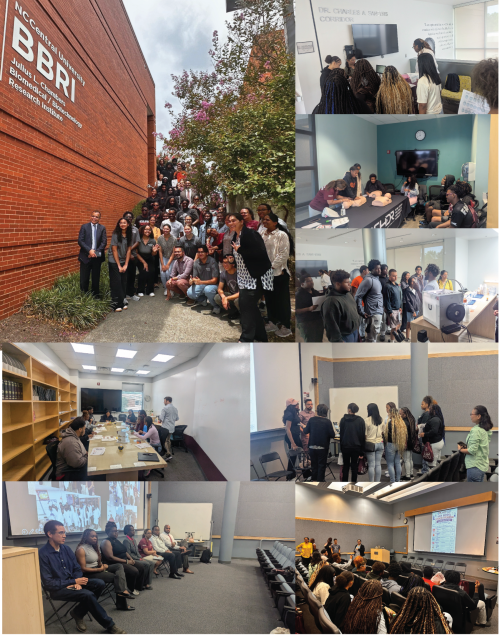
Last week, we welcomed a group of high school students from Enfield, NC, to NCCU for a field trip. My hope for this visit was simple: to create an opportunity for students to connect with people at different stages of STEM careers, see firsthand the work being done at the Julius L. Chambers Biomedical and Biotechnology Research Institute, and perhaps begin to envision themselves pursuing careers in science. We started the day with a panel discussion featuring an undergraduate student, an experienced master’s student, a newer PhD student, a public health educator, and three professors working in different research areas. All of the panelists shared their career trajectories, their motivations for pursuing their specific career paths, what their average day looks like, and what they wished they could change or adjust about it. One professor shared how someone they met during high school remains one of their strongest advocates and a mentor they still keep in touch with today, emphasizing that one should never underestimate the power of connecting with people at any stage of life. A PhD student shared how, as a first-generation student, she constantly has to navigate the hidden curriculum and figure things out along the way. She emphasized that it is okay not to know something, that it is okay to ask questions, and that it is definitely okay to reach out for help, even when it feels like you should already know the answer. A community engagement and public health expert shared how it is important to meet communities where they are, rather than trying to make them fit one’s schedule. As a result, many events intended to serve communities often take place after regular office hours or during weekends. An undergraduate student shared their aspiration to pursue an MD/PhD, describing their personal motivations for becoming a physician while also discovering a passion for research and learning. They explained that they did not realize it was possible to pursue both paths, but that doing so has now become their career goal.
A major theme that emerged from the panel discussion was that many individuals discovered career paths they did not know were available to them. Along the way, they were guided by mentors and learned to overcome the fear of asking questions and reaching out to others. Essentially, as I see it, they are now paying forward the help and guidance they received by sharing their own stories with these young, developing minds.
Following the panel, students rotated through a series of hands-on STEM activities. Each student received a passport that was stamped at every station as they explored different areas of research represented at our institute. They matched zebrafish embryos to different stages of development to learn how rapidly these organisms grow and why they are such a neat research organism. They mixed glue and water to create molds, introducing the concept of 3D scaffolds that support cells and tissues. They made brain hats while learning about the functions of different brain regions, practiced chest compressions on CPR manikins to see its value in saving lives, and explored how capillary action is used in simple blood-screening tools used in community health settings. Personally, watching the students engage with everyone, bravely ask questions, laugh about their guesses during activities, and enthusiastically mix their colorful molds was both a precious and humbling experience. It was inspiring to see our small community of researchers at the institute come together for the high school students and share what we do. It made me hopeful that, through this experience, the students were able to envision what their future aspirations could be. I am truly thankful to everyone who was a part of this event and grateful to the community that helped pay forward the mentorship and guidance that we have all received at various points along the way.
Get involved
Create an account or log in to post your story on the Node.
Sign up for emails
Subscribe to our mailing lists.