The community site for and by
developmental and stem cell biologists

Nobel Laureates Warn Against Going over the Fiscal Cliff

Posted by , on 11 December 2012

Although I’m not a fan of simply reposting press releases, this press release from The Coalition for the Life Sciences, about a letter-campaign by Nobel Laureates to emphasize the importance of research funding, is worthy of a read. The coalition is made up of several scientific organisations that overlap with the Node’s readership (ASBMB, ASCB, GSA, HHMI, SfN, and ASCI). While the press release is focused on the US, cuts in research funding in the US will indirectly affect us all.


FOR IMMEDIATE RELEASE December 10, 2012
Nobel Laureates Warn Against Going over the Fiscal Cliff

Bethesda, Maryland – Nobel Laureates from across the country are warning Congressional leaders and President Obama about the danger the fiscal cliff poses to research and innovation.
Starting December 3, the Coalition for the Life Sciences has sent a letter a day from a Nobel Laureate in either Chemistry or Physiology and Medicine. Twenty Nobel Laureates are engaged in this campaign. In these letters, each Laureate emphasizes the importance of federally funded research and the dire consequences of funding cuts. Of particular concern, the National Institutes of Health (NIH) will face an 8.2% across-the-board cut starting January 1, 2013, if Congress and the Administration refuse to agree on solutions to the fiscal cliff.
Coalition Board member H. Robert Horvitz, from the Massachusetts Institute of Technology, shared the 2002 Nobel Prize in Physiology or Medicine. He said, “This potentially very deep cut to the NIH as well as to all other federally-funded science would negatively impact job creation and seriously jeopardize the long-standing leadership position of the U.S. in research and innovation.”
Paul Berg, from Stanford University and the co-recipient of the 1980 Nobel Prize in Chemistry, agreed. “Past support of the NIH by the United States Congress has enabled the American scientific enterprise to rise to world leadership in the physical and life sciences. It is also why Americans have dominated as recipients of the Nobel and other illustrious Prizes.”
All the Nobel Laureates are concerned that cuts to the NIH will stifle discoveries that improve health, save lives, and drive our economy. NIH supports scientists and their critical work in every state across the nation, which means that every state would feel the negative effects of going over the fiscal cliff. Laboratories would shut down, scientists would be laid off, and local businesses that support research would close. Progress on developing promising new cures would slow, if not stop outright.
Coalition Director Lynn Marquis said the campaign arose from a shared anxiety among Coalition members about the future of the nation’s leadership in scientific output and innovation. “We felt strongly that voices from the scientific community needed to be heard and the Nation’s Laureates provide a unique voice that adds gravitas to the debate in Washington.”


The Coalition for the Life Sciences is an alliance of six non-profit professional organizations working together to foster public policies that advance basic biological research and its applications in medicine and other fields. For further information, please call Lynn Marquis, the Director of the CLS, at (301) 347-9309 or visit www.coalitionforlifesciences.org

Thumbs up (No Ratings Yet)
Loading...

Categories: Funding, News

Navigate the archive

Use our Advanced Search tool to search and filter posts by date, category, tags and authors.

December 11

Posted by , on 11 December 2012

Today’s recommended paper is:

Free Extracellular Diffusion Creates the Dpp Morphogen Gradient of the Drosophila Wing Disc
Shaohua Zhou et al. (2012)
Current Biology 22 (8), 668-675

Submitted by Barry Thompson:
“This paper overturns the idea that the Dpp morphogen moves by transcytosis.”

From December 1 to 24 we are featuring Node readers’ favourite papers of the past year. Click the calendar in the side bar each day to see a new paper. To see all papers submitted so far, see the calendar archive.

Thumbs up (No Ratings Yet)
Loading...

Tags:
Categories: Research

December 10

Posted by , on 10 December 2012

Today’s recommended paper is:

A Human Stem Cell Model of Early Alzheimer’s Disease Pathology in Down Syndrome
Yichen Shi et al. (2012)
Science Translational Medicine 4 (124), 124ra29

Submitted by Claire Cox:
“I found this paper fascinating as it demonstrates the potential of iPSC technology for studying disease pathology in culture. Generating cortical neurons from iPSCs and ES cells that have signs of Alzheimer’s Disease is remarkable and could pave the way for future studies such as drug screens.”

From December 1 to 24 we are featuring Node readers’ favourite papers of the past year. Click the calendar in the side bar each day to see a new paper. To see all papers submitted so far, see the calendar archive.

Thumbs up (1 votes)
Loading...

Tags:
Categories: Research

December 9

Posted by , on 9 December 2012

Today’s recommended paper is:

Morphogenesis of outflow tract rotation during cardiac development: The pulmonary push concept
Roderick W.C. Scherptong et al. (2012)
Developmental Dynamics 241 (9), 1413-1422

Submitted by Heather Etchevers:
“This modest paper carefully compiles observational data to support a dynamic model of organogenesis. I appreciate this sort of approach as it opens the field for others to confirm or improve on the hypothesis. The way science works – not all about proving small things, but getting incrementally closer to a big picture understanding.”

From December 1 to 24 we are featuring Node readers’ favourite papers of the past year. Click the calendar in the side bar each day to see a new paper. To see all papers submitted so far, see the calendar archive.

Thumbs up (1 votes)
Loading...

Tags:
Categories: Research

December 8

Posted by , on 8 December 2012

Today’s recommended paper is:

Variation of BMP3 contributes to dog breed skull diversity
Jeffrey J. Schoenebeck et al. (2012)
PLOS Genetics 8 (8), e1002849

Submitted by Katherine Brown

” Elaine Ostrander discussed this approach to understanding phenotypic diversity at the SDB meeting earlier this year, and it’s an impressive example of how the power of genetics can be harnessed to gain insight into the molecular basis of a wide range of developmental and behavioural traits.”

From December 1 to 24 we are featuring Node readers’ favourite papers of the past year. Click the calendar in the side bar each day to see a new paper. To see all papers submitted so far, see the calendar archive.

Thumbs up (1 votes)
Loading...

Tags:
Categories: Research

December 7

Posted by , on 7 December 2012

Today’s recommended paper is:

Normal Spastin Gene Dosage Is Specifically Required for Axon Regeneration
Michelle C. Stone et al. (2012)
Cell Reports 2, 1340–1350

Submitted by Nik Papageorgiou:
“The reason it’s my favourite is because it presents an elegant, ground-breaking elucidation of axon regeneration involving a protein that would be hard to suspect before.”

From December 1 to 24 we are featuring Node readers’ favourite papers of the past year. Click the calendar in the side bar each day to see a new paper. To see all papers submitted so far, see the calendar archive.

Thumbs up (No Ratings Yet)
Loading...

Tags:
Categories: Research

Book review: Everything you always wanted to know about auxin but were afraid to ask

Posted by , on 6 December 2012

This book review originally appeared in Development. Sabrina Sabatini reviews “Auxin Signaling: From Synthesis to Systems Biology ” (Edited by Mark Estelle, Dolf Weijers, Karin Ljung and Ottoline Leyser).

Book info:

Auxin Signaling: From Synthesis to Systems Biology. Edited by Mark Estelle, Dolf Weijers, Karin Ljung, Ottoline Leyser. Cold Spring Harbor Laboratory Press (2011) 253 pages ISBN 978-0-879698-98-0 $67.50 (hardback)
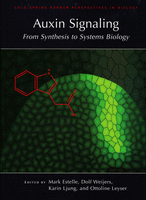
 

Whether you like it or not, if you work in plant science it is of utmost importance that you know what auxin is and does, since your research will, at some point, most certainly cross the auxin path. The plant hormone auxin regulates a plethora of developmental and physiological processes in plants. At the organismal level, the differential accumulation of auxin forms gradients, which, through interactions with other hormones, regulate processes as diverse as responses to external stimuli and embryonic and postembryonic development. All of these macroscopic processes are a reflection of the changes in gene expression triggered by auxin. The book Auxin Signaling tries to provide a broad coverage of each aspect of auxin signaling, from synthesis to transport and signal transduction, along with an in-depth description of auxin’s role in various events in plant development.

The book opens with a chapter by Abel and Theologis on the historical context of auxin research, which provides an evocative description of the scientific journey that brought us to the present level of knowledge of auxin signaling. This section thrills the reader with the ups and downs of auxin research, and spurs them to read the rest of the book to discover where the frontline of auxin research is now. The book then divides into four sections: auxin synthesis and transport, auxin perception and cellular responses, auxin in development, and signal integration.

The second and the third sections work together to illustrate the conceptually sequential mechanisms by which auxin is synthesized, metabolized, transported and perceived by the cell, followed by the basic cellular response. The first chapter of these describes the state of our knowledge of the auxin homeostasis pathway, despite the difficulties in the quantification of auxin and its intermediates. Apart from giving an in-depth description of the pathway, the authors have included many references to the experiments behind the facts, enticing the reader to critically assess the source of information. The next two chapters provide a unique perspective on classical topics such as auxin transport and perception. In ‘Auxin transporters – why so many?’, the authors illustrate the complexity and redundancy of the auxin transport machinery in the light of evolution, offering a refreshing (and for once non-PIN-centric) point of view. The authors of the next chapter provide a very interesting structural insight into auxin perception, cleverly describing how auxin acts differently from other hormones, the application of this mechanism as a model in drug development, and, notably, a controversial idea of what truly constitutes an auxin receptor. Perrot-Rechenmann nicely concludes this section by bringing the reader from the purely molecular to the cellular level of the auxin response, as she skillfully describes all the intricate networks that regulate the two major destinies of a non-dying cell: division or differentiation.

After explaining all the main features of auxin cellular signaling, the fourth section of the book, which might interest the readers of Development most, focuses on the role of auxin in plant development. The seven chapters that constitute this section cover the classical developmental events in which auxin has been known to play a major role: embryogenesis, shoot and root meristem activity, lateral root and vascular formation, and the differentiation of reproductive organs. The added bonus of this section is an opening chapter on mathematical modeling and a closing chapter on auxin in monocotyledon (monocot) development, which nicely broaden the horizon of the reader from the classical topics of auxin-regulated plant development.

The chapter on mathematical modeling describes recent efforts made to assist research on the role of auxin in plant development. Modeling is an invaluable tool for the study of convoluted signaling pathways, such as auxin’s, in the context of complex events, such as those that occur in development. In addition to its descriptive function, mathematical modeling is, most importantly, an invaluable instrument for the generation of new hypotheses, and any researcher working in development nowadays cannot ignore it. This chapter, by explaining each model in terms that are not overly technical, gives a good basic overview of modeling in auxin biology while also representing a good starting point for those who, after reading it, want to know more.

The role of auxin in plant development is complex, but the chapters that constitute the core of this section do an excellent job at summarizing the vast literature on the topic. Moreover, each piece covers the most advanced data and theories of their topic, making this section a very good read, even, if not especially, for those that already work in the auxin field. Despite the clarity and the brief introductory remarks in all chapters, it will be better for the novice reader to have grasped the notions illustrated in the previous sections in order to get the most from these chapters.

The concluding chapter of this section not only describes the role of auxin in monocot development, but also gives a detailed overview on monocot development itself. Some plant researchers tend to focus their attention, for practical reasons, on dicots. This chapter, although explicative and comprehensive, reminds us that the comparative study of auxin function can, in the light of evolution, tell us more about auxin signaling than independent study in a single phylum.

The last section of the book deals with signal integration. The introductory chapter offers an unusual view of auxin as the currency of the plant cell. Beyond this singular metaphor, the chapter gives a broad overview of auxin pathway interaction with the light response, the circadian clock, other hormones and pathogens. The chapter that follows neatly describes all the molecular principles underlying the complexity that can be generated within the auxin pathway. In my opinion, this piece should be read before the chapters on development, as it lays fundamental concepts that would help the reader to better interpret the events covered in the previous section. This is actually easy to do, since, as can be said for the whole book, each chapter is quite autonomous and can be read independently. The remaining chapters in this section cover the interplay between the auxin pathway and the response to light, and the importance of auxin in the plant-microbe interaction. Despite the high quality of this section, I believe that it lacks chapters on the role of auxin in the response to nutrient abundance, drought and the effects of other hormones on the auxin pathway. Although hints on these topics are given throughout, dedicated chapters would have made this book truly comprehensive.

Overall, this volume suffers slightly from being a subject collection, rather than a book. In particular, even though there is a preface from the editors and an excellent opening chapter, there is no concluding chapter, which leaves the reader slightly baffled at the end of the book. This is a common problem in scientific texts, but in a volume on a topic as complex as auxin signaling, a concluding chapter would have made the work feel more like a book and less like a well-edited collection of reviews.

However, each chapter in Auxin Signaling is truly remarkable: well written and easy to follow, providing sufficiently detailed yet understandable descriptions of complex concepts, and allowing a glimpse at the experimental procedures behind them. The authors have succeeded in producing a volume that could be extremely useful for a graduate student pursuing a research career in plant biology and, most certainly, for more experienced scientists who wish to gain comprehensive knowledge of the current state of auxin research. Indeed, the book is not only descriptive, but also provides the personal perspectives of the authors and thought-provoking discussions, making it of great interest for those who work in the auxin field. Although Auxin Signaling might be too specific for an undergraduate reader, its clarity makes it a good tool for lecturers and for those curious students who could still extract important notions and concepts from it.

Thumbs up (1 votes)
Loading...

Categories: Book Reviews

December 6

Posted by , on 6 December 2012

Today’s recommended paper is:

Coupling Mechanical Deformations and Planar Cell Polarity to Create Regular Patterns in the Zebrafish Retina
Guillaume Salbreux et al. (2012)
PLOS Computational Biology 8 (8), e1002618

Submitted by Eva Amsen:
“This interdisciplinary paper combines physics, mathematics and biology to show how computational modeling can describe the formation of complex biological structures.”

From December 1 to 24 we are featuring Node readers’ favourite papers of the past year. Click the calendar in the side bar each day to see a new paper. To see all papers submitted so far, see the calendar archive.

Thumbs up (No Ratings Yet)
Loading...

Tags:
Categories: Research

December 5

Posted by , on 5 December 2012

Today’s recommended paper is:

In toto live imaging of mouse morphogenesis and new insights into neural tube closure
R’ada Massarwa and Lee Niswander (2013)
Development 140 (1), 226-236

Submitted by Bob Goldstein:
“A clearer view of mammalian neural tube closure… an important step forward, and beautiful!”

From December 1 to 24 we are featuring Node readers’ favourite papers of the past year. Click the calendar in the side bar each day to see a new paper. To see all papers submitted so far, see the calendar archive.

Thumbs up (2 votes)
Loading...

Tags:
Categories: Research

Reprogramming development

Posted by , on 4 December 2012

This editorial by Development Editor-in-Chief Olivier Pourquié appears in the current issue of Development.

It seems most appropriate to start this editorial by congratulating the 2012 winners of the Nobel prize, John Gurdon and Shinya Yamanaka, for their work on stem cells and reprogramming. We at Development are particularly proud of this prize as John Gurdon published his original paper on the reprogramming of the frog oocyte nucleus to a totipotent state – the work that led to this award – in 1962 in the Journal of Embryology and Experimental Morphology (Gurdon, 1962), which was to become Development in 1987. Furthermore, John Gurdon was, until 2011, the Chair of The Company of Biologists, the charity that runs our journal. John Gurdon has been a role model for many of us and his original thinking has stimulated the field for many years and continues to do so.

The discovery that the nucleus of an adult cell can be reprogrammed to a totipotent embryonic state by nuclear transplantation in the frog revealed an unsuspected degree of plasticity of the genome and opened the way to the studies by Shinya Yamanaka on the reprogramming of adult somatic cells by a set of transcription factors (Takahashi and Yamanaka, 2006). Indeed, the experiments of Gurdon and Yamanaka clearly established that the information contained in the DNA of all somatic cells is sufficient to recreate an adult organism. That the nucleus of differentiated cells can be reprogrammed to the pluripotent state of early embryonic cells shows that it is possible to reverse the course of development and differentiation. This work opened tremendous new research avenues into the genetic control of pluripotency and differentiation. The ability to reverse-engineer embryonic cells and their derivatives from an adult counterpart, combined with the recent demonstration that sophisticated organs, such as the retina or hypophysis, can be grown from embryonic stem cells in vitro (Eiraku et al., 2011; Suga et al., 2011), means that recreating human organs in vitro is a real and achievable goal. This should open a new era in which the uncharted territory of human developmental biology will be explored. In addition, it will allow us to produce differentiated cells of all human lineages at all stages of differentiation, raising the possibility of establishing in vitro models of human diseases to study their pathophysiology and to screen for new treatments or cures. Finally, these advances should favour the development of cell therapy and regenerative medicine, potentially allowing the replacement of missing cells of body parts with cells from organs engineered in vitro. These are some of the major challenges that are now within reach thanks to Gurdon and Yamanaka’s discoveries.

In my view, this Nobel prize also beautifully illustrates the mutation that developmental biology is currently experiencing. Both Gurdon and Yamanaka clearly tackled a central question of developmental biology: how the genetic information is deployed during embryonic development to generate the variety of cell types and structures that will compose the adult body, and how this process might be reversed. Still, many scientists, particularly among our younger colleagues, will consider Gurdon and Yamanaka as stem cell biologists rather than developmental biologists. Although this might seem a semantic argument, it has a strong impact on the perception of a journal such as Development. The rapidly growing field of stem cell biology is largely an offshoot of developmental biology. However, it is now becoming independent from the more traditional developmental biology, creating its own structures with new societies and new journals. This reflects a healthy growth in the numbers of stem cell scientists, but it is occurring partly at the expense of the developmental biology community. Thus, while Development is clearly viewed as a community journal for those involved in core areas of developmental biology, feedback suggests that stem cell scientists do not necessarily regard Development in the same way.

I see engagement with the stem cell community as crucial to the future success of Development. As Editor in Chief, I have initiated several actions to raise the profile of the journal within this field. These include the recruitment of expert editors in the field, and creation of the ‘Development and Stem Cells’ section of the journal. Notably, many of our most highly downloaded and cited papers of the past 2 years appeared in this section – a preliminary indication that this move has been a success. In 2013, we hope to intensify our actions to reach out to the stem cell community and establish Development as an important forum for the publication of outstanding papers in this field.

Of course, while I believe that stem cell science is an important and expanding field within developmental biology, we will continue to be the home for more traditional disciplines, as well as for other growing areas, such as quantitative and systems biology, and evo-devo. In addition, when I took over as Editor in Chief, I felt that there was a need for Development to publish papers dealing with techniques of importance to the community. Over the past 2 years, we have published a number of such technical papers, and we are now expanding and renaming this section ‘Techniques and Resources’. We hope that this will provide an ideal home for high-quality papers of a technical nature, or those that describe a new resource, and we welcome your submissions.

Importantly, at the heart of our evolution as a journal, and running through this editorial, is the concept of community. Development is a not-for-profit journal run by scientists for scientists, and it is vital for us to make sure that we are efficiently serving the community of developmental biologists. We are very open to your feedback on what we are doing well (or badly) at the journal, and we will greatly benefit from your support while we move towards these new areas. Our community website the Node (thenode.biologists.com), launched in 2010, is one place where you can share your thoughts on the state of the developmental biology field, on scientific publishing and how Development is doing, or on anything else of relevance to developmental biologists. For those of you not yet familiar with the Node, I encourage you to visit the site and to contribute. For those happier in the real world than the virtual one, you will also find Development editors and staff at meetings throughout the globe and the year, and we’re always happy to talk about the journal and to receive your input.

This year has seen little change in the composition of the team of editors. Ken Zaret decided to step down as an editor and we are extremely grateful for his many years of service at Development and for his hard work to maintain the high quality standards of the journal. Although we are very sorry to see him leave, we were happy to welcome a new editor, Haruhiko Koseki from the Riken Center for Immunology in Yokohama. Haruhiko is a specialist in mouse development and epigenetics. He has joined the group of current editors, which also includes Magdalena Götz, Alex Joyner, Gordon Keller, Thomas Lecuit, Ottoline Leyser, Rong Li, Shin-Ichi Nishikawa, Nipam Patel, Liz Robertson, Geraldine Seydoux, Austin Smith, Patrick Tam and Steve Wilson. I congratulate them for their outstanding work in the past year. I also thank the in-house Development team – particularly Katherine Brown, our Executive Editor, and Claire Moulton, our Publisher – for their excellent support. We look forward to a successful 2013.

Thumbs up (4 votes)
Loading...

Tags: ,
Categories: News