

Revisiting metabolic fundamentals
Posted by Diego Sainz de la Maza, on 21 August 2026
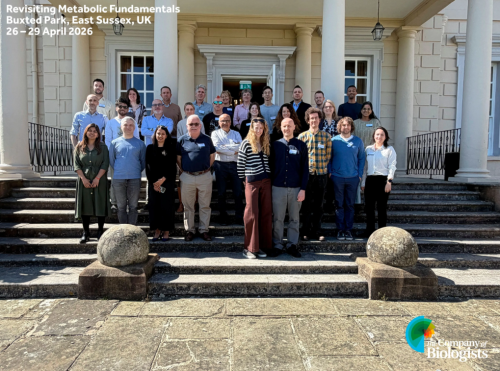
On 26 April, a sun-drenched country hotel in East Sussex set the stage for an intensive three-day workshop that brought together 30 leading metabolism researchers across cell biology, mitochondrial biology, developmental biology, cancer biology and systems biology. Organised by Lydia Finley and Wilhelm Palm, the meeting provided a forum for sharing unpublished findings, assessing the current state of the field, and exploring the next steps needed to accelerate its rapidly growing impact. This meeting aimed to reframe metabolism as an information-processing and signaling system, rather than simply a set of biochemical pathways that generate ATP and biosynthetic precursors.
The discussions made one point abundantly clear: metabolism can no longer be viewed simply as a network of reactions that build and break down macromolecules to meet cellular energy demands. Across a wide range of experimental systems and approaches, attendees presented compelling evidence that metabolism shapes cell identity, development, epigenetic regulation, homeostasis, survival, growth, disease, and intercellular communication. The shared findings showed that metabolites can act as signaling molecules, modify proteins and chromatin, influence cell fate, communicate between organelles and tissues, and alter responses to environmental stress. Rather than serving as a supporting player, metabolism is consolidating as a central organising principle of biology.
This workshop provided an extraordinary opportunity for the ten early-career researchers in attendance to discuss their own work and learn from recent findings by leaders in the field, whose work challenges and redefines traditional views of metabolism. The central topic was explored across multiple biological scales, from individual metabolites and protein modifications to whole-organism physiology.
Through the presentations and the “hot topics” discussion, it was also highlighted that the field has remarkable methodological momentum. New machine-learning approaches, large-scale databases, and innovative strategies to map metabolite–protein interactions are expanding the scope of metabolic research at an unprecedented pace. In addition, research in the field has substantially increased spatial and temporal resolution through high-resolution mass spectrometry, spatial omics, biosensors, and advanced microscopy. Far from approaching a plateau, the field continues to uncover fundamental mechanisms that govern biological systems, reinforcing its position as one of the most dynamic and influential areas of modern biology.
Beyond the science, the workshop’s relaxed setting fostered lively discussions and new connections among fellow metabolism enthusiasts from the field of cancer biology, developmental biology, mitochondrial biology, systems biology and metabolomics. Whether exchanging fresh perspectives on ongoing research, exploring the English countryside on foot, or even enjoying a round of golf, participants found plenty of opportunities to spark ideas and build collaborations. Altogether, the workshop not only highlighted how far the field has come but also underscored the exciting opportunities that lie ahead.
Liliana Piñeros is a postdoctoral researcher at the Heald lab, UC Berkeley. She is interested in investigating the cellular and molecular basis of the conserved scaling relationship between an organism’s size and its metabolic rate described by Kleiber’s law, using Xenopus frogs as an experimental model.
Diego Sainz de la Maza is a postdoctoral researcher at the Amoyel Lab, University College London. His research studies how cell metabolism regulates adult stem cell self-renewal and differentiation.
Get involved
Create an account or log in to post your story on the Node.
Sign up for emails
Subscribe to our mailing lists.