

The final stretch that tests every PhD Student
Posted by Cherene de Bruyn, on 4 September 2026
The recent deluge of Substack and Medium articles, promising strategies and frameworks to work effectively and to complete tasks with intentionality, would have some to believe that the ‘P’ in PhD stands for “productivity” and not Philosophy. As if these neatly bound systems are the golden recipe for delivering excellent work. Yet, this perfectly packaged lie is further from the truth than a PhD student claiming their lukewarm cup of coffee is the last one of the day. Nonetheless, these posts are consumed like sweet cakes, because we all want to work harder, do better, and finish stronger.

Being in the final stages of my own PhD, I am also experiencing the unavoidable intense internal pressure to get things done. And get them done fast. But my years of watching Olympic long‑distance runners duke it out on the track have taught me a valuable lesson.
In long‑distance endurance races, it is not always the athlete who is the fastest or who was leading the race that claims the gold. The winner, often overlooked or underestimated, is decided in the last 400 to 100 metres of the race. The “finishing kick”, which is a fast sprint to the finish line, is what determines the winner. It is a calculated strategy. Athletes who “kick” too early out of fear of losing or being overtaken lose steam in the final stretches of the race. Athletes who “kick” too late don’t have enough track left to build up the speed and momentum needed to carry them to victory. As a strategy, the perfect “finishing kick” is a useful skill. One that is planned and timed before the race. More importantly, it is also about having grit and resilience.
PhDs are often described as a marathon (really, it is more like a triathlon if you ask me). And I don’t think it’s your performance during the PhD that shapes you; it’s the final stages. The last 6 to 8 months, is a period consisting of final data analysis and frantically writing up the final thesis chapters. It’s the time where you need to show your iron and ability to get up and push through. To do hard things even when you are tired. To continue and not give up until you have given your last step over the finish line.
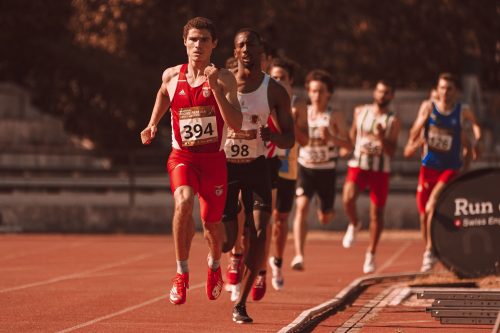
This is the hardest stage of the PhD, because everything you have done in the previous two years must now be shaped into a coherent and original piece of scholarship. It is a daunting task, and many have succumbed to performance anxiety, haunted by impostor syndrome that plagues even the academy’s brightest minds. This fear of failing before competition triggers our primal fight-or-flight instinct. Fighting the urge to fail, some PhD students rush towards the finish line and misjudge the distance. Blinded by the pending victory fireworks, their timing and pace are completely off, leading them to lose steam too early. In academia, this translates to burnout, a lack of motivation, and a decline in passion and energy. All of which can delay progress. Fast is not always better. Rushing forward can blind you to the curves and obstacles in the way. All of which can cause you to stumble. Additionally, speeding through your research does not allow you to discover the nuggets of information that could turn a good project into an extraordinary one. On the other hand, some might underestimate the distance to the finish line. While taking it easy and going with the flow can keep you in the race, being unprepared or worse, underprepared, is like not stretching before the race. You participate but eventually will get a cramp or trip over your own feet. And because your bidy and muscles are not warmed up enough, you will not have the power to build up the speed and momentum needed for the last push. If you are like me, an international student, keeping sight of the project timeline and milestones is needed to ensure that the distance to the final viva is not further away than anticipated. Or that you finish the race but with an unsatisfactory performance because you only had enough distance left for a meagre half kick.
How then do you tackle the PhD “finishing kick”?
Every PhD student will go through slumps after tough dedicated periods. But comebacks are what is important. The final push will feel hard and can be daunting. But like all athletes, I see the days spent in the lab, reading literature papers, and sifting through stacks of data as sessions where I have silently been building my endurance and stamina. And while the fear of failing still looms over my head, I remind myself that a race does not get finished in one quick go; like a journey of 1000 miles, it takes one step at a time. So, to finish the PhD, my PhD, I am strategically building and preparing for my “finishing kick”.
It starts by holding myself accountable to do one PhD-thesis-related thing a day. This includes formatting figures, creating a well‑annotated outline, or writing 500 words. As an “academic athlete,” wearing the right running shoes and gear is important. I intentionally make sure that I am equipped for my planned tasks. I’m a little old school and like to write notes and sections out by hand. I also work best in a quiet space because it helps me to think and connect ideas.
Finally, the most important point to remember is to “kick” in the right direction. You and I both don’t want to run miles in the wrong direction and not cross the finish line. So stay on the course. This is harder because everything and everyone is vying for attention. But to get things done, I have found that you need to stay in your lane, focused on your mission regardless of how you feel or what others might consider a priority. It is here, in the thick of the final months, that your grit as a PhD student is forged.
My final advice to current or future PhD students: Don’t let the last push, to finish the PhD, kick you down. Rather, let your “kick” be the push that carries you across the academic victory line.
One thought on “The final stretch that tests every PhD Student ”
Leave a Reply
Get involved
Create an account or log in to post your story on the Node.
Sign up for emails
Subscribe to our mailing lists.
Nice article. I always like sports analogies because everyone accepts that hard work, smart training, and dedication right up through the finish line, are critical to success.