

The signal that got through
Posted by Maxwell Wilson, on 24 April 2026
Written by Maxwell Wilson and Marianne Bauer
Although Marianne and I first met at the Aspen Center for Physics, USA, in the summer of 2022, our scientific careers had, in a sense, been pre-slated to converge.
Marianne began her research life as a statistical physicist, studying the dynamics of ultracold gases (about as far from developmental biology as you can get). But she followed her curiosity steadily toward living systems. This path eventually landed her in Bill Bialek’s group at Princeton University, USA, one of the world’s great incubators for quantitative approaches to biology. I never overlapped with her there, but I spent my own PhD and postdoc years in Princeton’s Molecular Biology Department, orbiting the same weekly biophysics seminar, the kind of room that trains you to ask the most fundamental version of your question and hold out for a real answer. We started our independent labs at similar times, I at UC Santa Barbara, USA, and Marianne, a few years later, at TU Delft, The Netherlands. Whether by attraction to the same scientific community or simply by the shared foundation of our training, I suspect it was only a matter of time before we found each other.
But it took a mountain, or nearly.
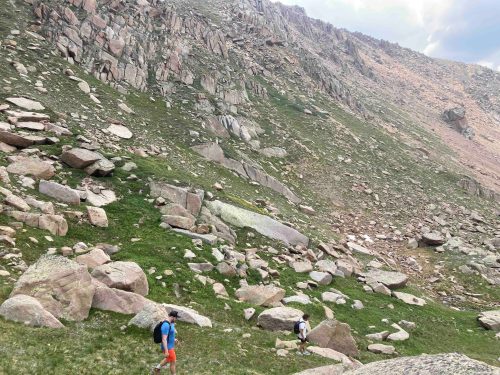
Twining Peak, Colorado. Elevation 13,711 feet.
One of the best-kept secrets of the Aspen Center for Physics is its mandatory downtime. Every couple of days, the entire group stops working and goes hiking. No laptops, no slides. Just altitude, views of the Rockies, and several hours of unstructured conversation. I am convinced that some combination of thin air and long trails produces a particular quality of scientific thinking that is very hard to replicate in a seminar room or at a desk.
My lab had just engineered a new suite of optogenetic tools that allowed precise, programmable control of developmental signaling pathways in human embryonic stem cells, including, critically, the Wnt pathway, which governs cell fate decisions and patterning in early development and adult tissues. Borrowed from neuroscience and adapted for developmental biology, optogenetics allows you to use light to activate specific signals in cells with millisecond precision. For the first time, we could systematically interrogate how cells respond to signals delivered at different rhythms and timescales. I was looking for theorists who wanted to think about these questions seriously.
I found one on a mountain.
Twining Peak sits directly on the Continental Divide, where precipitation from the same slopes drains west toward the Roaring Fork River and east toward Arkansas. On this mountain, the same water flows in two different directions at once. The trail is not a casual outing, and the terrain is unforgiving at altitude. Somewhere on that mountain, probably on the way back down, we sketched the outlines of several project ideas and agreed to stay in touch. It felt inevitable.
“If I didn’t know this was biology, I’d almost say you’ve hit it at a resonance or something.”
What happened next was mostly emails and Zoom calls, which is to say, the unglamorous reality of international collaboration. Marianne is in Delft; I am in Santa Barbara. The overlap in our waking hours was narrow, so most of our early meetings required one of us to be awake either very early or very late. Reading back through our correspondence from late 2022, I am struck by how many messages were essentially calendar negotiations: a wedding, a conference, a colloquium that ran long, nine emails to lock in a single Zoom meeting. When we did finally connect, our calls would often be interrupted by a Dutch overhead announcement that rang through Marianne’s building at 5 or 6 PM, a recorded voice cheerfully informing everyone that the working day was over and it was time to go home. It became a kind of running joke.
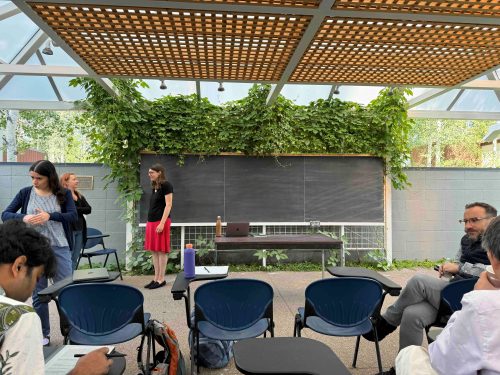
But those early conversations were productive and fun. Marianne took on a graduate student, Olivier Witteveen, to work on the theory side. I began sending data. And it was during one of these data-sharing exchanges, in March 2023, that the concept at the heart of our paper was first named.
I had shared a set of experiments tracking how beta-catenin, the central transcription factor of Wnt signaling, responded to optogenetic inputs of varying durations and intensities into the upstream receptor system. The traces were very complex. Peaks where you expected them, but also puzzling dips, and an intriguing non-monotonic response to signals delivered at certain intervals. Marianne, looking at the data with fresh eyes and a physicist’s intuition, wrote back, “If I didn’t know this was biology, I’d almost say you’ve hit it at a resonance or something.”
I replied: “I was thinking resonance as well!”
As it turned out, the cells were doing the opposite. Anti-resonance is not where the response peaks but where it vanishes. We had identified the right concept and the wrong sign, a class of error that is actually quite common in physics.
Resonance and anti-resonance are well-developed concepts in physics and engineering. Resonance is when a system responds especially strongly to inputs delivered at a particular frequency. It’s why bridges can shake apart in the wind, why wine glasses shatter at the right musical note. Anti-resonance is the counterpart. A frequency at which the system’s response drops out almost entirely, even as neighboring frequencies drive a strong reaction.
These ideas apply to any physical system that receives inputs that vary in time, and yet they have rarely been applied to biology. The reason, until recently, was that you could not watch the signaling dynamics in a living developmental system over the timescales needed, and you certainly couldn’t deliver precisely timed, reproducible signals to probe them. The convergence of low-phototoxicity long-term imaging and cellular optogenetic tools changed both of these things at around the same time. So with these new tools, we could treat a developing tissue in the same way engineers have studied circuits for almost a century: put in a signal, vary its frequency, and measure how the system responds.
What we found in the Wnt pathway is that cells do not respond uniformly across frequencies. At certain input rhythms, the transcriptional response (the downstream readout of whether a cell “heard” the signal) falls to near zero, even as nearby slower or faster signals drive robust activation. The system has a blind spot. That is anti-resonance.
The deeper question, why, is one we speculate about but do not claim to have answered. Is anti-resonance a developmental gatekeeper that helps cells avoid dangerous intermediate identities by filtering out certain signal dynamics? Is it an anti-cancer mechanism that blocks runaway activation by particular signaling patterns? Or is it a spandrel in the Gould-and-Lewontin sense, an architectural byproduct with no function of its own, present simply because of how the underlying circuit is built? We genuinely don’t know. What we do know is that we are very early in our understanding of developmental signaling as a temporal phenomenon, and that most of what we currently call a signaling pathway is really a static snapshot of something that is fundamentally dynamic.
I visited Marianne in Delft in the spring of 2024; she came to present at our departmental seminar at UCSB that fall. In between, we had monthly meetings, almost always early morning Pacific time, which is early evening in the Netherlands, punctuated by that cheerful Dutch announcement that the working day was officially over.
We were both Assistant Professors, both trying to build our labs, find funding, attract students, figure out how to operate independently, and both aware that the tenure clock does not pause for transatlantic collaborations. But the calls were genuinely fun, which I had not counted on. We never had to convince each other that the questions were interesting, which turns out to be more than half the battle. And when an experiment did not match what the theory predicted, or a theoretical prediction seemed to have nothing to do with what the cells were actually doing, we could say so without it becoming a diplomatic incident. That back-and-forth, a physicist poking holes in the biology and a biologist pushing back on the theory, is where most of the real ideas in this paper came from.
The most satisfying moment of this project had nothing to do with the science directly. At some point in the past year, I tried to schedule a meeting with my graduate student Sam Rosen, who is co-first author on the eLife paper. He couldn’t make it. He was on a scheduled call with Olivier Witteveen, Marianne’s student and his co-first author, a call they had set up themselves, independently, without prompting from either of us.
They had built their own version of what Marianne and I had built. We are still figuring out why cells ignore certain signals. Apparently, our students were paying attention to different signals entirely.
The eLife paper can be found at https://elifesciences.org/articles/107794. The companion Physics Review Research paper is at https://journals.aps.org/prresearch/abstract/10.1103/f7qj-f7qy.
Get involved
Create an account or log in to post your story on the Node.
Sign up for emails
Subscribe to our mailing lists.