

An extraordinary exploration of the extracellular environment
Posted by the Node, on 4 September 2026
[Editorial from Development’s latest Special Issue – The Extracellular Environment in Development, Regeneration and Stem Cells, edited by Alex Hughes and Rashmi Priya.]
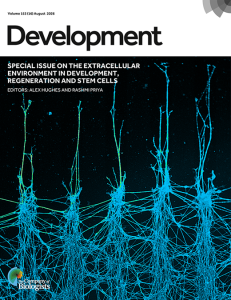
Developmental biology has traditionally been viewed as the study of the activity of genes and cells as functional units. However, cells do not exist in a vacuum, and the contribution of the geometrical, biochemical and mechanical properties of the microenvironment has increasingly been shown to influence, instruct and canalise important features of developmental processes such as cellular differentiation, migration, signalling and morphogenesis. With this special issue, we are pleased to highlight how the extracellular space contributes to development, regeneration and stem cell biology in diverse, interesting and sometimes unexpected ways.
A clear component of the extracellular environment is the extracellular matrix (ECM), a secreted milieu of various proteins, sugars and biominerals. Historically, the ECM has been difficult to study due to a lack of tools and its varied, complex composition of many components with distinct biochemical, mechanical and functional properties. A Spotlight in this issue highlights how developmental biologists studying the apical ECM are on the precipice of a discovery revolution (Heiman and Sundaram, 2026). Indeed, a Research Article from the issue demonstrates recent advances in our knowledge of apical ECM assembly (Belfi et al., 2026). We also see examples of innovations in ECM biology in our Stem Cells and Regeneration section, with Techniques and Resources articles presenting new tools to study ECM dynamics during vertebrate regeneration (Shen et al., 2026), as well as articles that reveal the requirements for ECM components in invertebrate regeneration (Cox et al., 2026).
Additional research papers in this issue demonstrate how ECM directly interacts with cells to regulate processes such as the delamination of epithelial cells (King et al., 2026), migration of the lateral line primordia (Mertens et al., 2026) and primordial germ cells (Tarbashevich et al., 2026), peripheral sensory neuron development (Saito-Diaz et al., 2026) and axonal pathfinding during regeneration (Roy and Hudspeth, 2026). These tissue-level interactions are also evident in plants, showcasing how airspace patterning is achieved in Arabidopsis leaves (Fitzsimons et al., 2026). In addition, the modification and regulation of secreted signals by the extracellular environment also contribute to signal activity and regulate target cell behaviour, either by the regulation of ECM component properties (Oleari et al., 2026; Wu et al., 2026; Szőcs et al., 2026), interactions with other extracellular factors (Moore et al., 2026; Jones et al., 2026), or a combination of these different mechanisms (Muzatko et al., 2026).
The musculoskeletal system is a particularly prominent example of how extracellular matrices contribute to organ function, with the skeleton and tendons rich in extracellular components. We see a similar focus in our published papers, showing how musculoskeletal elements in mammals, zebrafish and sea urchins instruct cell–cell and tissue–tissue interactions for skeletal (Douglas and Ettensohn, 2026; Descoteaux et al., 2026; Ma et al., 2026) and tendon (Steltzer et al., 2026) development, signalling (Umar et al., 2026), homeostasis (Raftery et al., 2026), patterning and even behaviour (Hanzelova et al., 2026).
Beyond the role of the ECM in development and regeneration, the intrinsic properties of tissues and their environment generate forces, mechanical signals and geometric constraints. Several of our review-type articles focus on the roles such biophysical cues play during development. A Primer provides a beginner’s guide to mechanical principles, introducing terminology and key examples of mechanics in development (Cao et al., 2026). Many of these concepts are expanded in dedicated Reviews, such as the biophysics of luminogenesis, which discusses the interplay between lumens, ECM and surrounding tissues (Lee et al., 2026). In addition, the issue highlights how tissue pressure is generated in embryos and the various ways in which compressive forces inform developmental mechanisms, such as differentiation, growth and tissue folding (Tan and Chan, 2026). Unsustainably high pressures cause tissues to break and rupture; another Review highlights that such fractures and fissures are key strategies in developmental morphogenesis (Santos-Oliván et al., 2026). Meanwhile, the role of geometry is expanded upon in a dedicated Review, emphasising that boundaries provide instructive inputs across the development and differentiation of plants and animals, both in vivo and in vitro (Harrison et al., 2026). These mechanical features are emphasised in our research papers, which demonstrate the role of tissue stiffness in regulating cell fate (Corujo-Simon et al., 2026), as well as new tools to measure tissue forces in an in vivo context (Hernandez-Rodriguez et al., 2026).
Together, the articles published in this special issue highlight the variety of ways in which the environment in which cells and tissues grow and develop influences their behaviour. It provides a broad overview of the extracellular environment across cell types, tissues, species and systems, and emphasises the importance of a regulated environment for proper development, regeneration and stem cell differentiation. With the development of new tools, techniques, and approaches, we look forward to the future of the field. We hope you enjoy reading the issue and that it inspires and supports the community as it embraces a holistic approach to understanding how embryos form. Development continues to welcome manuscripts that explore developmental biology from this perspective – we hope to receive your submission soon.
Get involved
Create an account or log in to post your story on the Node.
Sign up for emails
Subscribe to our mailing lists.