
The community site for and by
developmental and stem cell biologists

The human sex ratio at conception and the conception of scientific “facts”

Posted by , on 9 June 2015

Few things interest many people more than sex. For some, this means interest in practices and partners. For others, it means producing a son. There is an ocean of claims about how to do this. A quick Google search reveals claims that a woman can up the odds of a son by taking cough syrup, avoiding intercourse in the days before ovulation, achieving female orgasm, increasing sodium and potassium intake, decreasing calcium and magnesium intake, avoiding exercise, avoiding the missionary position, and increasing caffeine intake by the father.

As a scientist, it’s easy to dismiss such claims as folklore. Yet, science is sometimes no less tangled up with claims that amount to folklore, but which are widely accepted as scientific fact. This entanglement is well-illustrated in another manifestation of fascination with sex: the study of the human sex ratio.

Investigations of the sex ratio (often calculated as the proportion of males) date back at least to Graunt (1662) who described an excess of male births (Campbell 2001). By the late 1800s it was clear that more males than females die during later pregnancy (Nichols 1907). By the 1920s, the claim that the sex ratio at conception or “primary” sex ratio (PSR) is more male-biased than the birth sex ratio was widespread (e.g., Parkes 1926). Just how startling this is can be understood by considering what people knew back then. Other than the excess of male births, what data were available that could allow inference of the pre-birth sex ratio? Only samples of spontaneous abortions (Tschuprow 1915); the resulting sex ratio estimates were often, but not always, male-biased. Sexing was based on morphology, which is likely to generate a male-bias, especially for young fetuses. What data were not available? There were no sex ratio data derived from samples of embryos and/or extant pregnancies; such samples are now available from assisted reproductive technology (ART) and from chorionic-villus sampling and amniocentesis (techniques to sample fetal cells). There were no biochemical or molecular methods to detect the sex of a fetus or to assess whether it was karyotypically normal. In addition, there were no statistical methods to properly account for the complexities of data sets involving proportions.

Despite the concerns raised by some as to the problematic nature of inferring the PSR from spontaneous abortion data (e.g., MacDowell and Lord 1925), the male-bias of the PSR became a scientific fact. One reason is that scientists abhor a vacuum. This is not inherently problematic. After all, scientists could do nothing if “complete” knowledge was a prerequisite for any analysis. What is problematic is that claims for the male-biased PSR were usually shorn of connection with underlying data. Consider, for example, Shettles’ (1961, p. 122) opening statement that “In every population, more males than females are born, and still more are conceived.” This “digestible” fact about the PSR is memorable because of its unqualified simplicity, which makes it highly transmissible, especially given its main constituency: medical doctors (readers of Obstetrics and Gynecology). (Shettles provided citations later in his paper that he regarded as supporting his claim. He does not discuss the data; none of the citations contain data that are necessarily consistent with a male-biased PSR and not all even contain a claim about the PSR.) “Drinking from a firehose” comes to mind as an apt descriptor of medical training, so much so that the acquisition of this kind of digestible fact is an essential cognitive “device” for the completion of training. In this context, this device supercharged the spread of the claim of a male-biased PSR shorn of connection with data.

The post-WWII standardization of medical training in part driven by the wide adoption of a few textbooks accelerated the spread of the digestible fact about the PSR. For example, Stern’s (1960) widely-used and high-quality textbook on human genetics presented the claim that the PSR is male-biased and even went so far as to describe some of the data; however, possible sampling biases associated with the data went unmentioned.

The spread was also facilitated because many types of scientists regarded the male-biased PSR as basic knowledge. Groups with an interest in the topic included cell biologists, developmental biologists, demographers, epidemiologists, evolutionary biologists, gynecologists, and statisticians. This “balkanization” provided a perfect opportunity for a fact to be accepted more on its perceived acceptance by others than on the data themselves. One can readily imagine that, say, demographers pressed about the empirical basis for the male-biased PSR would state something along the lines of, say, “the gynecologists figured that out”. In part, the knowledge dynamic is similar to the game of “telephone” in which partial information at best is (re)transmitted. Here, the scientific argument underlying the message got lost in the transmission. Ironically, this occurred even though multiple professions had a stake in the problem, which at first blush one imagines might have fostered independent investigations. Instead, the presence of multiple professions likely had the opposite effect.

Sex ratio data derived from spontaneous abortions could provide a meaningful estimate of the PSR. Why did this not happen? The degraded knowledge dynamic described above limited any serious engagement with the complexities of how to use such data to estimate the PSR. For example, many fetuses die without the mother knowing she is pregnant and so are not included in samples of spontaneous abortions. Backwards extrapolation of the early sex ratio from later sex ratio data is possible but must be done very carefully. In addition, spontaneous abortions were usually regarded as unbiased samples from a population of fetuses having a male-biased PSR. The alternative possibility that the estimates arose from biased samples of a population having an unbiased PSR received little attention, and so possible corrections for a sampling bias went undeveloped.

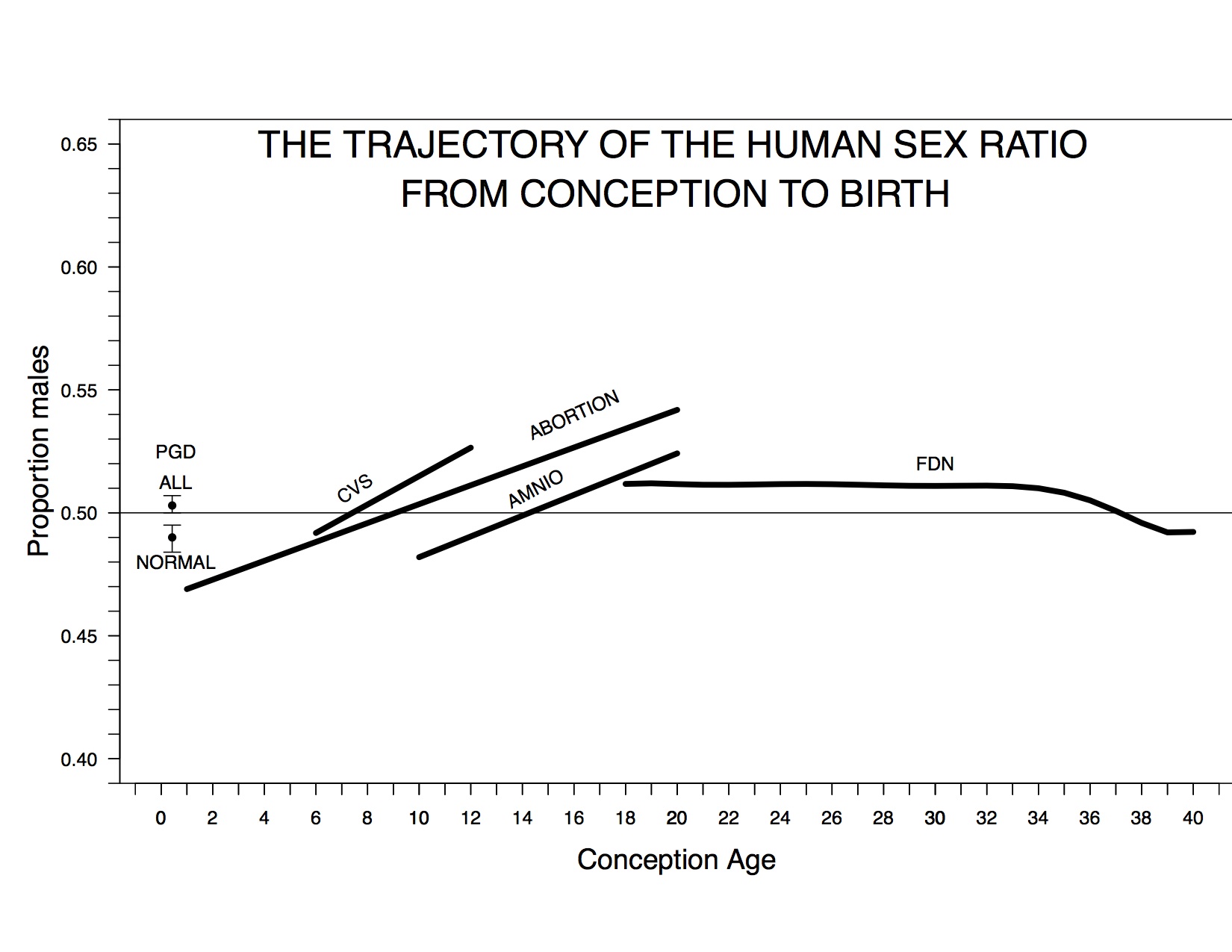
My colleagues and I recently estimated the trajectory of the sex ratio from conception to birth by analyzing three-to-six-day-old embryos derived from ART procedures, fetuses from induced abortions, fetuses that have undergone chorionic-villus sampling or amniocentesis, and US census records of fetal deaths and live births (Orzack et al. 2015).
 

trajectory

The trajectory of the cohort sex ratio from conception to birth. “PGD All” and “PGD Normal” denote the total and normal sex ratio estimates based on ART embryos, CVS denotes the estimated sex ratio trend based on chorionic-villus sampling data, ABORTION denotes the estimated trend based on induced abortions, AMNIO denotes the estimated trend based on amniocentesis data, and FDN denotes the trend of cohort sex ratio based on US fetal deaths and live births. A dashed line denotes a sex ratio of 0.5.

Our assemblage of data is the most comprehensive ever assembled to estimate the PSR and the sex ratio trajectory and is the first to include all of these types of data. We found that the sex ratio at conception is unbiased, the proportion of males increases during the first trimester, and total female mortality during pregnancy exceeds total male mortality (contrary to long-held opinion); these are fundamental insights into early human development (Austad 2015).

Our analyses avoided the perils of backward extrapolation (because we have data from embryos that are just a few days old) and the potential bias of estimates based on spontaneous abortions (because we did not use such data). On the other hand, our estimate of the PSR is potentially biased because most, but not all, ART embryos are conceived outside of mothers. Our estimate of the trajectory of the sex ratio after conception might also be biased because it is based in part on sex ratio data from mothers undergoing diagnostic procedures. As described in our paper, we believe that these potential biases do not influence our estimate of the PSR and of the trajectory. Nonetheless, we encourage scrutiny of potential biases influencing our analyses. Whatever the outcome of such scrutiny, our analyses set a new standard for analyses of the pre-birth human sex ratio, one that we hope will end the degraded knowledge dynamic that has long held sway in the study of the pre-birth human sex ratio.


References:

Austad, S. (2015). The human prenatal sex ratio: A major surprise Proceedings of the National Academy of Sciences, 112 (16), 4839-4840 DOI: 10.1073/pnas.1505165112

Campbell, R. (2001). John Graunt, John Arbuthnott, and the Human Sex Ratio Human Biology, 73 (4), 605-610 DOI: 10.1353/hub.2001.0048

Graunt, J. 1662. Natural and Political Observations Made Upon the Bills of Mortality. London: Martyn.

MacDowell, E. C., and E. M. Lord. 1925. Data on the Primary Sex Ratio in the Mouse. Anatomical Record 31: 143–148.

Nichols, J. B. 1907. The Numerical Proportions of the Sexes at Birth. Memoirs of the American. Anthropological Association 1 (4): 247–300.

Orzack, S., Stubblefield, J., Akmaev, V., Colls, P., Munné, S., Scholl, T., Steinsaltz, D., & Zuckerman, J. (2015). The human sex ratio from conception to birth Proceedings of the National Academy of Sciences, 112 (16) DOI: 10.1073/pnas.1416546112

Parkes, A. (1926). The Mammalian Sex-Ratio Biological Reviews, 2 (1), 1-51 DOI: 10.1111/j.1469-185X.1926.tb00600.x

Shettles, L. B. 1961. Conception and Birth Sex Ratios. Obstetrics and Gynecology 18 (1): 122–130.

Stern, C. 1960. Principles of Human Genetics. 2nd ed. San Francisco: W. H. Freeman.

Tschuprow, A A. 1915. Zur Frage Des Sinkenden Knabenüberschusses Unter Den Ehelich Geborenen. Bulletin de L’institut International de Statistique 20 (2): 378–492.

Thumbs up (1 votes)
Loading...

Tags: , , ,
Categories: Discussion, Research

Navigate the archive

Use our Advanced Search tool to search and filter posts by date, category, tags and authors.

8th International PhD School in Plant Development

Posted by , on 9 June 2015

On behalf of the organizing committee I would like to draw your attention to the 8th International PhD School Plant Development (IPSPD VIII) (www.plant-development.org).

The meeting will take place October 07-09 at Zellingen-Retzbach close to Würzburg, Germany.

Conference website:  www.plant-development.org

Registration costs are 195 Euro per person (includes accommodation, meals, conference dinner, conference fee).

Registration deadline: August 14, 2015

Organizing committee: Kay Schneitz, Markus Schmid, Rita Gross-Hardt

General information:

With the growing complexity of biological research projects in the last decades it has become increasingly important for scientists to communicate and collaborate across geographical and subject boundaries. Thus, young scientists not only need to be trained early in their career to present data at international meetings and discuss it with peers and leaders in the field but also to organize chair sessions as well as to network and identify potential collaboration partners. The PhD School on Plant Development was set up in 2008 with the aim of training young scientists in these skills and give them a platform for communication and collaboration.

Plant developmental biology is an exciting and fast moving field, which has seen many breakthroughs over the last decade. However, apart from this PhD School we are not aware of a signature meeting that is aimed at international graduate students and young postdocs.

The International PhD School consists of ten successive sessions that are each introduced by an internationally renowned keynote speaker. These sessions cover a broad range of topics, such as stem cells and meristem function, vegetative and reproductive development, hormone signaling, embryogenesis, gametophyte and germ line formation, seed development, cell biology as well as aspects such as epigenetics, evolution, systems biology and mathematical modeling. It is expected that two to three PhD students/young scientists represent their research data in each of the sessions that shall be chaired by other PhD students/young scientists. It will be at their responsibility to initiate fruitful discussions and guide constructive conversations. Two poster sessions will provide extra time and informal opportunities for discussions.

The IPSPD will take place at the congress center “Benediktushöhe” in Zellingen-Retzbach, a small town near Würzburg (http://www.benediktushoehe.de). This place is distinguished by its central location, which can be easily reached by train from throughout Germany, including from central international airports such as Frankfurt Airport or Nürnberg. Furthermore, past experience has shown that Benediktushöhe provides a professional seminar venue with nice rooms, excellent catering and a friendly and professional atmosphere. At the same time, the center charges moderate fees, which allows for registration costs that are easily affordable for students and young postdocs alike.

Invited speakers include:

Maria Albani (MPI Köln)

Martin Bayer (MPI Tübingen)

Miguel Blazquez (University of Valencia)

Thomas Dresselhaus (University of Regensburg)

Veronica Grieneisen (JIC, Norwich)

Ueli Grossniklaus (University of Zürich)

Marcus Heisler (EMBL Heidelberg)

Alexis Maizel (University of Heidelberg)

Moritz Nowak (VIB, Ghent)

Karin Schumacher (University of Heidelberg)

Dolf Weijers (University of Wageningen)

Thumbs up (No Ratings Yet)
Loading...

Tags:
Categories: Education, Events

Tenure-track professorship in Plant Genetics at TUM

Posted by , on 9 June 2015

Closing Date: 15 March 2021

Hi there,

the School of Life Sciences Weihenstephan at TU Munich invites applications for an assistant professorship in Plant Genetics. More information can be found at the link below. If you have any questions don’t hesitate to email me at kay.schneitz@tum.de.

Kay

http://portal.mytum.de/jobs/professuren/NewsArticle_20150601_151423

Thumbs up (No Ratings Yet)
Loading...

Categories: Jobs

Epigenomics of Common Diseases

Posted by , on 8 June 2015

Epigenomics of Common Diseases

6-9 November 2015
Wellcome Trust Genome Campus, Hinxton, UK
Conference hashtag: #ECD15

Bursary deadline: 8 September | Abstract deadline: 22 September | Registration deadline: 6 October

The 5th Wellcome Trust Epigenomics of Common Diseases conference will bring together leading scientists from the fields of epigenomics, genetics and bioinformatics to discuss the latest developments in this fast-moving area.

Epigenetic variation plays an important role in disease processes and provides a promising focus for disease prediction, prevention and treatment. Technological advancements in the past few years have fuelled a dramatic increase in the scale, breadth and availability of epigenomic reference data. In addition, novel developments such as single cell analysis and gene editing present exciting new opportunities. Associations between epigenetic variation, a variety of risk factors and the development of many diseases continue to emerge but causality has, in many instances, not yet been established.

This meeting will focus on epigenomic studies across of a wide range of common and other diseases, including approaches from a variety of different disciplines. It will explore technological and methodological developments and provide a forum to present and discuss recent advances in epigenomics of relevance to human disease. We welcome abstracts from all areas relevant to epigenetic and epigenomic research. Several oral presentations will be chosen from the abstracts submitted.

Topics will include:
Epigenomics of disease
Chromatin organisation
Model systems: animal and cellular models
Population epigenetics
Clinical epigenetics
Single cell epigenetics
Epigenetic engineering
Informatics and technology

Scientific programme committee:
Stephan Beck, University College London, UK
Susan Clark, The Garvan Institute of Medical Research, Australia
Andy Feinberg, Johns Hopkins University School of Medicine, USA
Edith Heard, Institut Curie, France
Caroline Relton, University of Bristol, UK

For further information, visit: https://registration.hinxton.wellcome.ac.uk/display_info.asp?id=515

Thumbs up (No Ratings Yet)
Loading...

Tags:
Categories: Events, News

Young Embryologist Network USA: Mouse livers and stem cell fate conversion

Posted by , on 4 June 2015

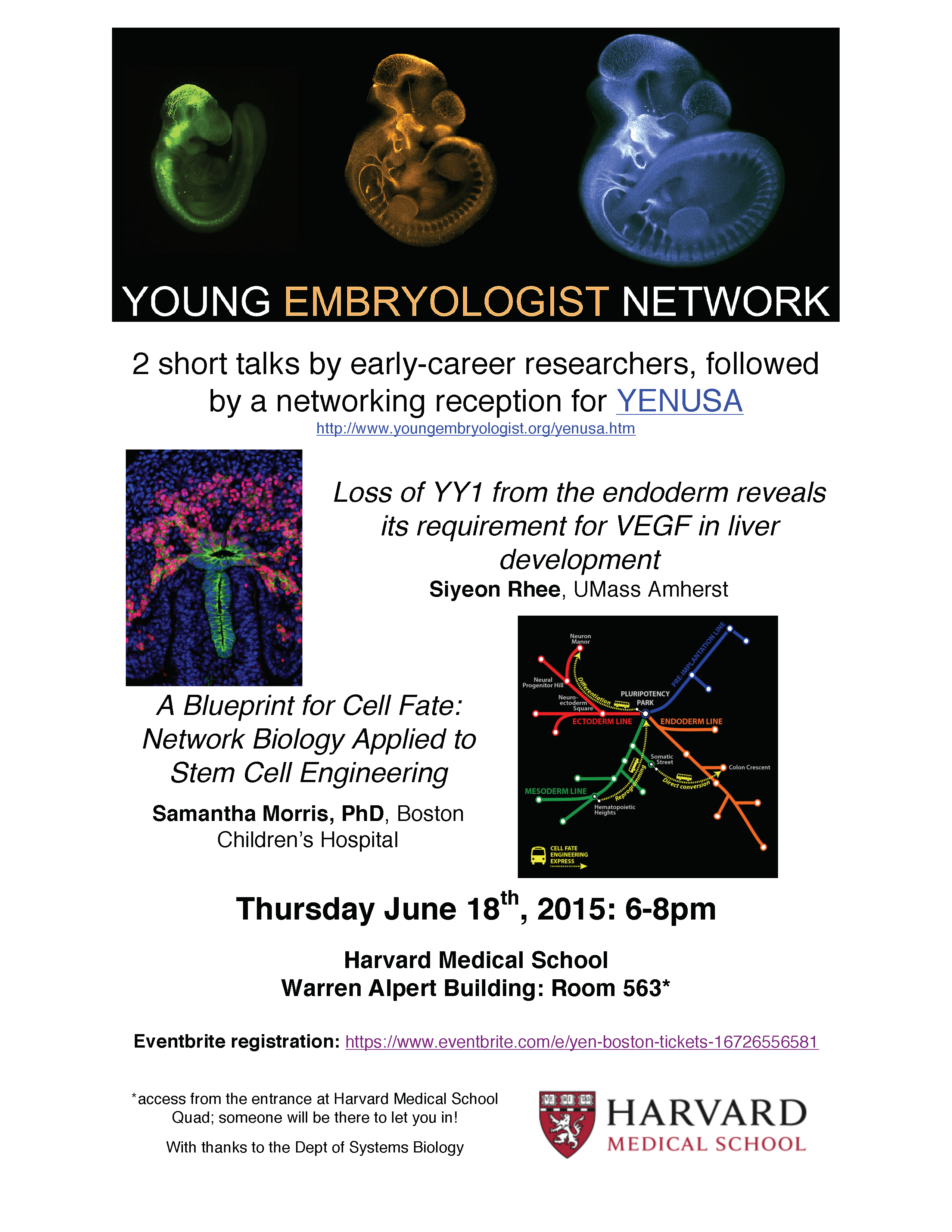
YENposterJune2015

The next Boston Young Embryologist Network talks event will be held in the Warren Alpert Building at Harvard Medical School Thursday June 18th, 6-8pm. Food and drink will be provided for discussions and mingling!

Please register with eventbrite to give an estimate of numbers for food.

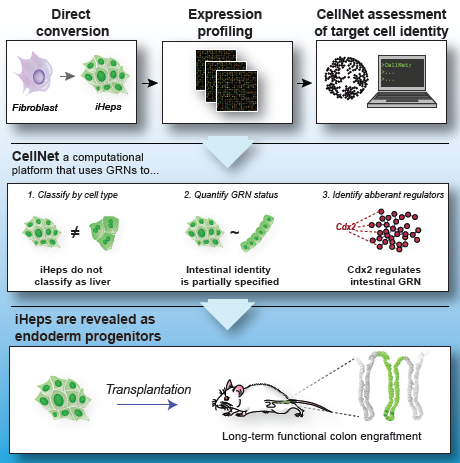
Short talks will be given by Siyeon Rhee, a graduate student from UMass Amherst, and Samantha Morris, a postdoc at Boston Children’s Hospital who will start her own lab at Washington University School of Medicine in St. Louis in July. Siyeon will discuss the role of Ying Yang1 in mouse liver development, and Sam will talk about her work investigating stem cell fate conversion and combining it with a network biology approach (for a teaser, see her abstract below).

Samgraphabstract

We look forward to seeing you there, and stay tuned for future events!

Thumbs up (4 votes)
Loading...

Tags:
Categories: Events, News

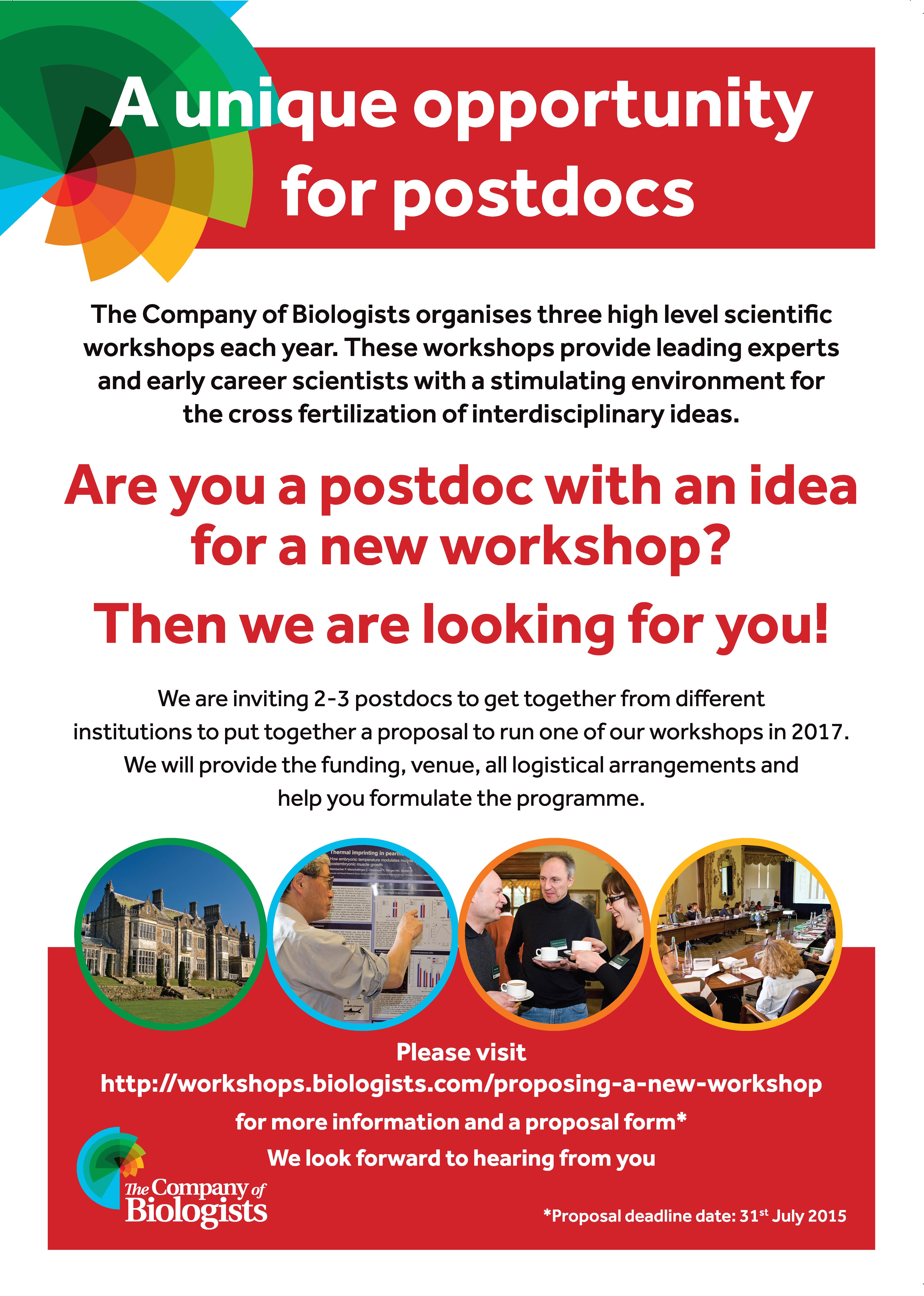
Organise a workshop- unique opportunity for postdocs!

Posted by , on 4 June 2015


(Click the image or here to get to the application site!)


Thumbs up (2 votes)
Loading...

Tags:
Categories: Funding, News

Postdoctoral position-Mansour Laboratory-University of Utah

Posted by , on 3 June 2015

Closing Date: 15 March 2021

My laboratory has an open position for a postdoctoral fellow to work on NIH-funded projects involving FGF signaling in auditory supporting cell differentiation in the mouse model. The ideal candidate should have at least two years of graduate or postdoctoral research experience in perinatal/postnatal inner ear development, including anatomic, molecular and functional analyses, with strong publications (can be pending) in these areas. Experience with mouse genetics is not absolutely required, but is a big plus. Stipend will follow NIH guidelines and the candidate will be mentored through the process of applying within two years of the initial appointment for individual support (stipend and/or newly developed project) as appropriate. In addition, presentation and networking opportunities include participation in the weekly Human Genetics Research in Progress series and the monthly Inner Ear Research Group, which comprises multiple labs with diverse interests.

E-mailed inquiries (suzi.mansour[at]genetics.utah.edu) should include a brief (< 1 page) current research description, a Biosketch, and the names and contact information of two individuals (current PI and one other), who can be contacted to comment on your suitability for this position. The position can start as early as July 1, 2015.

Thumbs up (No Ratings Yet)
Loading...

Categories: Jobs

Tenure-Track Position, NIDCR

Posted by , on 3 June 2015

Closing Date: 15 March 2021

A tenure track position is available for a dental-oral-craniofacial (DOC) developmental biologist to establish an independent research program in the Craniofacial and Skeletal Diseases Branch, NIDCR, NIH. Outstanding individuals working on any aspect of basic DOC biology (such as craniofacial development, development of periodontal and tooth-related tissues, and osteoimmunology), willing to contribute to the design of strategies to repair or regenerate DOC tissues lost as a consequence of pathologies or trauma, will be considered. Under the leadership of Pamela Gehron Robey, Ph.D., the Craniofacial and Skeletal Diseases Branch focuses on gaining an in-depth understanding of the skeleton, defined as bone, cartilage, teeth, and their associated soft tissues (bone marrow, periodontal and oral tissues, tendons). In addition to a strong portfolio in basic research, the Branch is actively engaged in translational and clinical studies, in line with NIDCR’s expanding clinical efforts in craniofacial anomalies and regeneration.

The Branch is located on the main intramural campus of the NIH in Bethesda, Maryland, just outside Washington, DC. On the NIH campus, ~1000 principal investigators including world-renowned experts in basic, translational, and clinical research, and ~5000 trainees pursue common goals, to seek fundamental knowledge about living systems and use that knowledge to enhance health and reduce illness. The NIH offers Principal Investigators the opportunity to mentor outstanding trainees at diverse levels, from post-baccalaureate and graduate students to post-doctoral fellows.


Candidates must have a Ph.D., M.D., D.D.S./D.M.D., D.V.M, D.O. or equivalent doctoral degree, as well as comprehensive, advanced training and a record of accomplishment. The position will be supported with independent resources commensurate with experience and programmatic needs, including positions for pre-doctoral and post-doctoral fellows, and a budget for consumables and equipment. Interested applicants should submit a single PDF document containing a Curriculum Vitae (please include a brief description of expertise gained in previous positions), a list of publications, a summary of research accomplishments, a plan for future research including a core research question (three page limit), the names and contact information of three people who are submitting letters of reference, and copies of no more than 3 publications. All materials should be emailed to:  Dr. Terry Yamaguchi, Chair, Dental-Oral-Craniofacial (DOC) Development Search Committee; c/o Ms. Shirley Simpson, ssimpson@dir.nidcr.nih.gov.  Review of applications will begin in August 2015, but applications will be accepted until the position is filled.


Selection for this, and any other position, will be based solely on merit.  NIH does not discriminate on the basis of race, color, religion, sex, national origin, politics, marital status, sexual orientation, physical or mental disability, age or membership or non-membership in an employee organization.  DHHS and NIH are equal opportunity employers.

Thumbs up (No Ratings Yet)
Loading...

Categories: Jobs

Postdoctoral Fellow in Regenerative Pulmonology, Harvard Medical School/Massachusetts General Hospital

Posted by , on 3 June 2015

Closing Date: 15 March 2021

Rajagopal Lab
Regenerative Pulmonology
Center for Regenerative Medicine
Massachusetts General Hospital
Massachusetts Eye and Ear Infirmary
Harvard Stem Cell Institute

Job description: The Rajagopal Laboratory at Center for Regenerative Medicine at the Massachusetts General Hospital is seeking a highly motivated research fellow to study airway biology. The fellow will join a collaborative group of scientists and physicians who study the basic and translational biology of airway stem cells, airway regeneration, fibrosis, squamous metaplasia and cancer. We integrate the approach of classical developmental and modern stem cell biology and use these to explore human tissue regeneration and disease. Mouse genetic models, explants systems, live cell imaging, and other techniques are routine.

Job requirements: The candidate should have PhD or an MD/PhD in a relevant field or equivalent training. A strong foundation in cell, developmental, cancer, or molecular biology is necessary including a foundation in the genetic modulation of any model organism. An ancillary knowledge of genomics or system biology is welcome. Knowledge of human disease is unnecessary as it will be acquired rapidly. Outstanding oral and written communication skills are required.

Email your CV, statement of interest and career goals, and names and contact information of at least three references to Jay Rajagopal (jrajagopal@partners.org). For more information visit: http://www.rajagopallab.com/

Thumbs up (No Ratings Yet)
Loading...

Categories: Jobs

Anatomy Head of Department, Yong Loo Lin School of Medicine

Posted by , on 3 June 2015

Closing Date: 15 March 2021

The National University of Singapore (NUS) invites applications for faculty appointment as Head of the Department of Anatomy.

The Department’s mission is to enhance the international stature of the School and of NUS through excellence in teaching and research. It is committed to teaching undergraduate medical, dental, pharmacy, and life science students. In addition, the Department provides research training to both undergraduate and postgraduate research students. Currently, research in the Department focuses on neurobiology, cancer biology and venoms & toxins in a vibrant academic environment. Researchers in the Department use a variety of techniques in cellular and molecular biology and the Department and the School are well equipped with state-of-the-art facilities.

The Department has over the past 5 years attracted SGD 10 million in competitive grant funding. The Department has 21 faculty members and a total of around 100 staff and postgraduate students. The Department publishes on average 57 scientific papers annually in high impact journals such as Cell, Nature Cell Biology, Nature Medicine, Journal of Clinical Investigations, Cancer Research, Hepatology, Advanced Materials, PNAS and Journal of Neuroscience. The Department enjoys strong collaborative links with research institutes within NUS, government agencies as well as overseas research institutes and leading universities.

The candidate should be an outstanding scholar who will be able to provide strong leadership in research and teaching with an excellent track record and international recognition for research in any of the main areas of research in the Department. Administrative experience in leading an academic department would be an added advantage. A generous start up package and first class laboratory facilities are available. The Head is expected to generate strong research programmes, secure external funding and provide intellectual leadership characteristic of a world-class university.

Remuneration will commensurate with the candidate’s qualifications and experience. Informal enquiries can be made to Ms Sing-Ee Lee: medlse[at]nus.edu.sg; Tel +65 6772 3729.

Interested parties should submit their applications, supported by a detailed resume and names of at least six referees to:

Ms LEE Sing Ee

Assistant Director, Academic Affairs

Dean’s Office, Yong Loo Lin School of Medicine

National University of Singapore

1E Kent Ridge Road, NUHS Tower Block

Level 11, Singapore 119228

Fax: +65-6778-5743   Email:  medlse[at]nus.edu.sg

Closing Date: 31 July 2015

(Only shortlisted candidates will be notified)

Thumbs up (No Ratings Yet)
Loading...

Categories: Jobs