

Winners from the 2025 Quintay International Course on Developmental Biology cover competition
Posted by the Node, on 14 July 2026
Last month, the Node ran a cover competition with images taken by advanced graduate students and postdoctoral fellows from across the Americas who gathered in Chile to participate in the International Course on Developmental Biology, an EMBO Practical Course held at the Marine Biology Station of Quintay (CIMARQ).
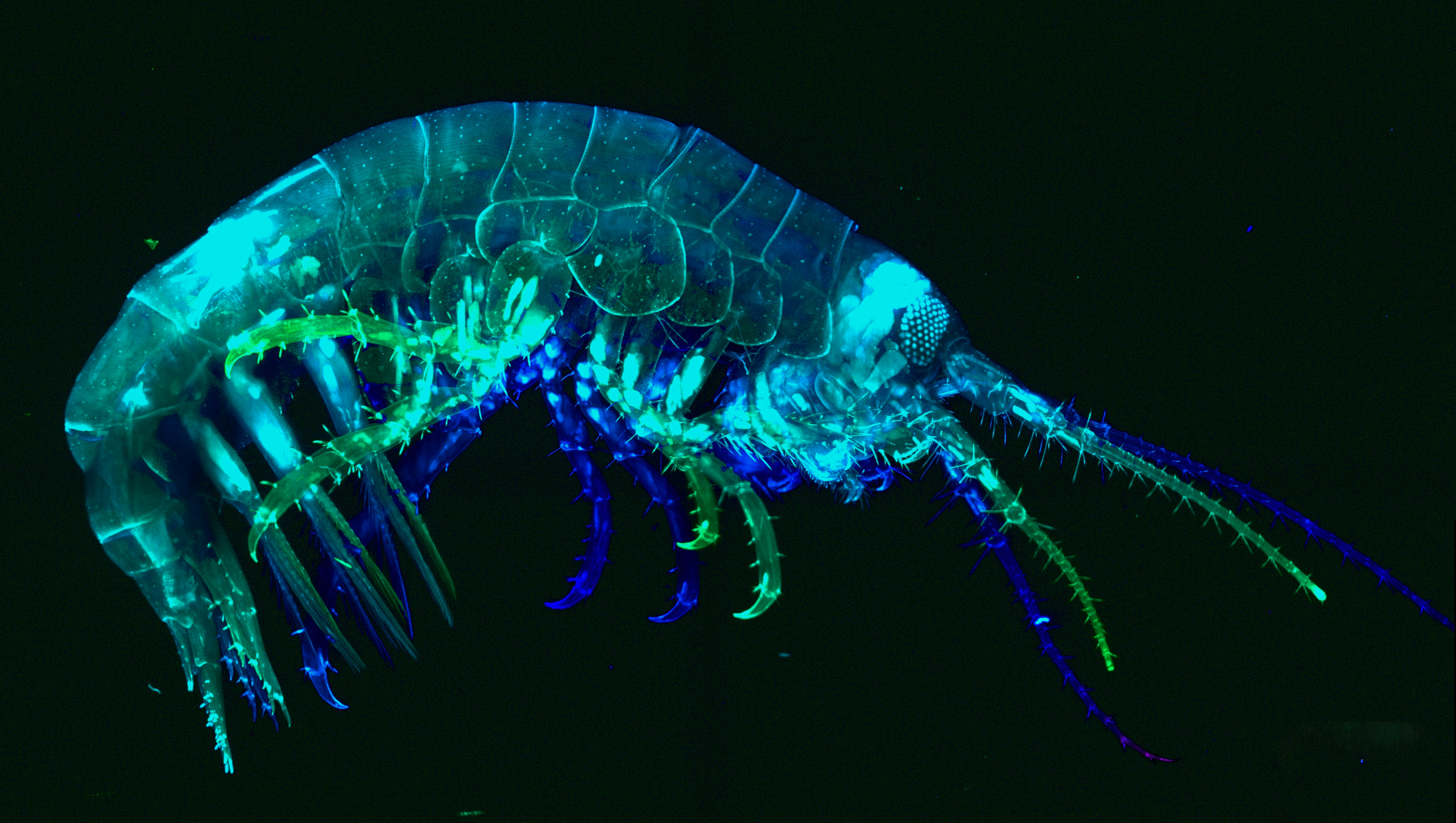
We held a vote over a two-week period. Nine impressive submissions were received from the 2025 student cohort, with images ranging from amphipods to Xenopus laevis and the winners of the popular vote were chosen. Among the great selection of images, the image taken by Natália Heloísa de Oliveira, Fernanda Salce, and Federica Salatiello, Amphipod, received the most votes. Congratulations! Their image will be published on the front cover of Development later in the year.
First, we hear from one of the winners, Fernanda Salce.
Fernanda, can you describe your research career so far?
Currently, I am a PhD student in Brazil at the Federal University of Rio de Janeiro, Macaé, RJ. Specifically, I work at the Institute of Biodiversity and Sustainability, affiliated with the Morphological Sciences PhD program.
Can you tell us about your current research?
I am focusing on Developmental Biology as I study the regenerative process of locomotor limbs in the beetle Tribolium castaneum. I am trying to analyse how transcriptional perturbations retain enough plasticity to ensure a given biological process is completed. Thus, I have been studying the limits of leg regeneration in Tribolium larvae under different zld dsRNA concentrations. In previous studies, our group showed that zld is a pioneer transcriptional factor whose activity is pivotal to the success of leg regeneration in the Tribolium larvae model, with zld dsRNA treatment fully inhibiting this process. Here, I am investigating at which point this system might recapitulate function even in the partial absence of zld mRNA. So, more specifically, I am trying to observe whether the regenerative process can be characterized as a bimodal switch-like system and, furthermore, which genes are integral and which are dispensable for leg regeneration in a zld-dependent manner. In parallel, I am also observing changes in morphospace exploration during leg regeneration under these different zld dsRNA concentrations.
What is your favourite imaging technique/microscope?
I frequently use the stereomicroscope for imaging. However, after the course in Chile, I have to say that Light-Sheet microscopy has become my new favorite technique. Not for its accessibility, mind you! But for the amount of morphological data you can extract from your samples. It is simply astonishing!
What is the most impactful thing you learned in the course?
That people are more accessible and approachable than they might seem at first. I would never have thought in my life that Roberto Mayor and I would be sharing drinks and grilling steaks together, but there we were, haha! But on a serious note, the course truly highlights how important social interactions and interpersonal skills are for a scientist.
If possible, describe a bit more about the image that made the cover, including what seems to be capturing wild-caught animals!
This is a crustacean in the genus Parhyale. We caught this bad girl with Nipam Patel’s help. He told us to put a few carrot pieces inside a plastic water bottle with some stones to attract a few of these animals overnight. Keep in mind, this was done inside an aquarium-like system with thousands of red sea urchins. The next day, we actually caught some and thus began our fishing minigame, using Pasteur pipettes and clove oil as anaesthetic. This specimen was particularly interesting because it was a female carrying eggs, so we separated the mother for the Light-Sheet microscope and the eggs for downstream analysis on the confocal microscope. The latter was also brought to Chile with Nipam’s aid.
As a side note, the confocal microscope had an extraordinary logistical undertaking behind it, from what we were told. Apparently, each piece of equipment had to be labelled and registered upon entry into the country, so this particular confocal microscope was designed to be “easily” assembled and disassembled. Truly mesmerizing stuff.
Lastly, for staining, we left our specimen in a phalloidin solution for a week, then stained it with DAPI before our first use of the Light-Sheet microscope during the course. Retroactively, I don’t think that we stained for enough time because you’ll notice that there are myofibers clearly visible in the extremities, but on the animal’s central axis, there was barely any staining – the few observations we caught were restricted to the head and portions of the tail. So, for future participants, my advice would be to begin staining as early as possible and to visualize your possible findings during the last week of the course for better results 😊.
Where can people find you?
You can find me on LinkedIn and Google Scholar.
The other two winners, Federica Salatiello, who was funded by the BEOM Department, Stazione Zoologica Anton Dohrn, Italy, and Natália Heloísa de Oliveira, a PhD student at the Federal University of São Paulo, Brazil, under the supervision of Prof. Dr. Marimelia Porcionatto, will be interviewed and featured on the Node later in the year.
Thank you to all the students who participated in the course: Victoria Fernandez, Ana Maria Soria, Candelaria Diaz, David Arancibia, Emilia Failache, Erika Venancio, Federica Salatiello, Fernanda Salce, Fernanda Dalami, Gonzalo Spelzini, Ignacio Casanova, Ingrid Pinto, Jaime Aguayo, Juan Pablo Venegas, Luis Eduardo Sánchez , Marco Mundaca, Mariana Tovar, Natália Heloísa de Oliveira, Nicolás Zúñiga and Pablo Fernández.
Did these images inspire you to take the course? The next cohort of the International Course on Developmental Biology is currently accepting applications until 30 July 2026.
Get involved
Create an account or log in to post your story on the Node.
Sign up for emails
Subscribe to our mailing lists.