

ULT1 and me
Posted by Vangeli Geshkovski, on 3 September 2026
“I have often thought how much more interesting science would be if those who created it told how it really happened, rather than reported it logically and impersonally, as they so often do in scientific papers.”
This was the opening paragraph of an essay written by George Beadle, a geneticist, and it was included in a book made for the 60th birthday of Max Delbrück, a biophysicist1.
I agree with George Beadle, and in this brief article, I would like to share my perspective on the story presented in our recent paper, about how a protein influences Arabidopsis development 2.
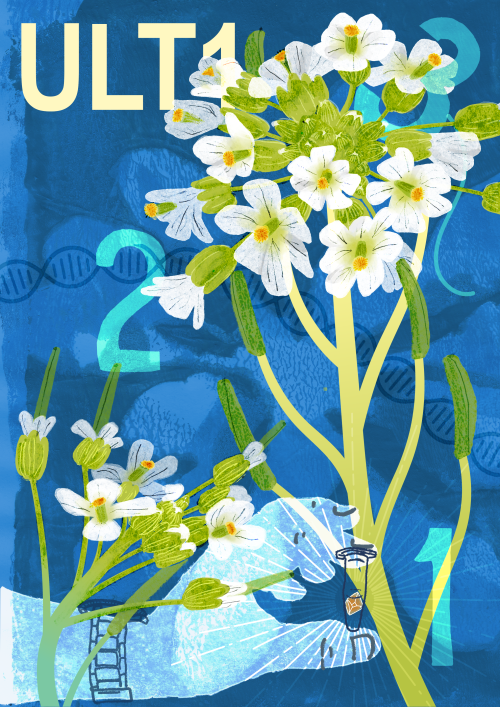
Following three guiding questions
Originally, ULTRAPETALA1 (ULT1) was identified in a forward genetic screen3. Steve Jacobsen, now a professor at UCLA, once told me that he might have been the first person to see its flowers almost thirty years ago. Jennifer Fletcher, researcher at UC Berkeley, was the first to characterize the mutation in detail3. As the name ULTRAPETALA indicates, plants carrying a mutation in this gene produce many more petals than wild type flowers. Fittingly, the first paper on ULT1, along with several ones following it, were published in Development3–5.
I entered the story 20 years later.
I first came across ULT1 during one of my Master’s internships, as I was doing biochemistry experiments to try and get the protein’s structure. I managed to purify and obtain crystals of part of the protein in the days before AlphaFold, and during the Covid pandemic, when it was difficult to even enter the lab. To this day, it was one of the luckiest experiments I have ever done – it worked on the very first try6.
I continued working on ULT1 over the next three years, trying to figure out how the protein works. As a student in (plant) development, I loosely followed Sydney Brenner’s three guiding questions:
- How does it get built?
- How does it work?
- And how does it get that way?
These questions ultimately relate to physiology, development and evolution.
As far as physiology goes, we knew a lot about flowering time and flower development, but the role of ULT1 in these processes remained quite mysterious.
It was also unclear how ULT1 works. For a long time, it was thought to activate genes, and much of the evidence seemed to point in that direction7. Overexpression of ULT1 produced a phenotype resembling loss of Polycomb function. Polycomb is a highly conserved protein complex with a well-established role in gene repression, so the interpretation seemed straightforward: too much ULT1 is like too little Polycomb.
But mutant phenotypes told a less clear-cut story. ULT1 mutants flower later than wild type Arabidopsis plants, a phenotype attributed to an increased accumulation of Flowering Locus C (FLC), the central repressor of flowering8. The extra petals are linked to an overaccumulation of WUSCHEL (WUS), a protein important for the maintenance of the stem cell niche in plants9,10. These phenotypes indicate that ULT1 may repress genes such as FLC and WUS, rather than activate them.
Genetics can be very confusing and sometimes misleading.
After a lot of biochemistry, some microscopy, bioinformatics, and more genetics, we finally nailed it down. We described, with some very nice experiments (definitely a non-biased opinion), that ULT1 directly interacts with and stimulates Polycomb activity. Importantly, this means that ULT1 has a repressive function after all.
The paper is now published in Nature Plants2 and has an associated News and Views article11. I’m also pleased that the work has received some public attention: the article was featured in the science section of Le Monde, one of the world’s leading newspapers12.
Many loose ends remain
We managed to answer the first two questions, about physiology and development.
I never managed to answer the third question, about the evolution of ULT1, which might be the most interesting one.
ULT1 is a plant-specific protein, while Polycomb is conserved across eukaryotes. That raises a deceptively simple question: why is ULT1 only found in plants?
What would happen if we put ULT1 into animal cells? Would it interact with the mammalian Polycomb machinery? Would it alter Polycomb activity or targeting?
And could we engineer artificial ULT1-like proteins that modulate or redirect Polycomb activity, perhaps one day providing new ways to intervene in diseases in which Polycomb function is disrupted, such as in many cancers?
I would love to find out.
But I’m onto something new now, so I’ll leave these questions to the next researcher. Good luck!
This article was written by Dr Vangeli Geshkovski and edited by Dr Laura Turchi
References:
1. Cairns, J., Stent, G. S. & Watson, J. D. Phage and the Origins of Molecular Biology. J. Hist. Biol. 1, 155–161 (1968).
2. Geshkovski, V. et al. The dual trxG/PcG protein ULTRAPETALA1 modulates H3K27me3 and directly enhances POLYCOMB REPRESSIVE COMPLEX 2 activity for fine-tuned reproductive transitions. Nat. Plants 12, 1561–1578 (2026).
3. Fletcher, J. C. The ULTRAPETALA gene controls shoot and floral meristem size in Arabidopsis. Development 128, 1323–1333 (2001).
4. Carles, C. C., Choffnes-Inada, D., Reville, K., Lertpiriyapong, K. & Fletcher, J. C. ULTRAPETALA1 encodes a SAND domain putative transcriptional regulator that controls shoot and floral meristem activity in Arabidopsis. Development 132, 897–911 (2005).
5. Moreau, F. et al. The Myb-domain protein ULTRAPETALA1 INTERACTING FACTOR 1 controls floral meristem activities in Arabidopsis. Development 143, 1108–1119 (2016).
6. Foucher, A.-E. et al. ULTRAPETALA1 remodels PRC2 recruitment to nucleosomes. 2026.06.16.732580 Preprint at https://doi.org/10.64898/2026.06.16.732580 (2026).
7. Carles, C. C. & Fletcher, J. C. The SAND domain protein ULTRAPETALA1 acts as a trithorax group factor to regulate cell fate in plants. Genes Dev. 23, 2723–2728 (2009).
8. Whittaker, C. & Dean, C. The FLC Locus: A Platform for Discoveries in Epigenetics and Adaptation. Annu. Rev. Cell Dev. Biol. 33, 555–575 (2017).
9. Somssich, M., Je, B. I., Simon, R. & Jackson, D. CLAVATA-WUSCHEL signaling in the shoot meristem. Development 143, 3238–3248 (2016).
10. Laux, T., Mayer, K. F. X., Berger, J. & Jürgens, G. The WUSCHEL gene is required for shoot and floral meristem integrity in Arabidopsis. Development 122, 87–96 (1996).
11. Velanis, C. N. ULTRA(PETALA)-boosted plant Polycomb. Nat. Plants 12, 1428–1429 (2026).
12. Jacquin, J.-B. Le ballet épigénétique derrière la floraison des plantes mis au jour.
Get involved
Create an account or log in to post your story on the Node.
Sign up for emails
Subscribe to our mailing lists.