
The community site for and by
developmental and stem cell biologists

Mole’s Comedia II. Inferno. Canto 20–39.

Posted by , on 15 October 2015

This Sticky Wicket article first featured in Journal of Cell Science. You can read the Mole’s visit to the first 5 circles of Grant Hell here. Read other articles and cartoons of Mole & Friends here.


JCS177204F1


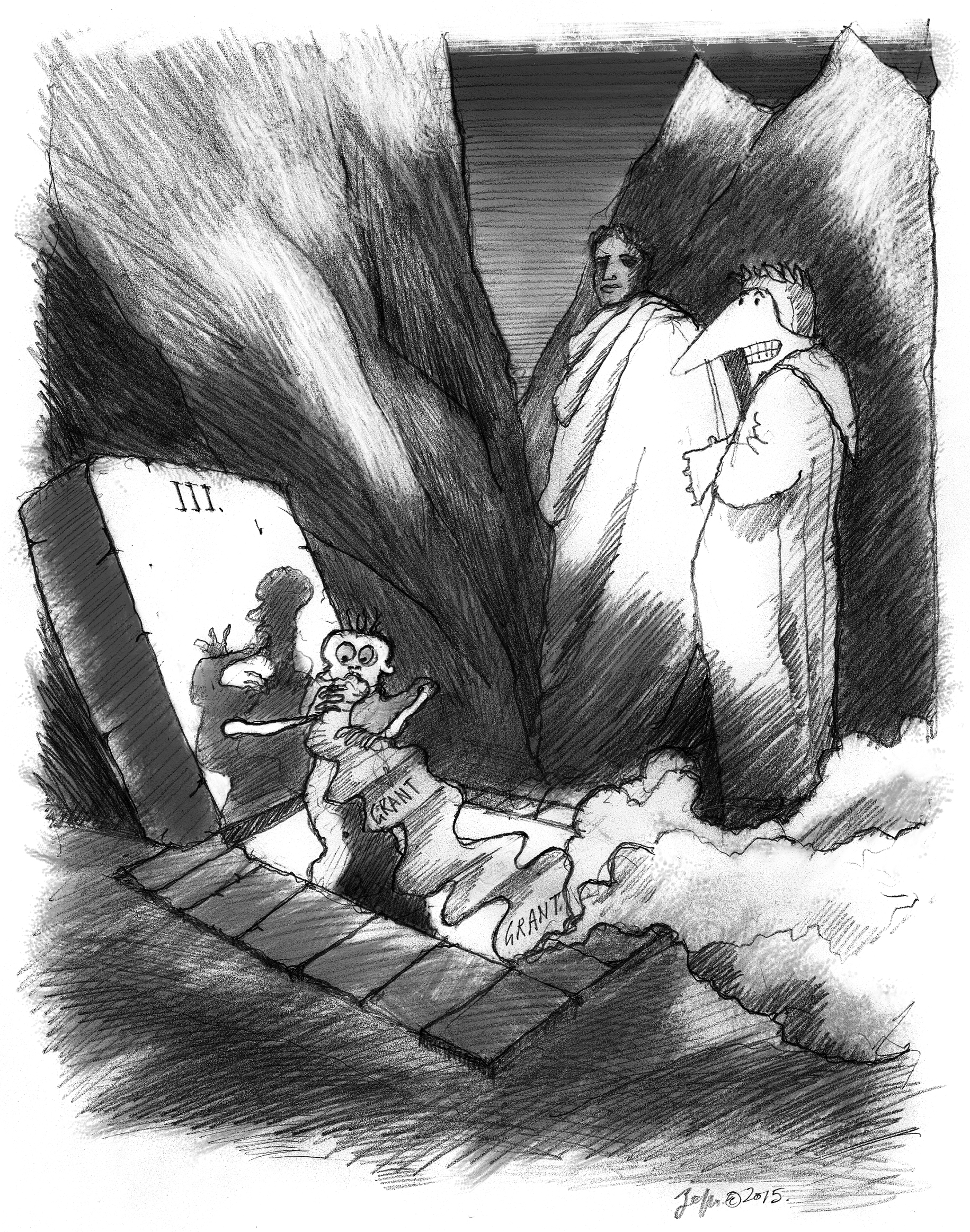
Mole was revising his rejected grant and moaning about how unfair it all is, when the shade of Francis Bacon, the Father of the Scientific Method, appeared to take him on a tour of Grant Hell. Sir Francis (‘Frank’) looks like Dumbledore but talks like a wanna-be hipster but, hey, maybe Mole is just dreaming all this. Anyway, they went to Grant Hell. There, they met lots of wretched souls who were not successful in revising their grants, and had lots of reasons why not.

Oh, one more thing. For some reason, the story is told in triplets that don’t rhyme. Probably they did in some other language, but it would have been too much trouble to translate it and make it rhyme. Mole may be getting lazy. Or maybe he’s up to something? No, most likely he’s just lazy. We join our travelers, having passed the Fifth Circle, and have continued up to the Fourth.


“Here is the Fourth Circle,” said Frank. This was Greed.

“But hey,” I said, “I thought greed is good. That’s what they tell us,

It makes the market work.” Frank shook his head.


“Wait,” I said, “Are you saying that these poor people are here

Because they wanted to do too much? They wanted too many grants?

I mean, what’s wrong with a little ambition if the science is good?


“Listen,” I went on, “I’m getting a little tired of hearing that somebody, who

I think is a really terrific scientist, has ‘too many grants.’ I mean, if they are

Getting the best work done, maybe they deserve the grants. You know?”


“And now,” I think I was on a roll. “Now you tell me that they are here,

In Grant Hell, because they work too hard.”1 “Easy, Big Guy,2” said Frank,

And I looked to see if he was talking to me. He was. Nobody calls me ‘Big Guy.’


He went on. “You’ve got it all wrong. They aren’t here because they wanted

Too many grants. They are here because they confused grant funding and power.

Their greed is not to do more great science but to amass influence.”


“Oh,” I said. “Then they get what they deserve.” Because being ‘powerful’

As a research scientist is a bit like being the King or Queen of Cheese.3

It isn’t worth very much and can smell pretty terrible. Frank cracked up at that one.


We had moved to the Third Circle, where the wretched never stopped writing,

Except to eat the paper they were generating. Or electrons, but I couldn’t see that.

Then they would write some more. “Here is Gluttony,” whispered Frank.


I stopped one poor soul who was eating a page as it came out of a printer.

“Why are you doing this?” I asked. “Oh,” he moaned. “You know how it is,

I don’t get my grants funded, so I write more and more and more.


“I was putting in a grant every cycle, but that didn’t work, so I went to two,

Then three. I don’t have anything new to say, and I spend all my time

Regurgitating my ideas and sending them in. Eventually I’ll get one.” He belched.


“But wait,” I cried, “Maybe you need to stop and actually think about what

You are writing! Maybe if you took some time out, you’d frame the work

In a way that reviewers will see why it is important?” He wolfed down a page.


“No, this is how I do it,” he sputtered between mouthsful. “This is how I roll.”

“How’s that working out for you?” I asked, but he wasn’t interested.4

“Let’s go up,” said Frank. “Not much more to see here.”


We found the Second Circle. Souls were flying in the winds that blew around us.

“This is Lust,” said Frank, watching them flit around us. “Their only crime, I think,

Is to want their grant too badly. They don’t want to change it, because they love it.”


I could understand. Maybe this was my own circle. I really, really want my grant.

I lust for it. The work is lovely, and elegant, and important. But it wasn’t funded.

I could feel myself starting to float off the ground and my clothes began to flap.


“Whoa, there, Compadre,5” said Frank, grabbing my leg and bringing me to earth.

“Get a grip. I mean, its just a proposal for what you want to do. There’s nothing

of value in a grant, except as a way to get the support for the work, right?”


I wasn’t so sure. I mean, when I write a grant, I think about the project,

Really think about it, often for months. The act of writing helps me to formulate,

Consolidate my thoughts. It’s a plan for the next few years of research.


But yes, he was also right. The act of writing a grant, really, is just an approach

To supporting the work that has been formulated. Yes, thinking about it is good,

But actually doing the work is what this is all about. I needed to think.


And found that we had entered the First Circle. Limbo. Nothing to do but wait.

And while we all waited to hear the results of our submission, we were happy.

Because until we get the bad news, we can imagine that we’ll get it.


We emerged in the light of Hope. And there, before us, was a mountain.

“We’ll climb that in a while,6” said Frank. “But first, I know a good place

Near here to get some lunch. You down for that?” Me, I didn’t know down from up.


Footnotes

1 Mole is correct here, and despite FB’s words to the contrary, many experienced investigators have their grants fail because of a perception that “they have too much money.” Indeed, funding institutions sometimes place limits on total amounts a program may have, and in those that do not, the reviewers may take this position themselves. But Mole feels that this is inappropriate; some investigators are simply more productive than others and, given the opportunity, more support can result in substantially more impactful research from such investigators. Of course, the opposite is also true – there are investigators who will not be productive, regardless of how much support they have.

2 Grande Salame

3 (il re o la regina di formaggio) It is possible that Mole is referring to either King Camembert (1411–1489) or, perhaps, Queen Gouda (1536–1590). Or he may be referring to his friend Weasel who is, indeed, very fond of cheese.

4 This approach, of flooding granting institutions with applications in hopes that one may “stick” is becoming much too common. Mole doubts that it is a viable strategy, unless such multiple applications can be done with the same care that goes into only one. As this is rarely the case, the strategy might, at least, be reconsidered. Given that the result is an avalanche of hastily prepared applications converging at any one competition, an exceptionally well-crafted (and well-reasoned) application might stand out and be favored. It’s just a thought.

5 (Fermati, il mio Ferrari)

6 The mountain, Grant Purgatory, eventually leads to Grant Paradise, which lasts only until the period of the grant runs out, and a renewal applied for. Mole points out that it may be interesting to note that, whenever a grant is rejected and we find ourselves in Grant Hell, we blame the process (“they killed me”). When it happens that we emerge into the light of funded Grant Paradise, though, we did it all by ourselves (“yes, I got the grant”).

Thumbs up (1 votes)
Loading...

Tags: ,
Categories: Discussion, Funding

Navigate the archive

Use our Advanced Search tool to search and filter posts by date, category, tags and authors.

Biocurator positions at Xenbase, the Xenopus Model Organism database

Posted by , on 13 October 2015

Closing Date: 15 March 2021

Xenbase (www.xenbase.org) is the Xenopus bioinformatics and genomics resource. Xenopus is a major model for fundamental cell and developmental biology and a model for human disease. Xenbase is a totally free, and globally accessible database, used by Xenopus researchers worldwide, and is funded by the National Institute of Child Health and Human Development. Xenbase has two performance sites: the curation team is based in Cincinnati, OH (PI: Dr. Aaron Zorn) and the developer/database management team is based at the University of Calgary in Canada (PI: Dr. Peter Vize).

Xenbase is seeking to fill 2 full time Curation positions to join the curation team at the Division of Developmental Biology, Cincinnati Children’s Hospital, Cincinnati, OH, USA. Curation positions offer a challenging job away from the wet-lab and research bench, where interpreting, annotating and displaying complex data is our main task. Curators also develop strategies to improve data curation; work to improve data display/querying on the website; interact with our user community at research conferences; develop programming skills; and contribute to Xenbase publications.

Job Description:

  • Curation and annotation of published Xenopus scientific literature, focusing on gene expression and the extraction of other research data: genes, transgenics, antibodies, morpholinos, phenotypes, genetic interactions, gene product functions and models of human disease.
  • Import and annotate data from large-scale screens (e.g., loss-of-function morpholino screens, gain-of-function mRNA screens).
  • Help develop new features: curation and processing of public and directly submitted RNA-seq and ChIP-seq NGS data from Xenopus experiments, curation of mutant phenotypes and transgenics; expanding our an anatomy atlas; implementing GO annotations.
  • Co-author reports and publications, and give presentations at national and international meetings and workshops.

Qualifications:

  • MSc or PhD degree in bioinformatics and/or developmental biology, genomics, genetics, molecular biology, zoology, anatomy or related field.
  • Demonstrated ability to produce scientific papers, reports and presentations
  • Demonstrated ability to work in a team as well as independently, efficiently (i.e both quickly and accurately) and be self-motivated
  • Strong interpersonal and communication skills, including excellent written and spoken English

Preference will be given to applicants with:

  • Experience with a bioinformatics, genomics or model organism database
  • Experience in data annotation/biocuration, knowledge of relational databases, and familiarity with ontologies.
  • Experience in a Xenopus or other vertebrate (mouse, zebrafish or chick) developmental biology lab.
  • Experience in analyzing genomics data, using GRN software, genome browsers and common bioinformatics tools.

How to Apply:

Please submit your application, to: aaron.zorn[at]cchmc.org with the following information:

  • A cover letter , including a statement of interest/purpose
  • CV/Resume.
  • Copy of your degree(s).
  • List 3 references/referees whom we may contact (please include their postal address, email and phone number).

Salary and Start Date:

Salary will be commensurate with qualifications and experience. Start date is negotiable, but expected to be in early 2016.

The successful applicants will be employees of Cincinnati Children’s Hospital and will undergo background checks, orientation and a 3-month probationary period. Employees are required to receive an annual flu vaccination.

More information about working at Cincinnati Children’s Hospital and living in Cincinnati can be found here: http://www.cincinnatichildrens.org/careers/working/default/

Thumbs up (No Ratings Yet)
Loading...

Categories: Jobs

DTP studentships on the Norwich Research Park

Posted by , on 13 October 2015

Closing Date: 15 March 2021

PhD opportunities available here:

http://biodtp.norwichresearchpark.ac.uk/projects

Use the search functions for particular topics or partner institutions, which include the JIC, TGAC, IFR, TSL and the UEA.


Thumbs up (No Ratings Yet)
Loading...

Categories: Jobs

Postdoctoral Researcher position with Andrea Münsterberg, UEA Norwich

Posted by , on 13 October 2015

Closing Date: 15 March 2021

Using chick embryos we recently identified BMP/Smad and Wnt/GSK3b signals as extrinsic cues that control the migration of prospective cardiac cells. We showed that BMP and Wnt pathways converge on a common effector: the transcription factor Smad1 (Song, McColl et al., PNAS 2014). We will use systematic approaches to determine the targets of BMP/Smad1 and Wnt/GSK3b signalling in early mesoderm cells. Identified candidate genes will be assessed for their function in controlling cell migration and fate choice.

More information can be found here http://www.jobs.ac.uk/job/AMD289/senior-research-associate/


Thumbs up (No Ratings Yet)
Loading...

Categories: Jobs

DTP studentships available at Oxford Brookes University

Posted by , on 12 October 2015

Closing Date: 15 March 2021

New call for applications for DTP studentships in the Department of Biological and Medical Sciences at Oxford Brookes University:

http://bms.brookes.ac.uk/research/studentships

The application deadline is 12 noon on November 20th.

Thumbs up (No Ratings Yet)
Loading...

Categories: Jobs

Postdoctoral Fellowship in Neurodevelopmental Disorders

Posted by , on 9 October 2015

Closing Date: 15 March 2021

NIH-funded postdoctoral position is available in the laboratory of Dr. Kevin Francis at The Children’s Health Research Center at Sanford Research (Sioux Falls, SD) to study the consequences of altered cholesterol metabolism on neurodevelopment and neuronal function.  The successful applicant will utilize a wide range of experimental approaches, including iPS cell models, electrophysiology, whole genome sequencing, confocal imaging, and genome editing, to answer questions of biological and clinical significance.  Current research projects are exploring lipid-protein interactions critical for neurodevelopment, identifying mechanisms underlying neuronal fate choice, and developing iPS cell-based assays for high-throughput small molecule screens.

Candidates with established expertise in electrophysiology are particularly encouraged to apply.  Experience in neurobiology, molecular biology, and stem cell biology is also desirable.

Additional information about the Children’s Health Research Center can be found on the center’s website here.

Contact:  Candidates should submit a cover letter (including career goals), curriculum vitae, and contact information for three or more professional references to Dr. Kevin Francis at:  kevin.francis@sanfordhealth.org.
Thumbs up (No Ratings Yet)
Loading...

Categories: Jobs

2016 Workshop – Tissue mechanics in morphogenesis: Focus on theoretical modeling – May 9-13, 2016, Paris

Posted by , on 9 October 2015

We are happy to announce the forthcoming workshop on « Tissue mechanics in morphogenesis: Focus on theoretical modeling ». This is an informal workshop open to anyone, theorist or experimentalist, who is developing or is using theoretical models to understand tissue mechanics during morphogenesis.

How tissues acquire and maintain their shape is a crucial question at the crossroad between developmental biology and physics, which requires the joint efforts of experimentalists and theorists. Theoretical modeling plays different roles in this context: it guides experiments, helps data analysis and provides conceptual and predictive frameworks, which are instrumental to understand tissue morphogenesis and homeostasis.

Several models have been developed over the past years, some are published, and some others are in preparation.
This workshop aims at encouraging:
– discussions between researchers in the field
– exchange of published and unpublished information
– discussion of regime of applicability of theoretical frameworks
– link between different scales: molecule, cell, tissue
– studies of dynamical processes in morphogenesis
– new approaches to data analysis
– improvement of existing models
– development of new theory/models
– new collaborations

Date and place : May 9-13, 2016, Université Paris 7 Diderot
For application and details see : http://www.msc.univ-paris-diderot.fr/tissue-mechanics

Looking forward to seeing you in Paris,

François Graner, Paris, France
Pierre-François Lenne, Marseille, France
Guillaume Salbreux, London, UK

contact: tissue.mechanics@univ-paris-diderot.fr

Thumbs up (No Ratings Yet)
Loading...

Tags:
Categories: Events, News

Postdoc position in Jim Smith’s lab at the Crick

Posted by , on 8 October 2015

Closing Date: 15 March 2021

A postdoc position is available in Jim Smith’s lab at the Francis Crick Institute to study the role of PAWS1 during embryonic development and in cancer. PAWS1 regulates signalling by bone morphogenetic proteins (Vogt et al., Open Biology 4, 130210; 2014), and we have recently demonstrated that it influences the activity of additional signalling pathways and modulates a range of different cellular functions, including ciliogenesis. See www.crick.ac.uk/jim-smith.

Thumbs up (No Ratings Yet)
Loading...

Categories: Jobs

Postdoctoral position at Sars Centre in Bergen/Norway

Posted by , on 8 October 2015

Closing Date: 15 March 2021

A 3-year postdoc position is available in the group ‘Evolution of nutrient and growth homeostasis in animals’ at the Sars Centre in Bergen/Norway. The successful candidate will identify novel genes involved in the molecular and cellular regulation of feeding and fasting using a tissue-specific transcriptome analysis in the cnidarian Nematostella vectensis. Expertise in the analysis of next-generation sequencing data is particularly appreciated.

Further details on the position, group and application procedure are available here:
http://www.sars.no/jobs/2015-10580_postdocFWF_steinmetz.php

Contact details:

Dr Patrick Steinmetz

e-mail:patrick.steinmetz@uib.no

Thumbs up (No Ratings Yet)
Loading...

Categories: Jobs

EDRC 2015 Meeting report: “Ich hab mein Herz in Heidelberg verloren”

Posted by , on 8 October 2015

Hundreds of fly researchers from Europe and around the world gathered in the picturesque German city of Heidelberg to attend the European Drosophila Research Conference or EDRC. The local organizers held the meeting at the beautiful historic “Stadthalle”(City Hall) of Heidelberg. I will briefly highlight some of the work that was presented at this meeting, although I will never be able to grasp the full width of topics. From neurobiology to population genetics, the program covered almost all disciplines in which this little fly has shown its strength over decades of research.


Before the official kickoff, the meeting had several interesting workshops. My personal favorite was the gut workshop, which covered the Drosophila intestine as a model for adult stem cell biology and immunity. Talks by Saskia Suijkerbuijk on cell competition in Apc mutant tumors in the gut, Maria Dominguez on the transcription factor Escargot and the micro-RNA miR-8 in stem cell identity and motility and beautiful live imaging of midgut stem cells from Lucy O’ Brien’s lab were but a few of the highlights from this session.


The meeting officially started with an EMBO plenary talk by Nobel-prize winner Eric Wieschaus about his long-time passion: embryonic gastrulation. A talk with beautiful movies and modeling approaches showed just how multidisciplinary the field of developmental biology has become. Next, Linda Partridge talked about the mechanisms of aging in a way that crossed organism boundaries to highlight both the history and the future development of this field. The meeting had a very strong plenary lecture program with Gero Miesenboeck, Andrea Brand, Herbert Jaeckle, Trudy Mackay and Norbert Perrimon highlighting Drosophila’s strength in their respective fields.


The Drosophila field keeps renewing due to the rapid development and adaptation of novel techniques. The low cost of Drosophila maintenance allows for genome-wide transgenic resources being available to the community. A great example at the EDRC was the collaborative effort to tag all protein-coding genes with GFP from the Schnorrer, Tomancak,Vijayraghavan, Sarov and Knust labs. Furthermore, Filip Port from the Bullock lab reported on various efforts to optimize CRISPR/Cas9 in Drosophila.


Obviously, it was evident for most of the audience that Drosophila is a great model organism. However, Andreas Prokop from the Manchester Fly Facility reminded us that it is of crucial importance to communicate Drosophila research to a wider audience as well. He highlighted several excellent outreach activities organized at schools as well as many resources generated by the Fly Facility that are made available to use as teaching tools. Check out his presentation on F1000Research Slides.


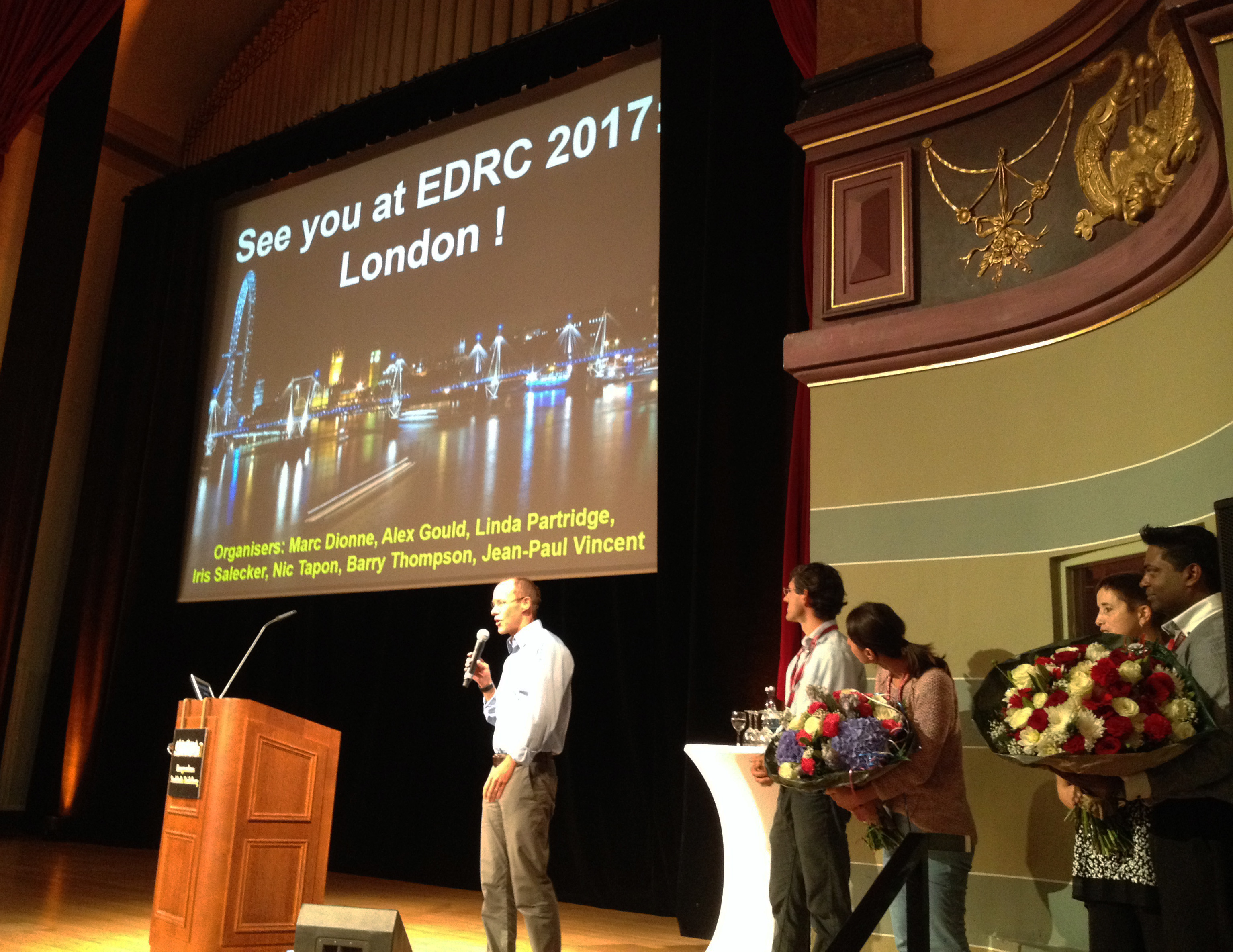
Meeting co-organizer Bruce Edgar reveals the location of the next EDRC 2017 in London
EDRC 2015 co-organizer Bruce Edgar reveals the location of the next EDRC 2017 in London

Poster sessions and lunches with rich German cuisine provided ample opportunity to talk science and catch up with colleagues. The meeting ended with the announcement where the next EDRC will be held: in 2 years time it will be London Calling to all Drosophilists!

Thumbs up (No Ratings Yet)
Loading...

Tags: , ,
Categories: Events, Research