

Temporal cascades are conserved in different neuronal lineages in flies: an interview with Jocelyn Tang and Alex Donovan
Posted by the Node, on 3 November 2026
Neural patterning is vital to ensure the correct birth order of neuron types during brain development. In Drosophila melanogaster, intermediate neural progenitors (INPs) and optic lobe neural stem cells (OL NSCs) give rise to the central brain and visual system, respectively. Despite their different origins and cell lineages, the temporal cascades of INPs and OL NSCs share similarities, there remain gaps in the INP temporal cascade. Jocelyn Tang, Alex Donovan and Andrea Brand use Drosophila larval brains to show that the nuclear hormone receptor Tailless (Tll) has a conserved function as a terminal temporal factor across these two cell lineages. They use genetic approaches to show that Tll is expressed in late INPs and acts as a terminal temporal factor in the cascade, as in the optic lobe. They show that the preceding temporal factor Scarecrow (Scro) activates tll expression, and that Tll represses Scro, showing cross-regulation and defining a temporal window. Tll also represses lineage progression factors hamlet and odd-paired and promotes gliogenesis. Finally, genome-wide binding analysis shows that Tll plays a similar regulatory role during the temporal cascades of INPs and OL NSCs, but also context-specific roles across these neural lineages. Altogether, this study shows that temporal cascades are conserved in different neuronal lineages.
Here we talk with co-first authors Jocelyn Tang and Alex Donovan.
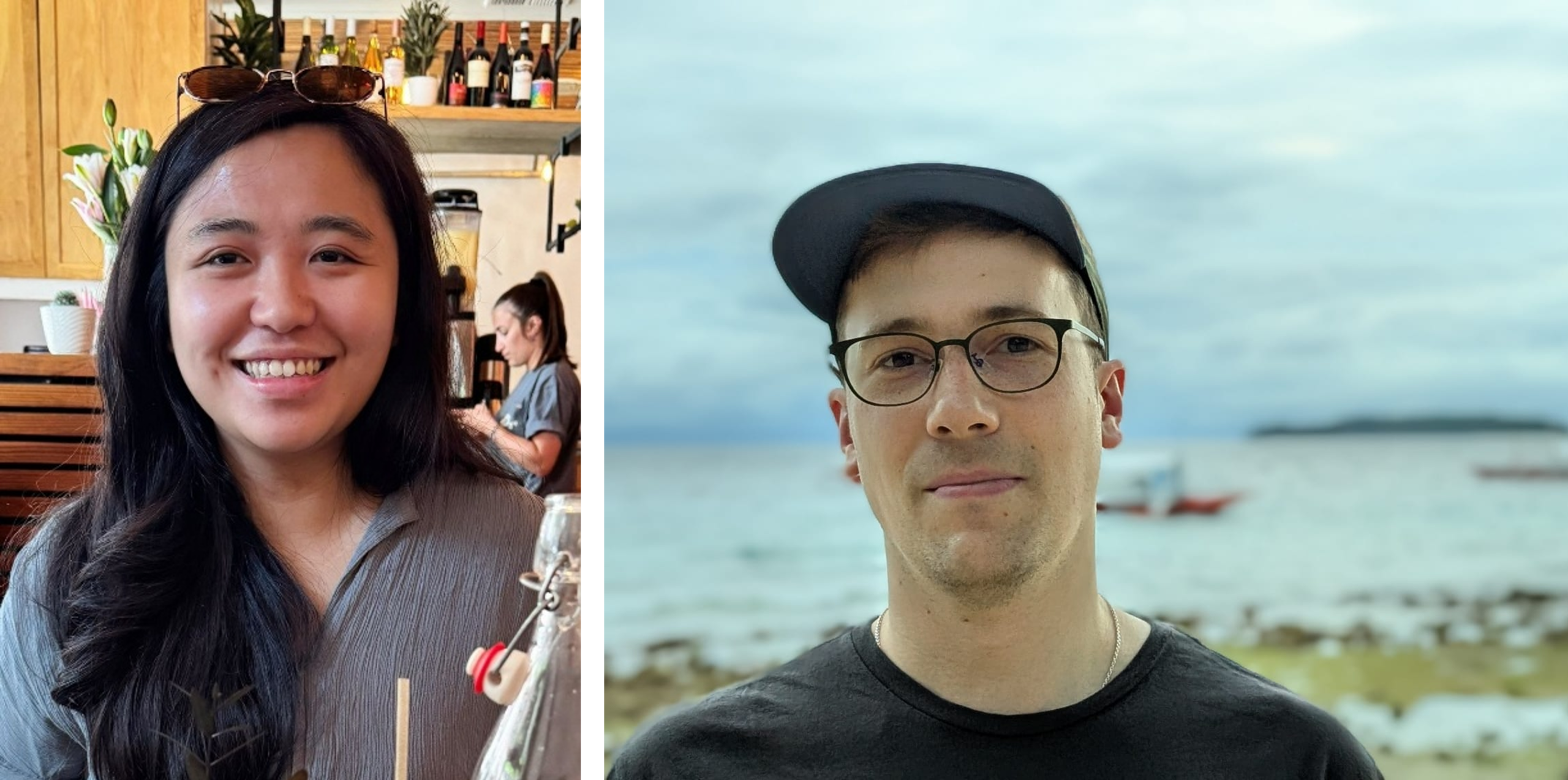
How did you come to work in the lab and what drives your research today?
Alex: During my PhD, I worked on the roles of chromatin remodelling factors in neurodevelopment, which sparked an interest in the epigenetic and gene-regulatory mechanisms that drive development. Towards the end of my studies, Andrea came to give a talk about new DamID methods that her lab had been developing. I was really drawn to these, as their modularity and flexibility could help me answer many of the questions around transcriptional and epigenetic regulation that I had found difficult to get at using the techniques I was working with at the time. I emailed Andrea and after a trip to Cambridge to meet the lab, she offered me a position. Alongside projects in flies, I went on to adapt many of these DamID technologies into systems compatible with human in vitro models, focusing broadly on questions relating to cellular competency and cell state transitions during development.
Jocelyn: I joined Andrea’s lab as a PhD student and was very interested in the topics of neural stem cell quiescence and temporal patterning. I was fascinated by the genetic versatility of Drosophila and the sophisticated experiments you could do with the model. Curiosity drives my research – since my PhD, my research interests have transitioned to studying non-autonomous signalling during neural stem cell quiescence and reactivation, as well as studying developmental mechanisms in the context of tumourigenesis (particularly in glioblastoma).
Can you tell us about the background of the field that inspired your work?
Over the past couple of decades, numerous labs have been steadily uncovering the complex gene-regulatory relationships that underlie the capacity of neural stem cells to change the identity of their neuronal or glial progeny over time. This process of temporal patterning has been particularly well studied in Drosophila neural stem cell lineages, which each have their own cascade of transcription factors that switch on and off over the course of neurodevelopment. In this study, we continue this long tradition of piecing together cross-regulatory relationships of temporal transcription factors, in a less well-defined neural stem cell lineage.
What are the key results of the paper?
The main finding of this paper is that the nuclear orphan receptor Tailless (Tll), is expressed at the end of the intermediate neural progenitor (INP) temporal cascade, mirroring the optic lobe temporal cascade. Tll contributes to the regulation of INP proliferation, with partial effects on gliogenesis. It also functions as a canonical temporal factor, where it is activated by the preceding factor Scarecrow (Scro) and, in turn, represses scro expression. What is interesting is that Tll has diverging roles: it is expressed in the Type II neural stem cells (NSCs) which produce the INPs, where it maintains stemness and cell identity, but in INPs, Tll serves as a marker for the end of the temporal cascade and termination of proliferation. Using a combination of Targeted DamID and NanoDam, we profiled the genome-wide binding targets of Tll in different cell types (Type II NSCs, INPs and optic lobe NSCs), revealing that binding patterns were broadly similar. This suggested that the divergent role of Tll in different cell types may stem from additional cofactors or differences in chromatin accessibility. We also identified an interesting evolutionary observation, in which many of the mammalian orthologues of Drosophila temporal factors define spatial domains in the developing mouse cortex. While temporal patterning is not as readily observed in the developing mammalian brain, the same factors serve to establish spatial patterning instead.
When doing the research, did you have any particular result or eureka moment that has stuck with you?
The eureka moment was actually the start of this research project – we were planning on using tailless mRNA expression as a marker for the Type II NSCs for a different experiment at the time, but when we did the HCR, we noticed that there was always a bit of signal where the INPs were. We initially dismissed this, thinking that maybe the probe we were using was giving a bit of background signal, as all prior literature had reported that tailless was only expressed in Type II NSCs. However, as we were imaging brain after brain, the signal we saw was so clean and consistent, we began to think: “What if this is a real signal?” Once we managed to confirm its expression in the INPs, the project started taking shape quickly, as our previous paper on the INP temporal cascade noted there were actually a lot of similarities between the temporal cascades of the larval optic lobe and the central brain. Based on our observations, identifying the experiments that we wanted to do was swift. It was very satisfying to further add and expand on the observations of our previous work.
Why did you choose to submit this paper to Development?
Development has always been one of the best places to find papers in developmental biology, so the choice was easy!
What is next for you after this paper?
Alex: I am currently continuing on with my interest in gene-regulatory mechanisms in neurodevelopment with an evolutionary twist in Madeline Lancaster’s lab at the LMB in Cambridge.
Jocelyn: I will continue my postdoctoral work in Andrea Brand’s lab, shifting my focus to understanding niche interactions in neural stem cell behaviour during both development and tumourigenesis. I will continue working with Drosophila, but my research has also extended to using human organoid models and patient-derived tumour cell lines.
What do you enjoy most about research, and why?
Alex: I love picking things apart to understand the exact mechanisms of how they work, which probably comes from the massive amount of time I spent as a child taking electronics apart and putting them back together again (sometimes to the dismay of my parents).
Jocelyn: I think science is sometimes a bit like detective work – putting pieces of evidence or observations together, some seemingly unrelated and coming up with surprising findings is always very exciting. The most enjoyable part of research for me is also sometimes the most uncertain – you can start answering one question and by the end be reading about an entirely different field from your own – you’re constantly learning, and research keeps you on your toes.
Let’s move outside the lab – what do you like to do in your spare time?
Alex: I love to travel and spend time outdoors hiking, running and climbing. When indoors, I spend my time going to contemporary art exhibitions, reading sci-fi novels, playing probably too many games and most importantly, sleeping.
Jocelyn: I have recently developed an interest in pottery and have been honing my skills at the wheel. I used to go horse riding often but now since I have moved to America, I have combined this hobby with a fascination in cowboys and the Wild West. Yeehaw!
Tell us something interesting about yourself that wouldn’t be on your CV.
Alex: I used to be a competitive fencer and competed all over the world with the national team.
Jocelyn: I love reading about fashion history and know excessive details about 17th-century fabrics.
Get involved
Create an account or log in to post your story on the Node.
Sign up for emails
Subscribe to our mailing lists.