The programme (http://www.grc.org/programs.aspx?id=11170) covers a wide a range of exciting subjects such gene regulatory networks, mechanics, stem cells, regeneration, organoids, and evolution. The conference will be preceded by a two-day symposium designed exclusively for students and post-docs.
As some readers will already be aware, we have recently introduced a new ‘format-free’ submission policy. We’ve been delighted by the early feedback on this – from what we’re hearing, this has been a popular move and will help make life easier for authors submitting to Development. But what do we mean by format-free and how does it differ from our earlier policy?
Now, when you submit your paper to Development, you don’t need to worry about specific formatting requirements for the journal – we don’t care if your references are not in Development style (they can even be numbered), whether your materials and methods section comes after the introduction or the discussion, or whether you’ve provided the figures in the format that we need for final publication. We hope this should make things easier for all authors, but particularly for those submitting to Development after their paper has been considered elsewhere; while we like to believe that all our authors select Development as their first choice of venue for publication of their work, we are realistic and recognise that at least a few of you might already have tried another journal first! In general, we don’t see the value in asking you to reformat (or just format) your paper in our house style before you know whether it is likely to be accepted for publication with us. Instead, we want to remove as many of the hurdles to submission as we can and make the whole process as quick and smooth as possible.
So what do we need at initial submission? The most important requirement we still retain, and one that we recognise will not be universally popular, is a length restriction. Research articles over 7000 words and Research reports over 3000 words (excluding title page, abstract, reference list and, now, materials and methods – more on which below) will be returned to authors with a request to shorten the paper to within this limit. We make this a requirement because we believe that length limits serve a valuable purpose – to ensure that a paper remains relatively concise and accessible to the reader. And we have chosen to enforce this guideline at initial submission because, in our experience, papers tend only to get longer during the revision process, meaning that it will become even more difficult to meet these limits at a later stage in the process. In exceptional cases, and following consultation with the handling editor, we may be able to consider papers that exceed this length, but we generally believe that it should be possible to write your paper in a way that does not run over this limit – and that this will make the paper a better read upon eventual publication.
We will also return your paper before sending it to the editor if text or figures are unreadable following conversion to PDF (although this is rare), and we may also ask you for a smaller PDF if the file is too large to be easily handled by editors and referees. In addition, we may have to delay assigning your paper to an editor if we can’t confirm the identity of your co-authors. You might be aware that a few journals (fortunately not us) have encountered problems with corresponding authors submitting papers with fake email addresses for their co-authors, allowing them to circumvent the normal checks that ensure that all co-authors are aware of and approve the paper and its submission. Therefore, where non-institutional (e.g. Gmail) addresses are provided, we will query these with the corresponding author and request either institutional email addresses and/or ORCID IDs. We are sure you understand that it is important we make sure all authors are kept fully informed of the status of their work, and hence why this is an essential check to keep at first submission.
With these changes, we hope to make initial submission to Development as easy as we can. In fact, we were already operating on a largely format-free basis before the announcement of this policy, but we have further relaxed our guidelines with this latest set of changes. We will, however, ask that you ensure your paper complies with our formatting guidelines at revision stage – should your work meet with positive assessment from our editors and referees. At this point, we will also require you to fill in our submission checklist – confirming that your paper complies with various policies and best practise guidelines – to provide high-resolution versions of the figures that our graphics team can process for publication, and to tell us about your funding bodies. Given that, according to recent statistics, we accept over 95% of papers where we have invited a revision, we hope that you won’t mind taking the extra time to format your paper at this stage, when you know the chances of eventual acceptance are very high.
The other significant change we have made, as alluded to above, is to remove the materials and methods section from our word count. The aim here is twofold. First, we want to give you a little more flexibility with article length – the total word limit remains the same even though we now exclude the materials and methods. Second, and more importantly, we recognise the importance of this section of the paper and want to encourage authors to provide appropriate details of all experimental protocols. Length limits often mean that methods sections simply cite previous papers, which cite even earlier papers, so that a reader can find it impossible to figure out how an experiment has been conducted. We would prefer that methods be provided in greater detail, allowing readers to fully understand the protocols. Where materials and methods are particularly lengthy, we will still encourage some of this information – additional details that are primarily of interest to the real expert in the field or to those wishing to replicate the experiments – to be provided in the supplementary information, but again we will not enforce this at initial submission and can work with the authors to make appropriate changes at revision stages.
Together, we hope these changes will make the submission process for authors – whether you are submitting to Development as first choice (which of course we hope most of you do!), or have already been elsewhere – a quicker and easier process. As always, we will continue to review these policies as we go forwards, and we welcome your feedback.
Here are the highlights from the current issue of Development:
Getting MAD in meiosis
In meiosis I, homologous chromosomes must pair and form crossovers to ensure appropriate chromosome alignment and segregation. During this process, as in mitosis, the spindle assembly checkpoint (SAC) functions to detect misaligned chromosomes at metaphase. This delays anaphase to enable error correction and induces apoptosis when errors cannot be corrected. Surprisingly, previous studies have suggested that the core SAC component MAD2 might be dispensable during spermatogenesis in mice, but Imrul Faisal and Liisa Kauppi now re-investigate the role of MAD2 in male meiosis (p. 1988). Using mouse models in which either all chromosomes (Mlh1 mutants) or just the sex chromosomes (Spo11β-only mice) show defective crossover formation, the authors look at the consequences of Mad2 heterozygosity on spermatocyte apoptosis and aneuploidy. While Mad2 heterozygosity does not rescue sterility of Mlh1 mutants, suggesting that the checkpoint is still active in this context, it does partially rescue apoptosis in the Spo11β-only mouse, resulting in low-level sperm aneuploidy. These data provide the first evidence that MAD2 is important for efficient SAC activation in spermatocytes, and suggest that cells with relatively mild chromosome crossover defects are more sensitive to MAD2 levels than those with severe defects.
Growing a labyrinth with G9a
Defects in placental growth and patterning can have severe consequences for foetal health, and can cause intrauterine growth restriction (IUGR). However, relatively little is understood about the mechanisms regulating placental development, particularly the later phase of maturation when the blood vessels of the so-called labyrinth elongate and elaborate. On p. 1976, Paul Delgado-Olguin and colleagues show that the histone methyltransferase G9a is required for placental maturation. Endothelial-specific knockout of G9a in mice has no effect on early placental development, but mutants show severe defects in labyrinth size and structure after mid-gestation, owing to reduced proliferation of endothelial cells. Intriguingly, the authors provide evidence for non-autonomous regulation of trophoblast cell proliferation, which is upregulated in the endothelial-specific knockout. G9a conditional mutants show reduced expression of Notch pathway effectors (previously implicated in regulation of placental maturation), and the placental vessel phenotype can be rescued by activation of the Notch pathway. Thus, G9a is a key regulator of placental maturation in mice, regulating the balance of endothelial versus trophoblast proliferation. Notably, this mechanism may also apply in human, since G9a and Notch pathway components show altered expression in samples from IUGR pregnancies.
Wheat domestication: Q is the answer
Domestication of wheat has involved a number of phenotypic changes from wild isolates. Notably, domesticated varieties possess a subcompact spike and a loss of the tough glumes that protect the grain, leading to a free-threshing phenotype. Several genetic determinants of these characteristics have been identified, including the Q gene, which encodes an AP2-like transcription factor. Cultivated wheats generally have the hypermorphic Q allele, whereas wild varieties have the q variant, associated with lower AP2 activity. It is known that AP2 factors can be regulated by the miR172 miRNA, and that Q bears a mutation in the miR172 binding site, but how this putative regulation affects the phenotypes associated with domestication has been unclear.
Two papers in this issue of Development address the regulation of Q by miR172. Steve Swain and colleagues (p. 1959) isolate a new allele of Q, Q’, which results in higher protein abundance due to impaired miR172-mediated targeting. Through analysis of Q’ and induced revertants, the authors show that higher levels of AP2 activity are associated with the formation of ectopic florets in place of glumes – an apparent homeotic transformation in the spike. Similar results are also presented by Jorge Dubcovsky and co-workers (p. 1966), who further demonstrate that reduced miR172-mediated degradation of Q is largely responsible for the free-threshing and other phenotypes associated with domesticated varieties. The relative levels of miR172 and Q define spikelet morphology, with higher Q or lower miR172 activity being associated with glume-to-floret transition and free-threshing character, and lower Q activity with the opposite changes. Moreover, a gradient of miR172:Q levels along the spike is associated with a gradient of homeotic changes.
Together, these two papers convincingly demonstrate that tight regulation of Q by miR172 is important for the acquisition of free-threshing character in domesticated wheat varieties, and help to resolve prior controversies as to the mechanism underlying the Q phenotype. These studies also add to our understanding of how AP2 factors regulate floral patterning in plants.
Video Highlight
On p2070, Brant Weinstein and colleagues describe generation of a zebrafish transgenic line expressing GFP in lymphatic vessels allows visualization of the developing lymphatic network, demonstrating a stereotyped, stepwise assembly.
Hiroshi Hamada, director of the RIKEN Center for Developmental Biology, talks about his career in Japan and North America, his fascination with left-right axis determination and his love of Irish music.
This Review discusses the diverse epithelial cell behaviours involved in small neurosensory organ development, using dental placodes, hair follicles, taste buds, lung neuroendocrine cells and lateral line neuromasts as examples.
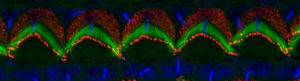
How do we perceive sounds, gravity or head movements? It all starts during development, when sensory cells in the inner ear acquire a crown of motion detectors known as the stereocilia bundle. The Tarchini laboratory investigates the molecular mechanisms that corral and layer stereocilia into a functional bundle, a highly polarized architectural process that, when defective, results in deafness. (http://tarchini-lab.org).
We are seeking a Postdoctoral Associate interested in dissecting how G protein signaling controls and coordinates two features essential for hearing and balance ability: 1) the striking alignment of hair cells along the epithelial plane (planar polarity), and 2) the staircase-like architecture of the motion-sensor compartment of hair cells, the stereocilia bundle.
Required qualifications include a recently obtained PhD in Developmental or Cell Biology, Neuroscience or a related field. Expertise with inner ear Biology and mouse genetics is desired but not required
The Jackson Laboratory (http://www.jax.org) in Bar Harbor, Maine, USA, is recognized internationally for its excellence in research, unparalleled mouse resources, outstanding training environment, and exceptional core services – all within a spectacular setting adjacent to Acadia National Park. The Tarchini lab is currently funded with an R01 grant from the National Institute on Deafness and Other Communication Disorders (NIH NIDCD; https://www.nidcd.nih.gov) and support from The Jackson Laboratory.
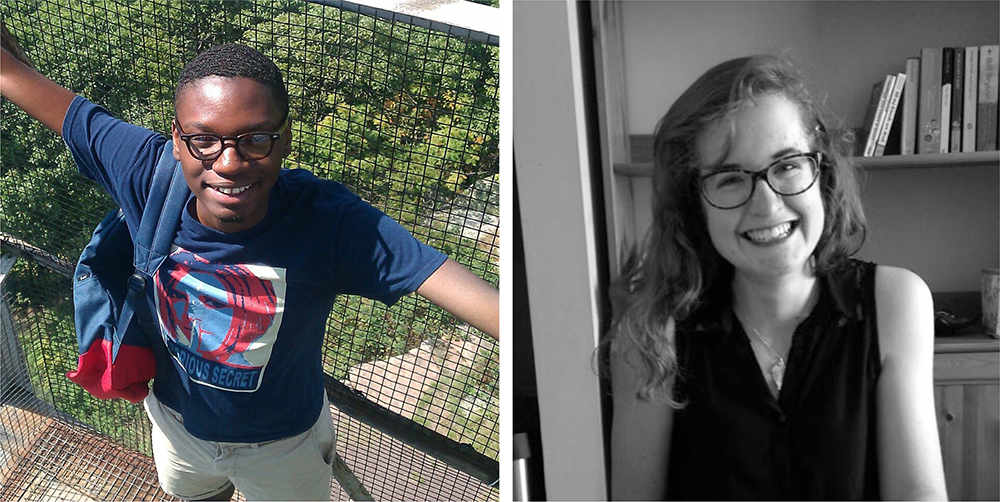
Each year, the British and US societies for Developmental Biology have their annual meeting, the BSDB‘s usually in April, the SDB‘s usually in July. The winner of the student poster prize in each of the meetings gets the chance to go to the other society’s meeting the following year. Beginning in 2012, the Node began getting the winners together for an interview chain, and the tradition is continued here with the SDB’s 2016 poster winner Yusuff Abdu (from Jeremy Nance’s lab, NYU; Yusuff was interviewed last year in Boston by Mathew Tata) interviewing the BSDB’s 2017 winner Claire Bromley (Jon Clarke’s lab, Kings College London).
What’s your favorite model embryo other than zebrafish and why?
I would have to say Drosophila. Their genetic tractability and possibilities for live imaging during embryogenesis make them an excellent system to understand many things, including early development – a topic that I am fascinated by.
Tell us more about the work in your lab.
In Jon’s lab we are working to understand the processes that make and shape a neuroepithelium and make and shape neurons. We use the zebrafish neural tube as our model. I’m working on how you shape the neuroepithelium. There are many complex cell rearrangements that occur. For example, cells from each side of the neural primordium initially interdigitate before rearranging to meet at a distinct, straight left-right interface. I’m currently investigating the role of biomechanical forces during this process. We hypothesise that there is a ‘tug-of-war’ between these two columns of neighbouring cells that acts to position the cell interfaces at the tissue midline. By cutting the ‘rope’ between cells we can measure how far they ‘fall back’. This gives us an idea of how hard they were pulling on each other, allowing us to reveal intrinsic forces. I’m now trying to use light to interfere with these forces to understand their function.
Imaging must be an important part of your project. What challenges have you faced and how did you solve this problem?
To be able to perform laser cuts in the densely packed neural rod, we had to trial a variety of techniques to find one that gave reproducible cuts coupled with rapid imaging post-cut. I found collaborating with Conny Schwayer and Carl-Philipp Heisenberg who have a UV laser on a spinning disk scope the best way to go. This also gave me several trips to Vienna! We optimised UV laser cuts and have been able to gain interesting insights into the forces present in this complex 3D structure.
What questions in brain development do you find most intriguing?
I am intrigued by the early formation of shapes and patterns during development – and not just in the brain! It’s amazing how single cells go on to form functional organisms in a highly reproducible fashion. All the research projects that I have worked on so far have focused on understanding early events during embryogenesis, whether through the lens of symmetry breaking or shape changes.
Along the same line, what do you plan to work on in the future?
I am most excited by work at the interface of biology and physics. Morphogenesis is intrinsically a mechanical process in many ways, and I feel that important discoveries in this area can be made through collaborations between biologists and physicists. As a biologist I have learnt a lot from physicists – and I hope to continue to do so in the future.
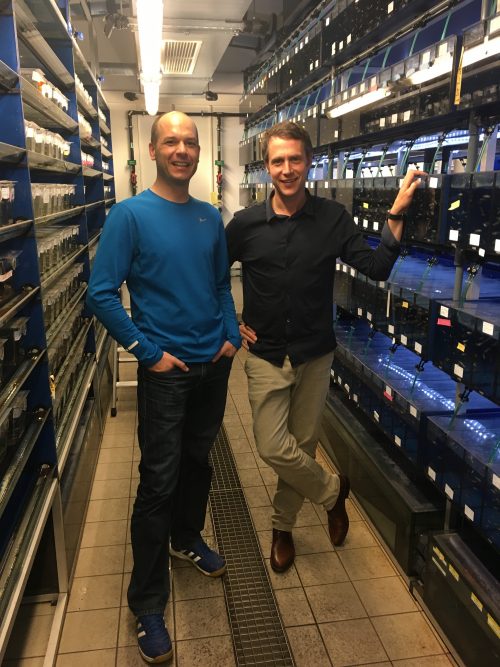
Cell sorting is a critical process during development, as differently specified cells are segregated to the right parts of the embryo. Differences in cell adhesion and cortical tension are thought to be crucial to this process, but the mechanics have been difficult to probe in vivo. This week’s paper, published in the current issue of Development, argues that directed migration – rather than differential tissue surface tension – drives cell sorting during zebrafish gastrulation. We caught up with lead author S.F. Gabriel Krens and his supervisor Carl-Philipp Heisenberg, Professor in the Institute of Science and Technology in Klosterneuburg, Austria.
Gabriel (left) and Carl-Phillip (right)
Carl-Philipp, can give us your scientific biography and the key questions your lab is interested in?
CPH I studied Biology in Munich, did my PhD in the lab of Christiane Nüsslein-Volhard, in Tübingen/Germany and worked as a postdoctoral fellow in the lab of Steve Wilson in London/UK. I started my own lab at the MPI-CBG in Dresden/Germany in 2001 and moved from there to the newly founded IST Austria in Klosterneuburg/Austria a few years ago.
And Gabriel, how did you come to join the Heisenberg lab?
During my PhD I was introduced to work with zebrafish in the research group of Prof. Herman Spaink and my supervisor Dr. Ewa Snaar-Jagalska at the University of Leiden (NL). The focus of my work was more to understand the role of MAPKs in development. Since the importance of these proteins in early embryonic processes, I was also soon exposed to the work of Carl-Philipp and I got very much interested in the multi-disciplinary approach that he was taking.
I met him for the first time in person at ‘the zebrafish conference’ in Dresden, and after a second visit later to the MPI-CBG in Dresden, I knew that this was the place I wanted to go to, to do my postdoctoral research. After finishing my PhD, I joined his lab for my postdoctoral studies, and later also moved with him to I.S.T. Austria.
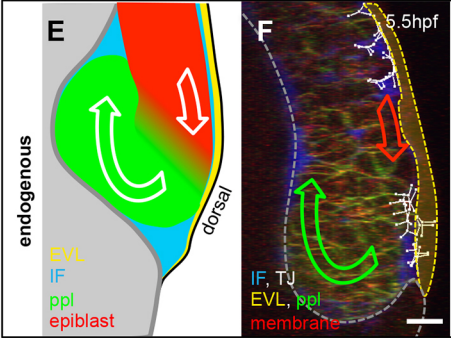
Mesoderm internalisation at the onset of gastrulation from Figure 1, Krens, et al. 2017
Can you give us the key results of the paper in a paragraph?
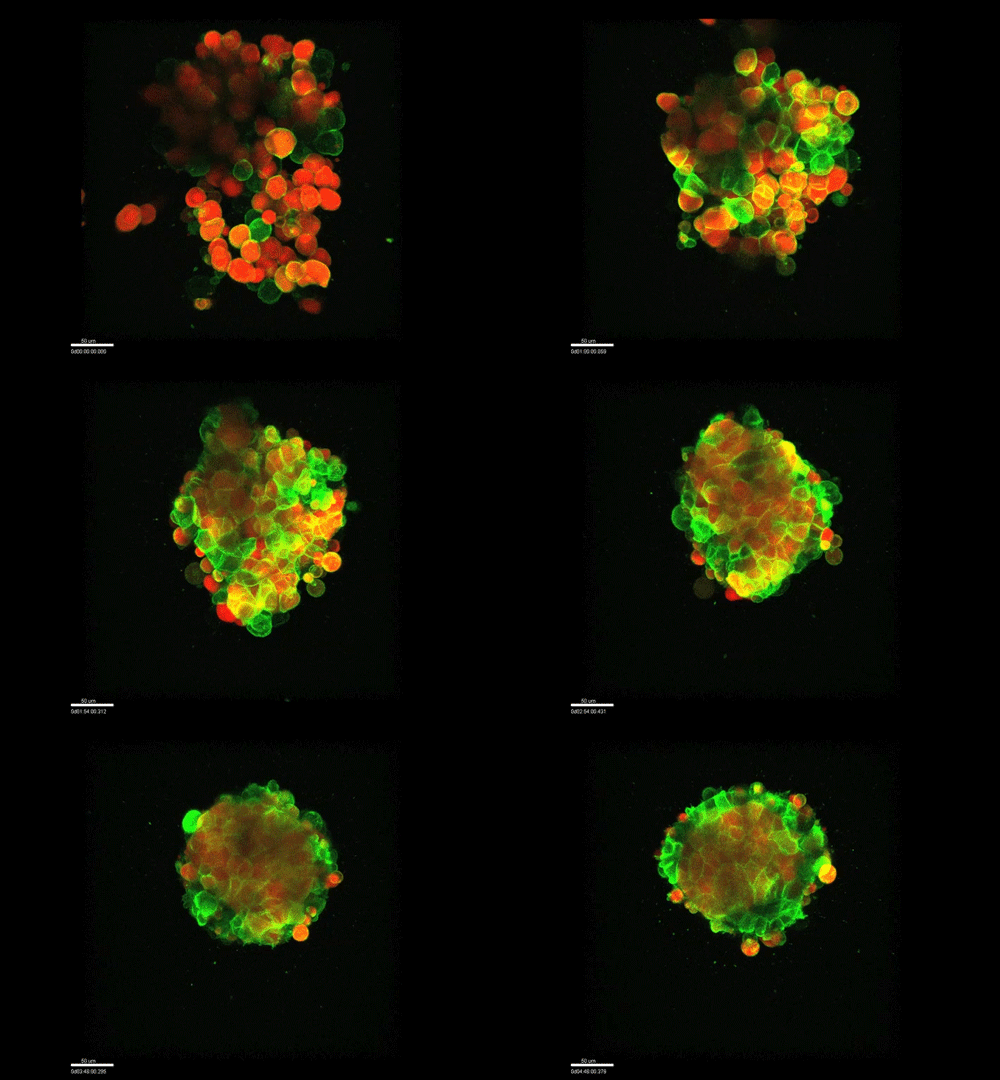
GK One of the key results in my opinion is there was only very little known about the role of the interstitial fluid – in particular in early development. Many interpretations therefore have been drawn on the interaction that different cells display toward each other, without taking into account their direct ‘liquid’ environment of their physiological context: the developing embryo. This notion only appeared to me after performing quite a number of experiments in vitro and trying to understand the differences of germ layer organization between the in vitro data and in vivo gastrulation processes. In addition, I got the chance from Carl-Philipp to visit Wayne Brodland in Waterloo (Canada) and Wayne told me back then that he knew how to extract interfacial tensions from images based on his DITH hypothesis, but that he lacked the experimental data to do so. I had been optimizing the imaging of our cell sorting assay in vitro to the point that we could record on a cell-membrane resolution that would allow us to extract interfacial tensions. After obtaining our first results on experiments performed in culture, I was excited to test the CellFIT-3D in vivo, but we were missing this 3rd ‘liquid’ interface. I noticed that there were gaps between cells in the developing embryo. It did not take us long to consider that these cavities were not empty, but rather fluid-filled (IF), and that we should take this additional fluid interface into consideration too for our tension analysis. Ever since, we have been tightly collaborating with Jim and Wayne to develop the technology, improve image quality and to get to a level of biological understanding of the differences in interfacial tension relationships in vitro and in vivo to the point that we thought was ready to be published.
What made you decide to look at osmolarity in the first place? Is it an underappreciated variable in culture experiments?
GK We already knew for quite some time that the interfacial tension distributions that we found in vitro were not able to explain the behaviour of what we see in vivo. We tried many approached to find out what was different, and one of them was to use the poky mutant fish line from Daniel Wagner. These fish have a defective enveloping layer and are therefore quite susceptible to osmotic variation of the embryo culture medium. By experimenting with this, we discovered that we could actually influence the germ layer organization in these fish by only altering the embryo medium. So far, we were not able to extract tensions in these fish, as the dye to label the IF diffused out at the moment of gastrulation initiation, but this was the main motivation to try to characterise the osmolarity of IF of early zebrafish embryos.
Cell sorting in heterotypic cultures of ectoderm and mesoderm progenitors. Movie 1 from Krens, et al. 2017
And how do you think osmolarity might influence cell behaviour in your experiments?
GK It is well known that cells respond to osmolarity, and that there is an immediate / short-term response and a long-term response. Changing the osmolarity will change the osmotic pressure and subsequently the hydrostatic pressure in the cells. This hydrostatic pressure needs to be compensated, which can occur by an increase of contractility of the actomyosin cortex and by changing the composition of the cytoplasm / metabolism. On long term – it is likely that also regulators of cytoplasmic composition, such as ion-channels, aquaporins and metabolic regulators, are involved in the process. This would be a nice area to follow up on.
Do you have an idea about the cues that direct the mesendoderm progenitor migration during internalisation?
GK I think that this is an open question in the zebrafish that stands out already for a long time. I find it more and more difficult to believe that we have missed out on that one components in all previous molecular and genetic screens that have been performed so far. On top of that, there as been numerous attempts, and so did we, to find THE cue that directs mesendoderm progenitor cells to the embryonic interior. Therefore, I am starting to believe that this might be more a generic factor, such as the embryonic layout, rather than one single guidance molecule. As we discuss at the end of our manuscript, this could also distribution of IF, as this seems to form gradient at the onset of gastrulation. At this moment this hypothesis goes more toward speculation that anything that is build on data!
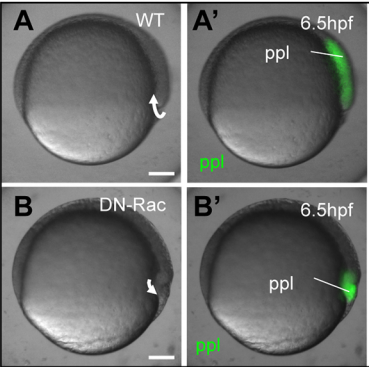
GFP-expressing ppl progenitors in wild type and DN-Rac conditions, from Figure 4, Krens, et al. 2017
When doing the research, was there a particularly exciting result or eureka moment that has stayed with you?
GK During this work, there were quite some eureka results, as we had to overcome a significant amount of technical and intellectual difficulties. But we definitely had a couple of very good moments: The matching simulations output with the CellFIT found to the experiment; the osmolarity rescue experiments in vitro; the DN-Rac data I still find rather stunning as this was an experiment with low hope and a surprisingly awesome result; but most special is the moment that we managed to both extract and measure IF osmolarites, as this is a rather challenging set of experiments that need to come together perfectly to get it to work.
And what about the flipside: any moments of frustration or despair?
GK As mentioned before, we have tried quite some approaches, which all had their challenges. The whole study took pretty long and that means that there were also times that things did not go so smoothly of course and that many things failed or that we got quite some experiments to work with nice supportive data, but that did not make it in the manuscript. We also moved labs in between – which also did not simplify matters – but I am really glad with the final result of the work.
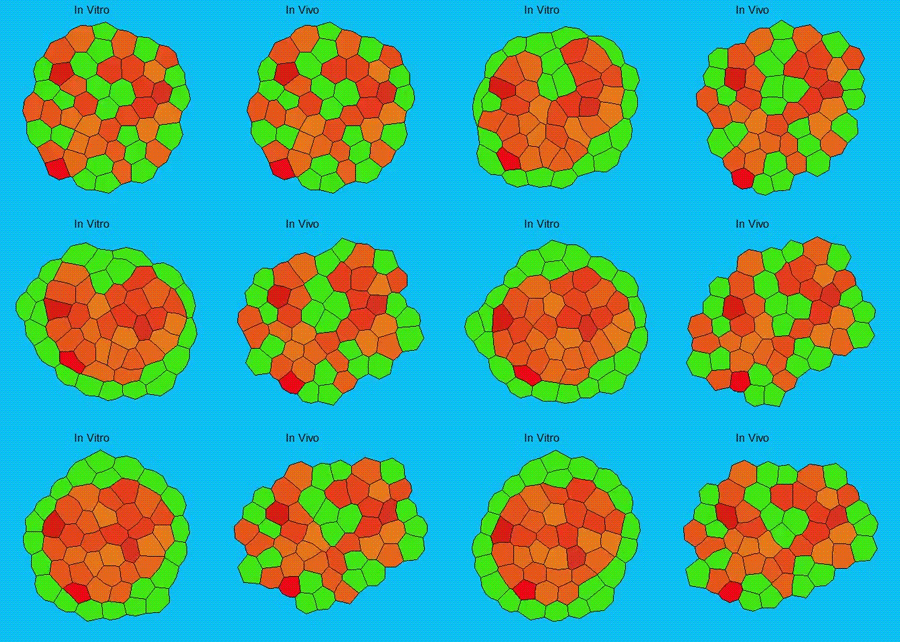
Finite Element simulations of progenitor cell sorting using relative interfacial tension distributions determined in vitro and in vivo. Movie 4 in Krens, et al. 2017.
What next for you following this work?
GK Momentarily I am turning my focus to the more technical part of the lab-work that I have been doing. We needed to do quite some ‘expert experiments’, which also demanded quite some manual annotation of image data. Automation of the (image-)analysis of these experiments will be beneficial to a lot of my colleagues. I will also find it really interesting to further get to know if there is a specific component in the IF that might effect cells to have physical properties: what is the composition of IF, how is the composition regulated and I remain curious to find out why mesendodermal germ layer progenitor cells actually end up at the inside of the zebrafish gastrula.
And where will this paper take the Hesienberg lab?
We got particularly interested in understanding how interstitial fluid is accumulating within the early zebrafish blastula, and whether this accumulation is important for cell/tissue morphogenesis and cell fate specification during gastrulation. Our preliminary data clearly support a model where differences in the osmolarity between the inside and outside of the embryo trigger interstitial fluid accumulation and we are currently trying to find out how this affects gastrulation.
Finally – what do you get up to when you are not in the lab?
GK People who know me, know that I do not have to think long to give a reply to this question: I am a passionate mountain biker. The fact that we moved closer to the mountains is a big bonus for someone that come from a country that is know to be extremely flat and below sea level. Besides that, I do some running and drawing.
A postdoctoral H2020 funded position is available, to develop a deeper understanding of the relevance of in vivo Drosophila models to study pathologies of disease, within Acies Bio – a research driven biotech company based in Slovenia.
We welcome applicants who hold a PhD in a relevant subject, or are nearing completion. A successful candidate would be an independent researcher, experienced in disease model development: particularly in vivo models in the fruit fly Drosophila melanogaster. Expertise in molecular biology model development, phenotypic characterisation, and candidate compound efficacy evaluation is desirable. The Innovation Associate will be responsible for developing and implementing phenotypic assays on existing disease models as well as generating new models for disease.
The researcher will have access to state-of-the-art facilities and work in an international and interdisciplinary setting. The candidate can expect to maintain an active international research profile through publications, academic partnerships and attendance at conferences (including the EDRC 2017). They will also gain insight into commercial aspects of drug discovery research programmes and receive mentorship in the area of intellectual property protection and IP-driven experimental design strategies. This 1 year fixed post will commence on 01/09/17, however there would be a strong, realistic desire towards continuing employment.
This position must comply with MSCA mobility criteria (<12 months work in Slovenia since Sept 2014), and relocation expenses would be covered. The Associate will have the benefit of working in a lively European capital (integration fully supported with afternoon language lessons), and living in an ideally located Central European country with access to the Mediterranean, the Julian Alps, and 4 neighbouring countries. Slovenia has an MSCA country correction coefficient of 86% – reflecting the low cost of living.
For further information and to submit an application for this vacancy visit
Two Post-Doctoral positions are available immediately in the laboratory of Stephane Angers in the Leslie Dan Faculty of Pharmacy (www.angerslab.org), University of Toronto, to develop strategies to inhibit developmental signalling pathways in cancer.
Our laboratory is studying the genetic circuitry important for cancer development to identify vulnerabilities that could be harnessed for the development of new medicine. Our approach involves genome-wide CRISPR functional screens, which we perform in cancer cell lines and primary cells to identify context-dependent fitness genes important for cancer cell growth. Our recent work identified the Wnt receptor Frizzled-5 as being essential for the growth of a subset of pancreatic cancers (Steinhart et al, Nature Medicine 2017). In collaboration with the group of Dr. Sachdev Sidhu we are developing synthetic antibodies targeting Wnt components and other cell surface proteins involved in cancer progression.
We are looking for a highly motivated, self-directed postdoctoral fellow with strong team capabilities. Preference will be given to candidate that recently obtained their Ph.D (less than 12 months) and that have a keen interest to develop and independent research program in the areas of genomics, cell signaling and cancer biology. The ideal candidate will have a strong publication record as a first author in the field of cancer biology with expertise in either organoid models, mouse models, cell signaling or antibody development.
Please submit your application as a single PDF document to stephane.angers@angerslab.org with the following information: a cover letter, statement of interest, and CV with contact details for 3 referees.
The contribution of scientific research in shaping societies is increasingly significant. However, African researchers make up only around two per cent of the world’s academic research community. One of the central problems for African science is poor quality and quantity of research-based education. We believe that basic scientific research could help developing African nations, and we also believe that Drosophila melanogaster – the fruit fly – can be used as a powerful and inexpensive model system to scale-up and improve both post-graduate education and research output in Africa.
The “DrosAfrica” project (www.drosafrica.org) has the aim of training and establishing a connected community of African researchers with the knowledge to be able to use Drosophila as a model system to study biomedical problems. Historical evidence of the power of Drosophila as a research model comes from Spain in the 80’s (see this piece by Alfonso Martinez-Arias for background) where Drosophila transformed the scientific panorama when resources were limited. With this in mind, we have decided that the first aim of DrosAfrica should be to train well-established African scientists to use Drosophila as a model system to study human diseases.
To date, DrosAfrica has trained 57 scientists from many African countries including South Sudan, Egypt, Nigeria, Kenya and Uganda. These efforts have already paid dividends, as various DrosAfrica alumni and collaborators are using the fruit fly in their own labs, such as Profs. Abolaji and Adedeji, and Drs. Vicente-Crespo, Wuyep, and Nyanhom (Box 1). Critically, these scientists are already training the next generation, with multiple PhD and MSc students in their lab leading biomedical projects using the fruit fly as a model.
We believe DrosAfrica can make a substantial contribution in developing and advancing science for sustainable prosperity in Africa. The mission of DrosAfrica is two-fold. Firstly, to help establish a highly skilled community of researchers capable of using Drosophila as a model system to study biomedical problems. Secondly, to develop Drosophila biomedical units with high-quality research facilities that allow African researchers to train and run projects that will impact the biomedical sciences.
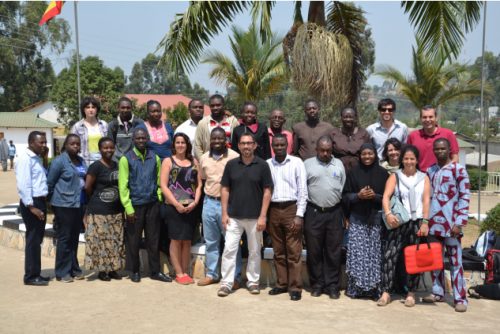
Participants and Faculty of the DrosAfrica2013 workshop at Kampala International University, Uganda.
The Workshop Approach
To achieve our goals, we have adopted an approach that centres on carrying out workshops with world-class researches training African scientists at host institutions. Through a collaboration with Professor Sadiq Yusuf, then at Kampala International University (KIU, Uganda), we organised the first DrosAfrica workshop in KIU for African scientists in 2013, followed by others in Uganda, Kenya and Nigeria. The aim of the workshops is to equip African scientists with all the knowledge and tools required to be able to use Drosophila to study biomedical problems. The workshops are organised to be highly practical and interactive, including hands-on laboratory experiments to compliment the lectures. The 20-25 workshop participants learn about the advantages and disadvantages of Drosophila for biomedical research, as well as how to set-up a Drosophila laboratory. Ultimately, and most importantly, the workshop helps participants to improve their critical thinking and to gain further experience using the scientific method.
Another key aspect of the workshops is to facilitate networking, especially among the African scientists that might be ready to implement in their own institutions the research approaches learnt in the workshop. The topic of the workshops is tailored to the research interest of the collaborating institution, and can range from insecticide resistance and host-pathogen interactions to cancer and neurodegeneration. To identify a host institution for a workshop we either directly contact a prospective institution that we think would benefit from our approach, or a scientist that knows about us (occasionally a previous workshop participant) invites us to organise a workshop where she/he works. After initial discussions by skype or phone, we visit the institution and make further arrangements for the workshop, topics and funding.
Our Thanks To
None of the work by DrosAfrica would be possible without the extremely generous help from various organisations and scientists. The Company of Biologists, who has funded various workshop expenses including the microscopes that are essential for Drosophila manipulation, constantly supports DrosAfrica. We would also like to thank the faculty that has helped us in our efforts over the years. The response has always been remarkable with everyone we approached agreeing to help us. We also thank KIU, The Cambridge-Africa Alborada Research Fund, the International Centre for Genetic, Engineering and Biotechnology (ICGEB), The World Academy of Sciences (TWAS), EMBO, and The Wellcome Trust for financial support. We are also thankful to trendinafrica.org, CamBioScience, the Department of Zoology and the University of Cambridge for support, and St John’s, Emmanuel and Pembroke Colleges (Cambridge, UK) for funds.
Anyone that reads this article is encouraged to visit our website (www.drosafrica.org), and think about ways in which they can help, from their own work and time to any advertisement and financial support.
ASANTE SANA
Box 1. Achievements by DrosAfrica alumni and collaborators
Prof. Amos O Abolaji co-organised and participated in a five-day course at the University of Jos (Nigeria) on the use of Drosophila in Experimental Medicine (2016). In all, about 40 participants attended the event. “My first encounter with this amazing model was during a postdoctoral training at the Federal University of Santa Maria, Brazil. Now in Ibadan, so far thirteen M.Sc. students have successfully used the fly for their projects. We now have a Drosophila lab that can conveniently accommodate 20 students.” Prof. Abolaji is hosting our next workshop at the University of Ibadan, July 2017 (http://ibadan2017.drosafrica.org)
In KIU (Ishaka, Uganda), under Dr. Marta Vicente-Crespo’s supervision (now in St Augustine International University (Kampala, Uganda), two BSc Pharmacy, and two MSc have completed their thesis using Drosophila to study various subjects from toxicity studies to epilepsy and the olfactory system. In addition, she currently supervises three PhD and two MSc students using Drosophila to investigate RNA decay, epilepsy and aging.
Dr. Ponchang Apollos Wuyep, Associate Professor of Applied Microbiology and Biotechnology, Head of Department, Department of Plant Science and Biotechnology, Faculty of Natural Sciences Building, University Of Jos, Nigeria. “My focus is fungal infectious studies. More specifically, to infect Drosophila melanogaster with various virulent Aspergillus sp and then screen for plant compounds that might help the fruitfly to fight the infection…maybe venture into antifungal drug screen. I am working with three students (one MSc, one BSc and one PhD). All these projects got inspired by DrosAfrica”. Dr Wuyep will teach in our 2017 workshop at the University of Ibadan.
Dr. Steven Nyanhom, Chairman of the Department of Biochemistry (Jomo Kenyatta University of Agriculture and Technology JKUAT, Nairobi) is currently using Drosophila in his research. He participated as Faculty in our last workshop in September 2016 at ICIPE, Nairobi.
Prof. Ahmed A. Adedeji. Habib Medical School, Islamic University In Uganda (IUIU), Kampala, Uganda. Currently using Drosophila in his research. He has repeatedly participated as Faculty in our workshops, and he will teach in our next workshop at the University of Ibadan, July 2017.
Mr. Temitope Etibor, former staff of KIU Western Campus, was accepted at the Integrated Biology and Biomedicine PhD program at the Institute Gulbenkian in Portugal. Etibor’s words show that the impact of the workshops goes way beyond the practical skills of working with flies: “The faculty of the DrosAfrica have been very good mentors and wonderful on a personal and career level. I have always been in touch with Martha Vicente-Crespo and Will Wood (members of Faculty) and they have helped me push my career forward in order to make me an excellent scientist. Through the many things I have learnt, I was able to apply for and successfully obtained an FCT PhD Scholarship in Portugal with the support of the aforementioned Faculty. I am so happy to be an Alumnus of the DrosAfrica initiative and I hope they keep receiving funds to aid the cause of research progress in Africa”.
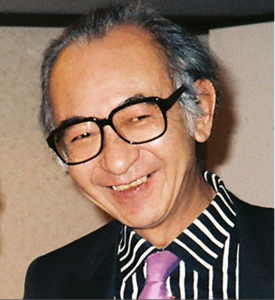
Tokindo S. Okada (here referred to as TSO) was one of the leaders who steered developmental biology in new directions when this field was at its turning point around 1980. He also made invaluable contributions to the creation of a global forum for developmental biologists. He died on January 17, 2017, two weeks short of his 90th birthday; his name, Tokindo, stands for his birth on New Year’s Day of the Asian lunar calendar. Among developmental processes, two of his major interests were in the flexibility of the differentiated state, and in tissue organization from different cell types with different cell-adhesion properties. His own studies and those of researchers from his school created new directions for modern developmental biology in ways reflecting those interests.
TSO was born in Itami in Hyogo as a son of Rihei Okada, an owner of an old sake warehouse, collector/researcher of rare birds and authority on the Haiku poet Basho Matsuo. He thus grew up in a highly cultural environment. During his Konan High School days, he was exposed to contemporary developmental biology using amphibians, as conducted by Hiroshi Takaya. This inspired him to study developmental biology at Kyoto University. The most important elements of his undergraduate and graduate periods were his meeting and marriage to Ei Waki, who stimulated and supported TSO in all aspects throughout the rest of his life.
TSO received his PhD with a focus on tissue interactions in endodermal organogenesis in amphibians (Okada, 1960). Around this period, TSO, together with Ei Okada (by then his wife), visited the laboratories of Conrad H. Waddington at the University of Edinburgh, Department of Genetics (1957-1959), and of James Ebert at the Carnegie Institute of Washington in Baltimore (1964). These visits had a tremendous impact on his life. Studying with Waddington must have broadened TSO’s scope, and working with Ebert made him – in his own words – ‘learn from a wide perspective to organize people’.
As a result of these visits to British and American institutions, TSO was acquainted with leading developmental biologists, and he himself became highly recognized. This also promoted visits from many developmental biologists to TSO in Kyoto, resulting in the formation of an international forum centered around TSO, including Nicole Le Douarin, John Gurdon, Anne MacLaren, Lauri Saxén, Alberto Monroy, Walter Gehring, Volker Schmid, Aron Moscona, Jim Weston and others. TSO took advantage of this forum to help strengthen global liaisons among developmental biologists beyond personal ties. He served as the president of the International Society for Developmental Biologists (ISDB) from 1982 to 1986, and was awarded the Ross Harrison Prize in 1989 for his work on transdifferentiation. In the Asian sector, he also made a great effort to create China-Japan and India-Japan collaborations among developmental biologists.
His long friendships with John Gurdon and Nicole Le Douarin were particularly special. Gurdon first visited TSO in 1962 on his way back to Oxford from the USA via Japan; TSO had already told Ei then that John would eventually be awarded the Nobel Prize. Later, a student from the Okada school, Kazuto Kato, did a post-doc with Gurdon. TSO and his family spent a summer at Woods Hole with Nicole Le Douarin when she had started using chick-quail chimeras, which had a revolutionary impact on developmental biology using avian models (Le Douarin, 1973). TSO and Le Douarin developed a mutual respect and friendship. One of us (H.N.) was the first Japanese postdoctoral fellow (1978-80) to work at Le Douarin’s institute in Nogent-sur-Marne and many Japanese students followed, including Hirohiko Aoyama and Yoshiko Takahashi from TSO’s lab – the latter of whom united many of the ideas of Le Douarin and TSO (e.g. Sato et al., 2002).
TSO was promoted to a full professor at the Department of Zoology in Kyoto in 1967; during this period, he investigated organ reconstitution from dissociated kidney cells (Okada, 1965). This work could be considered a prototype of the currently popular organoid models. However, a real turning point for TSO came when he founded a new laboratory as a professor in the newly launched Department of Biophysics at Kyoto University in 1968. We were the first graduating class of the department. Japanese laboratories at the time were organized by a full professor, an associate professor and a few assistant professors, adopting a style analogous to that of German laboratories. TSO invited Goro Eguchi, who was working on lens regeneration in the newt iris, and Masatoshi Takeichi, who was then working on the lens, to join him as associate and assistant professors, respectively. TSO started investigating cell differentiation and flexibility of the differentiated state.
TSO was fond of the color contrast of dark green and red; his office furniture in the new Biophysics building bore this contrast. His green jacket was his trademark. He once owned a red Alfa Romeo. When TSO appeared at Le Douarin’s institute, they were very impressed by the color combination of his dress as it surpassed their expectations for a Japanese scholar. Thus, his life was rich in dandyism, and its combination with his clairvoyant science charmed his students and many other people.
In the classroom, TSO’s favorite teaching subjects strongly reflected his interests in topics such as transdetermination (e.g. the serial imaginal disc transplantation experiments of Ernst Hadorn; Hadorn, 1968) and tissue segregation (e.g. Malcolm Steinberg’s differential adhesiveness hypothesis; Steinberg, 1970). TSO also wrote many introductory books on developmental biology in Japanese for nonprofessionals, students and professional biologists. These were easy to read, inspiring and fascinating, and spoke of the beauty and mystery of developmental processes. They were rich in new and forward-looking conceptual frameworks. Of course, the flexibility of differentiation and cell-cell interactions for organogenesis always formed the basis of his books.
Inspired by his books, many talented students gathered at the TSO lab. The 10-year period from 1975 to 1984 was the highlight of Okada’s group, not only because of scientific productivity but also in terms of training the next generation of developmental biologists to develop their own unique characters; this became referred to as the ‘Kyoto School of Developmental Biology’. Although only chicken and mouse embryos, and some amphibians, were used in the TSO lab, his broad interests also encompassed areas as diverse as plant development. Graduating students went on to use various organisms in their subsequent careers: cats (Masami Watanabe), zebrafish (Kohei Hatta), medaka (late Kenjiro Ozato), newts (Mitsumasa Okamoto and Shin-ichi Abe), Drosophila (Shigeo Hayashi and Akinao Nose), butterflies (Kazuo Watanabe), nematodes (Kazuya Nomura and Shin Takagi), oligochaetes (Chikako Yoshida-Noro), cellular slime molds (Hideko Urushihara) and Arabidopsis (Koji Goto). Some of his students turned to cell biology (Yasuhiko Tsunematsu, Kei Takahashi, Masamichi Ueda, Kenji Ueda, Kenji Okazaki, Yasuji Ueda, Yasuaki Shirayoshi and Akira Nagafuchi). This diversity reflects the school’s culture that promoted individual interest-oriented choices of organisms and strategies.
TSO devoted himself to the study of the flexibility of differentiated states. As a student, Yoshiaki Ito observed a mass of lens cells that developed in a long-term culture of chicken embryonic neural retina. TSO immediately realized that this represented transdifferentiation from the retina into the lens and started an in-depth analysis of this phenomenon (Okada et al., 1975). He and his student Masasuke Araki identified two different mechanisms by which lens can form from neural retina culture (Araki and Okada, 1977). At early stages (around E3.5), before neuronal differentiation, neural retinal cells behaved like stem cells of all ocular tissues (Okada et al., 1979), whereas at later stages, after retinal cell differentiation (around E8), generation of lens appeared to be genuine transdifferentiation – re-fating of differentiated cells. TSO himself performed many experiments involving retinal cultures and immunohistochemistry. His last series of experiments dealt with the mechanism of lens transdifferentiation from the E8 retina. He found that an approximately 10-day period of spreading culture was required for lens transdifferentiation to occur (Okada et al., 1983). Thirty-five years later, it was shown that the spreading culture condition results in reduction of Notch signaling, which otherwise inhibited the intrinsic lens-generating potential of the neural retina (Iida et al., 2017).
TSO also routinely used mouse teratocarcinomas as a model with which to investigate his interest in the concept of flexible differentiation; this then permitted our use of embryonic stem cells (ESCs) shortly after they were first reported by Martin Evans in 1981 (Evans and Kaufman, 1981). Yoshio Hamada and others from the school made full use of ESCs to knock out their favorite genes. Tadao Atsumi established a monolayer culture line from the embryoid body cell line OTT6050, and this facilitated the discovery of E-cadherin by Masatoshi Takeichi. Although induced pluripotent stem cells were only produced many years later by Shinya Yamanaka, the ideas underlying their isolation had already been introduced to developmental biologists in Japan under the prevailing influence of TSO.
When the cloning age arrived in the late 1970s, TSO was eager to introduce molecular biology to the study of developmental biology. He invited Kunio Yasuda and one of us (H.K.) to join his group as assistant professors, asking us ‘do anything challenging, with the condition that it involves the keywords “genes” and “lens” ’. Yoshiro Shimura provided technical supervision during the cloning of crystallin genes. We were given tremendous liberty, but were subject to monitoring by TSO’s extraordinarily sharp eyes, being told ‘Stop it, it’s trivial’, as soon as we developed irrelevant ideas. One successful outcome was the demonstration that the chicken δ-crystallin gene is correctly regulated in a lens-specific manner in mouse cells, indicating the existence of evolutionarily conserved lens-specific gene regulatory mechanisms (Kondoh et al., 1983). This study developed further, leading to the discovery of Sox2 and Pax6 as interacting transcription factors for the initiation of lens development (Kamachi et al., 1995, 2001), and the identification of the Maf family of transcription factors as essential regulators of lens maturation (Ogino and Yasuda, 1998). The electroporation technique for gene manipulation in chicken embryos was also developed along this line (Nakamura, 2009).
Masatoshi Takeichi, who was then an associate professor, set forth to characterize Ca2+-dependent, trypsin-sensitive adhesion molecules and discovered the cadherins (Takeichi, 1986, 1988), while Hajime Fujisawa (who left the group at an early stage of the 10-year period) later discovered neuropilin and plexin (Satoda et al., 1995; Takagi et al., 1995). Although TSO did not participate directly in the molecular characterization of cell-cell interactions, he successfully furnished his laboratory with an environment to encourage such investigations.
The flexibility of the differentiated cell state is perhaps best manifested during tissue regeneration. Thus, modern studies of regeneration using planarians, pioneered by Kiyokazu Agata and Kenji Watanabe (Agata and Watanabe, 1999), can be regarded as a direct reflection of TSO’s interests. In a similar vein, many researchers who joined the TSO school have developed their individual talents and have been successful in various branches of developmental biology.
TSO had planned to keep the laboratory in Kyoto for several more years, but this did not happen. Haruo Kanatani, the Director of the National Institute for Basic Biology (NIBB) in Okazaki, who had also been a friend of TSO at Konan High School, died an untimely death, and TSO was asked to succeed him. He accepted the NIBB Director position and left Kyoto in 1984. He re-formed a tag team with his former colleague Goro Eguchi, who was by then a professor there investigating pigment cell-derived lens development. TSO compiled studies on transdifferentiation and related phenomena in a volume of Current Topics in Developmental Biology (Okada and Kondoh, 1986), and summarized his work in the book Transdifferentation (Okada, 1991).
During his six years in Okazaki, TSO further promoted international collaborations among developmental biologists; he organized many international meetings on different themes in Japan and other Asian countries. These meetings provided hubs for the interaction of developmental biologists on a global scale during the period when international meetings were less frequent than they are today. The small scale of these meetings facilitated trans-generational discussions among participants from different backgrounds. His dedication toward forming global links presumably compensated for his loss of laboratory activities during the period.
For 10 years from 1993, TSO was the Director of the Biohistory Research Hall in Takatsuki, a newly opened private museum owned by Japan Tobacco, which was located midway between Kyoto and Osaka. TSO, together with Vice Director Keiko Nakamura, enjoyed operating this research museum. The research section covered the embryonic and phylogenetic development of various non-mammalian animals, while the museum section aimed to expose a wide audience – ranging from elementary school pupils to nonprofessional biology lovers – to the wonder and beauty of developmental processes. Different types of exhibitions and small concerts were part of the museum’s events and were an amalgamation of his enthusiasm for science and music. This was a joyful period for TSO, allowing him to fully express his esthetics. In 2007, TSO received the Order of Cultural Merit, the most prestigious award in Japan.
TSO had various and serious interests in subjects other than developmental biology. One example was his collection of longicorn beetles. His most profound interest was in Western classic music, and he wrote many critiques on 20th century compositions. His son, Akeo Okada, is a professor of musicology at Kyoto University. In the same way that various elements of his broad scientific interests were elaborated by his colleagues and students, one of TSO’s talents was clearly passed on to his son.
The life of Tokindo S. Okada was rich, influential and joyful. He was an exceptionally attractive and great mentor. We miss him, but he lives vividly in our memories.
References
Agata, K. and Watanabe, K. (1999). Molecular and cellular aspects of planarian regeneration. Semin. Cell Dev. Biol. 10, 377-383.
Araki, M. and Okada, T. S. (1977). Differentiation of lens and pigment cells in cultures of neural retinal cells of early chick embryos. Dev. Biol. 60, 278-286.
Evans, M. J. and Kaufman, M. H. (1981). Establishment in culture of pluripotential cells from mouse embryos. Nature 292, 154-156.
Hadorn, E. (1968). Transdetermination in cells. Sci. Am 219, 110-114.
Iida, H., Ishii, Y. and Kondoh, H. (2017). Intrinsic lens potential of neural retina inhibited by Notch signaling as the cause of lens transdifferentiation. Dev. Biol. 421, 118-125.
Kamachi, Y., Sockanathan, S., Liu, Q., Breitman, M., Lovell-Badge, R. and Kondoh, H. (1995). Involvement of SOX proteins in lens-specific activation of crystallin genes. EMBO J. 14, 3510-3519.
Kamachi, Y., Uchikawa, M., Tanouchi, A., Sekido, R. and Kondoh, H. (2001). Pax6 and SOX2 form a co-DNA-binding partner complex that regulates initiation of lens development. Genes Dev. 15, 1272-1286.
Kondoh, H., Yasuda, K. and Okada, T. S. (1983). Tissue-specific expression of a cloned chick delta-crystallin gene in mouse cells. Nature 301, 440-442.
Le Douarin, N. (1973). A biological cell labeling technique and its use in experimental embryology. Dev. Biol. 30, 217-222.
Nakamura, H. (2009). Electroporation and Sonoporation in the Study of Developmental Biology. Tokyo: Springer Japan.
Ogino, H. and Yasuda, K. (1998). Induction of lens differentiation by activation of a bZIP transcription factor, L-Maf. Science 280, 115-118.
Okada, T. S. (1960). Epithelio-mesenchymal relationships in the regional differentiation of the digestive tract in the amphibian embryo. W. Roux Arch. EntwMech. Org. 152, 1-21.
Okada, T. S. (1965). Immunohistological studies on the reconstitution of nephric tubules from dissociated cells. J. Embryol. Exp. Morphol. 13, 299-307.
Okada, T. S. (1991). Transdifferentiation. Oxford: Clarendon Press.
Okada, T. S. and Kondoh, H. (ed.) (1986). Commitment and Instability in Cell Differentiation: Current Topics in Developmental Biology, Vol. 20. London, UK: Elsevier.
Okada, T. S., Ito, Y., Watanabe, K. and Eguchi, G. (1975). Differentiation of lens in cultures of neural retinal cells of chick embryos. Dev. Biol. 45, 318-329.
Okada, T. S., Yasuda, K., Araki, M. and Eguchi, G. (1979). Possible demonstration of multipotential nature of embryonic neural retina by clonal cell culture. Dev. Biol. 68, 600-617.
Okada, T. S., Nomura, K. and Yasuda, K. (1983). Commitment to transdifferentiation into lens occurs in neural retina cells after brief spreading culture of the dissociated cells. Cell Differ. 12, 85-92.
Sato, Y., Yasuda, K. and Takahashi, Y. (2002). Morphological boundary forms by a novel inductive event mediated by Lunatic fringe and Notch during somitic segmentation. Development 129, 3633-3644.
Satoda, M., Takagi, S., Ohta, K., Hirata, T. and Fujisawa, H. (1995). Differential expression of two cell surface proteins, neuropilin and plexin, in Xenopus olfactory axon subclasses. J. Neurosci. 15, 942-955.
Steinberg, M. S. (1970). Does differential adhesion govern self-assembly processes in histogenesis? Equilibrium configurations and the emergence of a hierarchy among populations of embryonic cells. J. Exp. Zool 173, 395-433.
Takagi, S., Kasuya, Y., Shimizu, M., Matsuura, T., Tsuboi, M., Kawakami, A. and Fujisawa, H. (1995). Expression of a cell adhesion molecule, neuropilin, in the developing chick nervous system. Dev. Biol. 170, 207-222.
Takeichi, M. (1986). Molecular basis for teratocarcinoma cell-cell adhesion. Dev. Biol. 2, 373-388.
Takeichi, M. (1988). The cadherins: cell-cell adhesion molecules controlling animal morphogenesis. Development 102, 639-655


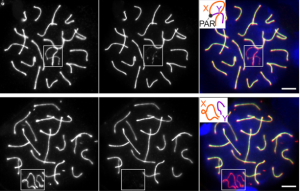 Surprisingly, previous studies have suggested that the core SAC component MAD2 might be dispensable during spermatogenesis in mice, but Imrul Faisal and Liisa Kauppi now re-investigate the role of MAD2 in male meiosis (p.
 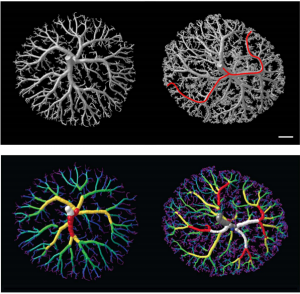 On p.
On p. 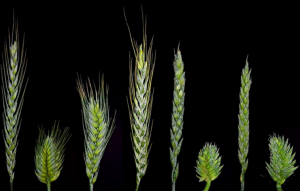 Several genetic determinants of these characteristics have been identified, including the Q gene, which encodes an AP2-like transcription factor. Cultivated wheats generally have the hypermorphic Q allele, whereas wild varieties have the q variant, associated with lower AP2 activity. It is known that AP2 factors can be regulated by the miR172 miRNA, and that Q bears a mutation in the miR172 binding site, but how this putative regulation affects the phenotypes associated with domestication has been unclear.