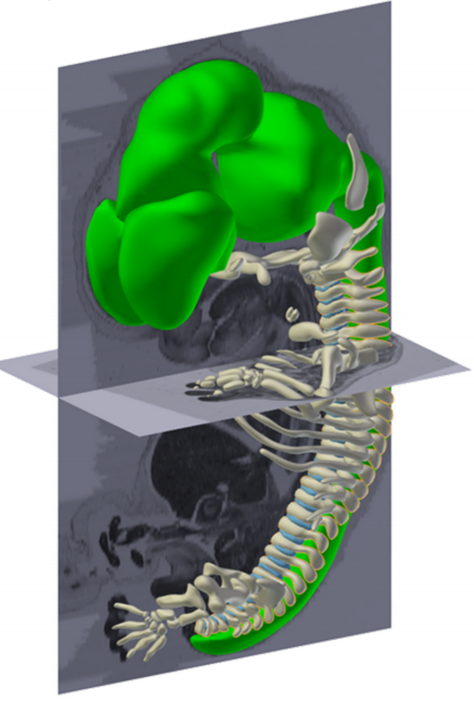
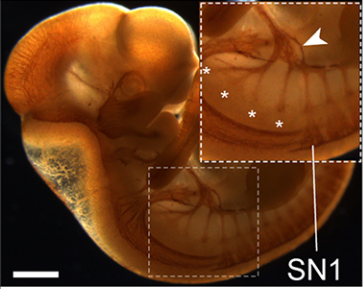
A post-doctoral research associate position in the Department of Zoology, located in Central Cambridge on Downing Street, is available from 1 March 2017 for up to thirty-six months. This is a Leverhulme Trust-funded post, to work with Dr. Andrew Gillis on the embryonic development of gill arch appendages in a cartilaginous fish, the little skate (Leucoraja erinacea).
Cartilaginous fishes possess paired appendages (branchial rays) that project from their gill arches, and over a century ago, Carl Gegenbaur famously proposed that such appendages represent the evolutionary antecedents of paired fins and limbs. We have recently found evidence of developmental parallels between the branchial rays of cartilaginous fishes and the fins/limbs of jawed vertebrates. We now wish to further dissect mechanisms underlying the development of skate branchial rays, in order to test Gegenbaur’s classical hypothesis of gill arch-paired fin serial homology. Duties will include the design and execution of experiments to test for shared embryonic origin, gene regulatory and patterning mechanisms between branchial rays and fins/limbs, and the preparation of results for publication.
The successful applicant should have a Ph.D., completed or completion imminent, in developmental biology, evolutionary biology, comparative anatomy or a related field, with a strong interest in evolutionary-developmental biology. Prior molecular biology and/or bioinformatic training would be beneficial. Skate brood stock is maintained at the Marine Biological Laboratory in Woods Hole, U.S.A., so willingness to travel to the MBL during summer months for experimental work with skate embryos would be beneficial. Enthusiasm, determination and the capacity to work independently are essential.
Further information on this vacancy may be found here.
The closing date for applications is Monday, 23 January 2017. To apply online, please visit http://www.jobs.cam.ac.uk/job/12377/ and click on the ‘Apply’ button. This will route you to the University’s Web Recruitment System, where you will need to register an account (if you have not already) and log in before completing the online application form.
Please quote reference PF10959 on your application and in any correspondence about this vacancy.
The University values diversity and is committed to equality of opportunity.
The University has a responsibility to ensure that all employees are eligible to live and work in the UK.
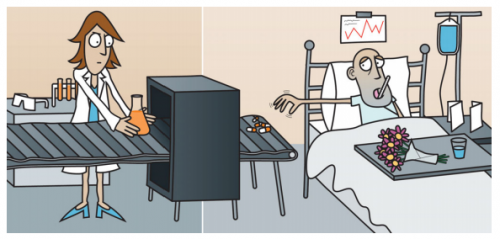
Biomedical research is experiencing what has been termed a ‘reproducibility crisis’. There is much talk about how we can improve the rigor and robustness of our research to increase its value and predictiveness. Many remedies are being discussed, such as increasing statistical power, reducing bias by improving internal validity, fostering transparency by open data policies, and publication of NULL results, among many others. In general, this debate is about increasing the quality of our research. Errors, mistakes and mishaps negatively impact on quality. In a work environment as complex as experimental biomedical research a substantial number of errors may occur on a daily basis, which can jeopardize the quality of our work, and may waste resources, or even endanger personel. Surprisingly, the issue of errors, and how to avoid them, has not yet received any attention in the current ‘biomedical research waste’ debate.
There is no way for professionals to not make mistakes from time to time. What really makes a difference is how we deal with such mistakes. Often mistakes can even teach you that a certain strategy may not be sufficient to solve a given problem. In any case, we do not want to keep repeating mistakes, so we have to learn how to avoid them. However, while this may work for the person responsible for or witnessing a mistake, this information is lost for the surrounding community if not properly communicated. While most people may consider it as helpful to learn from other’s mistakes, they may not want to admit and communicate their own mistakes in front of others. Potential reasons include just feeling ashamed or concerns that a certain mistake may put the own position at risk. So the question is: How can we facilitate the reporting of errors in an open, non-punitive manner?
Systems to report critical errors and incidents were already in place during World War II in order to improve safety for military pilots. Today, critical incident reporting systems (CIRS) can be found in the energy sector, aviation, or clinical medicine. The basic concept of such CIR systems is that they offer a way to report mistakes and (critical) incidents without the need to reveal the identity of the reporter. While CIRS are mandatory in the context of clinical medicine, structured ways to report errors are virtually unknown in the context of academic preclinical research.
We have therefore developed, tested, and implemented a CIRS for biomedical research. The Department of Experimental Neurology, with approximately 100 students, researchers, and technicians, carries out academic research in preclinical biomedicine. At the moment nine workgroups with different research focus, reaching from spinal cord injury to neuroimmunology work in our department, using techniques like cell culture, microscopy, MRI, animal behavioral studies, molecular biology or biochemistry.
We first encountered the challenge how to handle errors and critical incidents in a structured way in 2012 when we the decided to implement a quality management system to improve the quality and validity of our research. The system we choose as a framework was the ISO 9001:2008 norm, which requested a statement on how we handle critical incidents. During the implementation process we learned a lot about quality management (QM) in general, since QM is very rare in academic basic research. We therefore had to adapt and even invent many features of our QM on the go. The development of CIRS for the laboratory environment is a typical example for this learning by doing approach.
Our first version of an error reporting system was paper based, just a form sheet on our pinboard. While this form already covered all necessary questions, it was almost completely ignored by our staff. Trying to understand the reasons, we found out that the paper version was not convenient and more importantly, not confidential enough. Our colleagues were worried that the reported incident could reveal their identity and may put their position at risk. Acknowledging this obstacle, the idea was born to use an online tool, which does not require user specific information, nor requiring or logging any personal information. Since there was no out of the box system available, which met out needs (anonymous, browser based, structured, but not as complex as a medical CIRS), Sebastian Major, a member of our department designed the LabCIRS from the scratch. The source code and a documentation can be found at github.
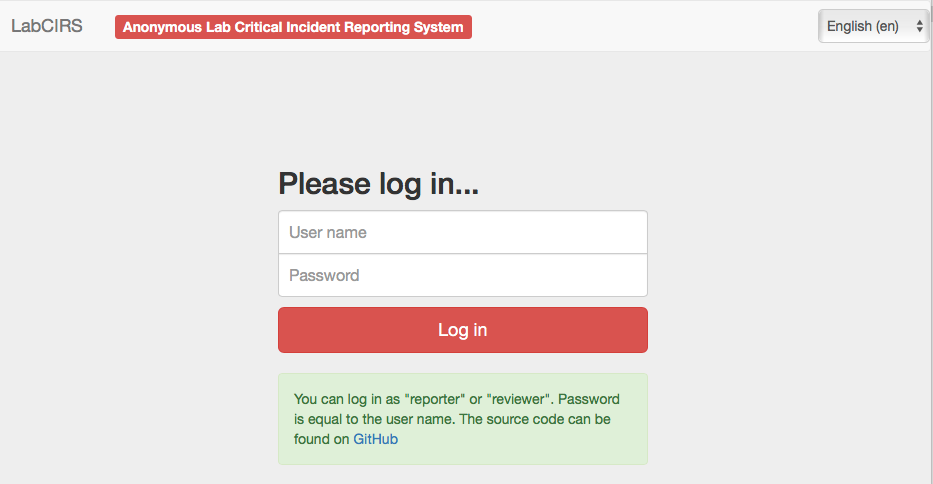
After some fine tuning and beta testing, LabCIRS went online at the end of 2013. This is how it works for the researcher (student, technician, postdoc, etc.): First, one has to log in with a shared login for all department members which does not point to a single user. The system is bilingual (English /German), so depending on their preferences, users can choose the language they feel more comfortable with. After login, the user sees all formerly published incidents and can either search and read through them or report a new incident.
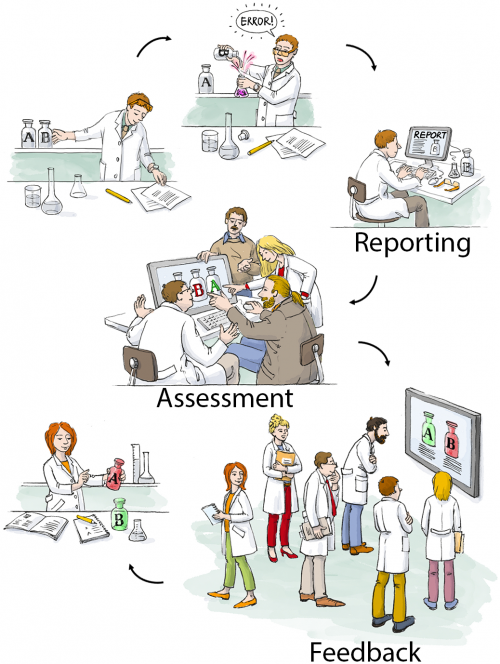
While reporting an incident the reporter can assign a date, describe what happened, and if make suggestions on how to avoid the event in the future. In addition, images can be uploaded, and as a last step, the reporter is asked if the reported incident should be available for all users of the LabCIRS, or reported just to responsible personel.
The reported incident is then checked by a “reviewer” who has privileged access to LabCIRS. This reviewer translates the reported incident and makes sure no personal information is reported. In a next step, the reported incident is internally discussed in our monthly quality meeting with the focus on how the avoid a recurrence of the same incident in the future. Then, if the reporter agreed, it is published inside the LabCIRS, via mail and in addition reported at one of our weekly department meetings.
While it is of course desirable to make all reported incidents available to the public, we found it important to leave this decision to the reporter.
At the very beginning, only about half of the reported entries were cleared by the reporter to be openly published in the department. Over time, however, when it became evident to the reporters that reporting is appreciated and the idea is not to blame anyone, but to learn from mistakes and, if possible, to avoid them in the future, the mindset slowly changed. For more than one year now, all of the reported incidents are cleared for publication. This demonstrates a change in error culture, away from hiding mistakes towards an open discussion and prevention.
Clearly, it is not software which makes people change their minds about quality and error culture, but for us, the LabCIRS was and is a helpful tool helping us in this process.
If you would like to give it try for yourself to check out if this could be useful for you as well, feel free to check it out under http://labcirs.charite.de and download it (or even commit something) at github.
You can find a more detailed report on our LabCIRS in our publication in PLOS Biology.
Here are the highlights from the new issue of Development…the last one of the year!
SETting chromatin state through transcription
Setd5 is a poorly characterised murine member of the SET domain family, generally associated with histone methyltransferase activity. However, the closest homologues of Setd5 are thought to be catalytically inactive, and have instead been associated with the regulation of histone acetylation levels at genes. On p. 4595, Anna Osipovich and colleagues generate Setd5 mutant mice and embryonic stem cells (mESCs). Setd5 homozygosity is lethal, with mutant embryos failing to survive beyond E10.5. Phenotypically, mutants display multiple defects, most notably in the cardiovascular system. Globally, cell proliferation is impaired and apoptosis increased. The mESC system reveals phenotypes consistent with the in vivo observations, including impaired differentiation down the cardiac lineage, while RNA-seq analysis shows that over 10% of coding genes are dysregulated in mutant cells – including key genes involved in cardiovascular development. Setd5 interacts with members of the polymerase-associated factor 1 complex (PAF1C) and NCoR co-repressor complex, the latter of which mediates gene silencing through histone deacetylation. Although the precise developmental consequences of Setd5 ablation have yet to be fully understood, this work suggests that this protein might cooperate with PAF1C and NCoR to mediate co-transcriptional regulation of histone acetylation and gene activity.
A new view on implantation
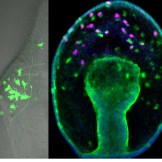
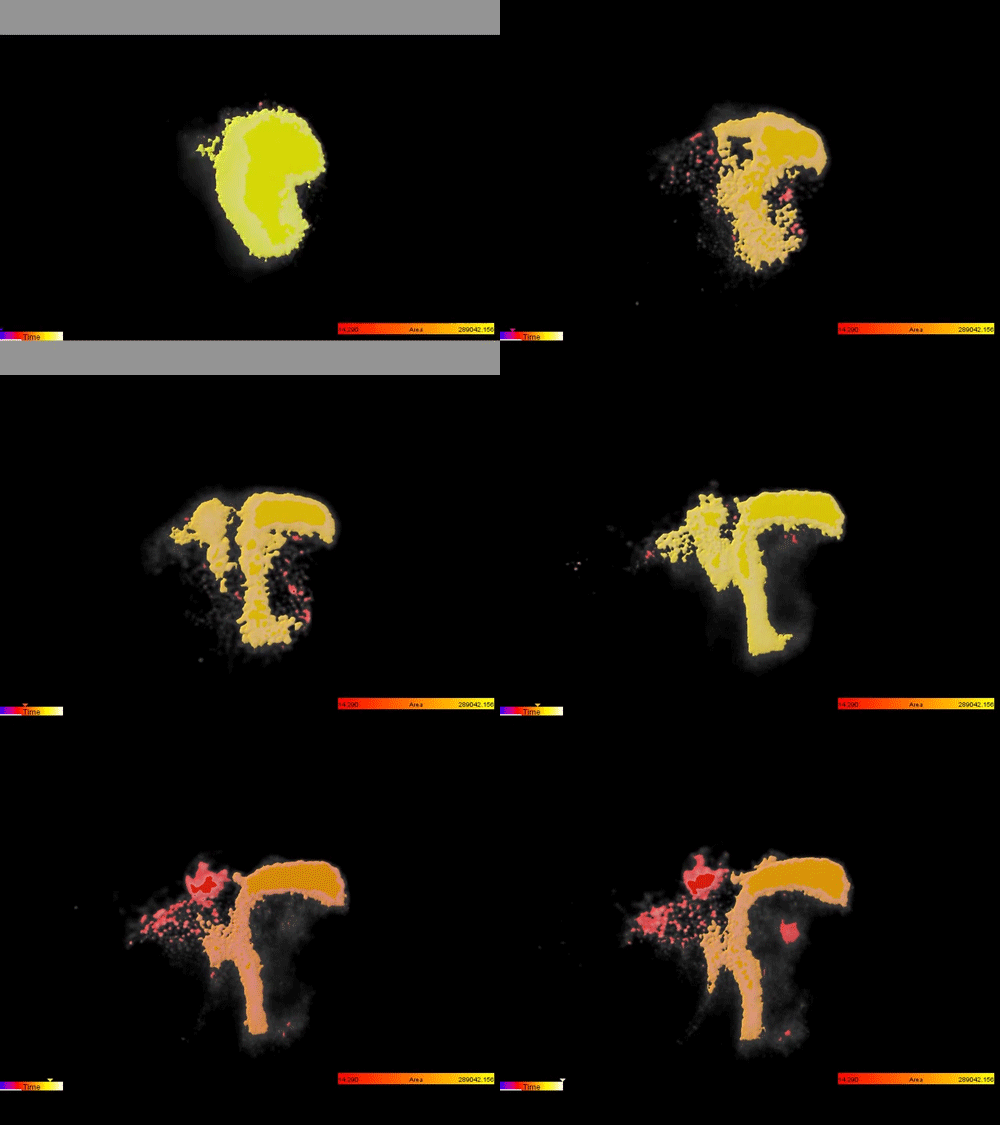
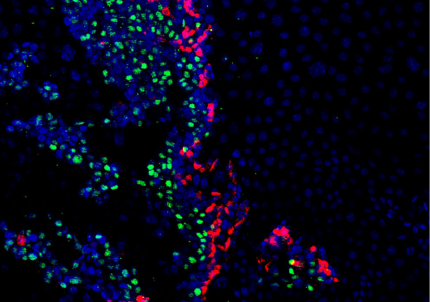
Implantation of the blastocyst into the uterus is obviously a critical step in mammalian development, yet we understand very little about the three-dimensional environment into which the embryo implants. It is known that, in mouse at least, blastocysts attach in uterine crypts, but how these form and whether such structures are also found in human is unclear. Here (p. 4749), Diana Laird and colleagues seek to provide new insights into uterine architecture before, during and after implantation. The authors develop sophisticated imaging and computational tools to characterise the 3D structure of the mouse uterine luminal and glandular epithelium, showing that the pattern of folding alters dramatically prior to implantation, giving rise to folds that overlap with structures described as crypts. Moreover, uterine glands reorient towards the site of implantation and show structural changes. This technology is able to detect architectural defects in mutant animals (such as aberrant luminal folding in Wnt5a mutants) and can also be applied to human uterus samples – as well as, potentially, other organs. This work provides an unprecedented view of the environment into which the embryo implants, and opens up avenues for further analysis of the mechanisms underlying uterine restructuring during early pregnancy.
Sparking regeneration with ROS
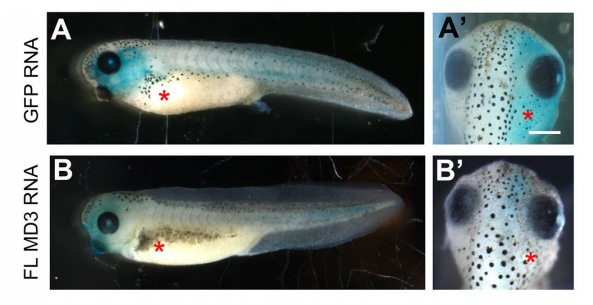
During regeneration, multiple signalling pathways act to coordinate the various processes required to regenerate an injured organ or body part. Both reactive oxygen species (ROS) and electric currents have been shown to modulate regeneration, but how they exert their effects, and whether their activities might intersect, is poorly understood. Here (p. 4582), Fernando Ferreira, Min Zhao and colleagues set out to address the potential interplay between ROS and bioelectric phenomena using the Xenopustadpole tail regeneration model. They uncover a dual role for NADPH oxidases in regulating bioelectric activities: NADPH oxidase-driven electron flow induces membrane depolarisation, while the hydrogen peroxide produced leads to activation of sodium channels in cell membranes of the regeneration bud, with consequent effects on transepithelial potential and electric currents that mediate regeneration. Moreover, external application of hydrogen peroxide can induce tail regeneration during the refractory period in the tadpole’s life – when regeneration is normally blocked – as well as the formation of ectopic tails at injury sites during the regenerative period. Although the mechanisms by which bioelectric activities might modulate the cellular processes required for regeneration still require further investigation, this work links two previously unconnected regulators of regeneration and provides convincing evidence for redox-bioelectric integration in this context.
Robust transcriptional control of multiciliogenesis
Multiciliated cells (MCCs) are found on various epithelia where they drive fluid flow – such as in the airways, the brain ventricles, and the skin of Xenopus embryos. Their differentiation is known to be coordinated by transcriptional regulators such as Multicilin and Gemc1, as well as by the key transcription factor Foxj1, which is also required for cilium formation in cells that produce just a single motile cilium. On p. 4654, Chris Kintner and colleagues identify another transcription factor required for proper differentiation of MCCs – Foxn4. Through an elegant combination of morpholino and CRISPR-based loss-of-function technologies, they show that loss of foxn4 disrupts docking of basal bodies to the cell surface – an essential prerequisite for cilium extension. This phenotype is reminiscent of the foxj1 phenotype, except that it largely recovers over time and that foxn4 has no apparent effect on cells with a single cilium. Through RNAseq and ChIPseq analyses, the authors find that Foxn4 promotes expression of a subset of Foxj1 targets. They propose that Foxn4, acting downstream of Multicilin, might be required to promote high-level expression of Foxj1 target genes that may be necessary for efficient generation of multiple cilia.
PLUS
An interview with Doug Melton
Doug Melton is Xander University Professor at Harvard University, co-director of the Harvard Stem Cell Institute and a Howard Hughes Medical Institute Investigator. His lab investigates the development of the pancreas, and uses insights from this process to direct the production of insulin-producing beta cells from stem cells. We met Doug at the 2016 Society for Developmental Biology-International Society of Differentiation (SDB-ISD) joint meeting in Boston, USA, where he gave the Jean Brachet Lecture. See the Spotlight article.
Fox transcription factors: from development to disease
Forkhead box (Fox) transcription factors regulate diverse biological processes both during development and throughout adult life. Mutations in many Fox genes are associated with human disease and, as such, various animal models have been generated to study the function of these transcription factors in mechanistic detail. In their Primer, Maria Golson andKlaus Kaestner review these studies and provide an overview of the Fox family, highlighting several key Fox transcription factor families that are important for mammalian development.
The many faces of hematopoietic stem cell heterogeneity
Not all hematopoietic stem cells (HSCs) are alike: they differ in their physical characteristics, they respond to different extrinsic signals, and they have different lineage outputs following transplantation. This raises questions as to why HSC subtypes exist, how they are generated, and whether HSC heterogeneity affects leukemogenesis or treatment options. In their Review, Mihaela Crisan andElaine Dzierzak provide a developmental overview of HSC subtypes during embryonic, fetal and adult stages of hematopoiesis and discusses the possible origins and consequences of HSC heterogeneity.
Department/Location: Wellcome Trust – Medical Research Council Cambridge Stem Cell Institute, University of Cambridge
Salary: £29,301-£38,183
Reference: PS10876
Closing date: 08 January 2017
Fixed-term: The funds for this post are available until 30 June 2022 in the first instance.
The Cambridge Stem Cell Institute is a world-leading centre of excellence in stem cell biology and regenerative medicine, supported by the Wellcome Trust and the Medical Research Council (www.stemcells.cam.ac.uk). The Institute comprises over 300 scientists whose research spans fundamental science through to clinical applications. Our vision is to develop a deep understanding of stem cell biology for the prevention and treatment of human disease.
Public Engagement (PE) is an essential part of our work. We seek to provide opportunities for the public to explore and question research developments and for researchers to improve their understanding of public views. The purpose of the PE Manager role is to create and support a community of scientists who recognise the importance of dialogue with the public and who have the skills and opportunities to undertake PE activities. Overall, the CSCI aims to have highly visible public engagement that is woven into all aspects of scientific research and the PE Manager is envisioned to develop this ethos across the institute.
The PE Manager is responsible for the implementation and development of the PE Programme, which includes a wide variety of public events for different target communities, as well as digital engagement activities and professional development training for researchers. The post holder will also be responsible for developing a reward and recognition framework for researcher-led public engagement that aligns with institutional public engagement priorities. The role involves both long-term, strategic planning and detailed event management (see further particulars). The PE Manager will manage one part-time (50%) Events Administrator and there may be opportunities to expand the team from 2018 onwards.
We are seeking an innovative and self-motivated public engagement professional to lead the programme through an exciting phase of growth. As we plan for our move to custom-built premises on the Cambridge Biomedical Campus in 2018, you will need to take the lead on multiple large-scale, innovative projects in order to cement PE in the working culture of our institute.
You will be educated to degree level (or equivalent), ideally in a scientific subject. You will have had experience in a similar role, preferably having managed a small team. You must demonstrate a proven track record in relationship building, event organisation, report writing, and data management. You will have outstanding organisational and administrative experience and be comfortable working to tight deadlines with minimal supervision. You should have demonstrable experience in web-based/social media communication and you should have excellent written and verbal communication and negotiation skills.
The post will work in close collaboration with senior roles in the Admin team, with supervision from the PE steering committee and SCI Administrator and will report to the Institute Director.
To apply online for this vacancy and to view further information about the role, please visit: http://www.jobs.cam.ac.uk/job/12282. This will take you to the role on the University’s Job Opportunities pages. There you will need to click on the ‘Apply online’ button and register an account with the University’s Web Recruitment System (if you have not already) and log in before completing the online application form.
Please upload your current CV and cover letter with your application by Sunday 08 January 2017.
Interviews will be held on the morning of Monday 23 January 2017.
Informal enquiries are also welcome via e-mail to David Kent at dgk23@cam.ac.uk.
Please quote reference PS10876 on your application and in any correspondence about this vacancy.
The University values diversity and is committed to equality of opportunity.
The University has a responsibility to ensure that all employees are eligible to live and work in the UK.
Craniofacial Biology – University of Southern California Health Science Campus
We are seeking a promising postdoctoral research associate, with expertise in molecular biology and bioinformatics. The program’s goal is to create the next generation of cutting-edge dental and oral health researchers in the U.S. and to shape independent scientists who are able to initiate research programs that will ultimately improve world health. This appointment provides a broad, interdisciplinary experience preparing postdoctoral researchers to generate new discoveries that identify, prevent, treat and cure diseases of the craniofacial complex. The ideal candidate seeks advanced training in all aspects of molecular and oral biology, bioinformatics and oral pathology.
Postdoctoral associates will thrive in an integrated curriculum that includes mentoring, scientific advancement, career development, publication and grantsmanship. The curriculum is taught through symposiums, seminars, clinical research centers and collaborate research. Mentors are committed to helping students transition from scholar to independent investigator in an academic or industry environment.
Position Accountabilities:
serves as a research associate for the purpose of enhancing and developing research competencies. Participates in planning, designing and conducting highly technical and complex research projects under the direction of a supervising mentor/ personal investigator (PI). May or may not work independently.
Identifies, researches, compiles and evaluates data sources, background information and/or technology related to area of specialization.
Analyzes and evaluates research data utilizing computers and provides interpretations requiring significant knowledge of a specialized area of research. Searches literature, utilizing all available resources including electronic, regarding new methodology and designs experiments accordingly.
Contributes to the development of research documentation for publication and/or prepares technical reports, papers and/or records.
Operates and maintains sophisticated laboratory/scientific equipment.
Minimum Education: Ph.D. or equivalent doctorate within previous five years
Minimum Experience: 0-1 year
Minimum Field of Expertise:Education in Molecular Biology, Bioinformatics and/or Biostatistics research with advanced knowledge of equipment, procedures and analysis methods. US citizenship required.
Preferred Education: Ph.D. in Molecular Biology with experience in Bioinformatics
Preferred Experience: Directly Related Research. Publications in peer-reviewed journals in the same or related field.
Skills: Analysis
Assessment/evaluation
Communication — Written and Oral Skills
Conceptualization and Design
Organization
Planning
Problems identification and Resolution
Project Management
Research
Statistical analysis
Special Instructions to Applicants: A copy of the doctoral diploma or other certification that indicated that the terminal degree has been completed satisfactory is required. If the doctoral candidate has not yet obtained a degree, he/she should provide evidence that a thesis has been approved together with a documented indication of the expected date of formal graduation. It is the responsibility of the faculty mentor to verify documentation. The documentation is to be filed with the Office of Postdoctoral Affairs.
For immediate consideration, please email CV to: Janice Bea (jbea@usc.edu)
November turned out to be a bumper month on the Node with posts on research (current and historical), meetings and new resources, as well as interviews and a meeting report. Plus some beautiful science-inspired art. Here are some of our highlights, as well as our pick of the best of the web this month.
Happy Thanksgiving! Yes, we CT scanned our turkey, and like any good dinosaur biologist, prepared and accessioned the skeleton (OUVC 10789). pic.twitter.com/V2YbF6mF22
The first issue of @Nature was printed today in 1869. In opening article Huxley writes on obsolescence of theories but permanence of poetry. pic.twitter.com/rNXy5mbyAD
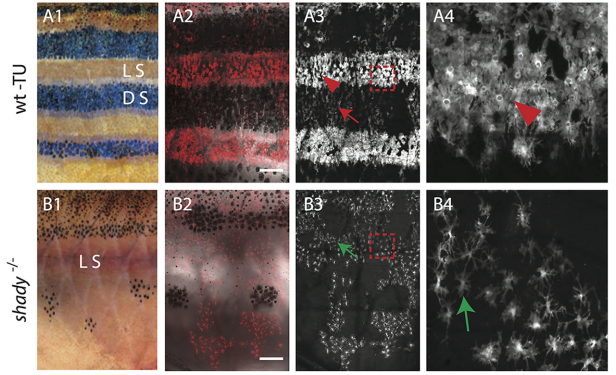
Staying underwater, Uwe Irion and colleagueslink heterotytpic, gap junction-mediated cell interactions with cell morphology during zebrafish skin patterning.
The JCS team featured Celeste Nelson as a Cell Scientist to Watch, whose lab is “focused on studying how groups of cells physically position or turn themselves into tissues.”
Nicholas Pilon and colleagues describe how a mouse line found in a screen for genes involved in neural crest development provides a model for Waardenburg syndrome type 4.
Colin Bingle and colleagues develop an in vitro model of the murine middle ear epithelium, recapitulating cell populations and protein production.
Our latest monthly trawl for developmental biology (and other cool) preprints. See June’s introductory post for background, and let us know if we missed anything
This month, we found preprints covering various aspects of plant growth and patterning, a lot of cell biology – including insights into microtubules organisation, RNA localisation and yeast size control – as well as a bunch of tools. One of the most talked about preprints of the month comes from our ‘Away from the bench‘ section: a guide for how to structure scientific papers. Happy reading!
MultiCellDS: a community-developed standard for curating microenvironment-dependent multicellular data. Samuel H. Friedman, Alexander R.A. Anderson, David M. Bortz, Alexander G. Fletcher, Hermann B. Frieboes, Ahmadreza Ghaffarizadeh, David Robert Grimes, Andrea Hawkins-Daarud, VStefan Hoehme, Edwin F. Juarez, Carl Kesselman, Roeland Merks, Shannon M. Mumenthaler, Paul K. Newton, Kerri-Ann Norton, Rishi Rawat, Russell C. Rockne, Daniel Ruderman, Jacob Scott, Suzanne S. Sindi, Jessica L. Sparks, Kristin Swanson, David B. Agus, Paul Macklin
The Monarch Initiative: Insights across species reveal human disease mechanisms. Christopher Mungall,Julie McMurry, Sebastian Koehler, James Balhoff, Charles Borromeo, Matthew Brush, Seth Carbon, TOM CONLIN, Nathan Dunn, Mark Engelstad, Erin Foster, Jean-Philippe Gourdine, Julius Jacobsen, Daniel Keith, Bryan Laraway, Suzanna Lewis, Jeremy Nguyen Xuan, eKent Shefchek, Nicole Vasilevsky, Zhou Yuan, Nicole Washington, Harry Hochheiser,Tudor Groza, Damian Smedley, Peter Robinson, Melissa Haendel
The Wellcome Trust – Medical Research Council Cambridge Stem Cell Institute is founded on the concept that deep understanding of stem cell biology will contribute to transforming future healthcare (http://www.stemcells.cam.ac.uk). In 2018 we will move into a new purpose built building adjacent to Addenbrooke’s Hospital and multiple research institutes – http://cambridge-biomedical.com/.
The Institute has openings for Group Leaders who will complement and synergise with our existing programmes. Areas of particular interest include:
i. The interface between physical, materials or engineering sciences and stem cell biology
ii. Cell and gene therapy
iii. Ageing of stem cells
Junior group leader candidates will have a minimum of 3 years post-doctoral experience, distinctive research achievements, and an original project proposal. Senior group leader candidates will be internationally recognised for independent high quality science and have an exceptional and well-founded research proposal.
The Institute offers a collegiate environment with excellent core facilities plus extensive opportunities to pursue basic and disease focussed studies. Successful candidates will be supported to obtain external personal fellowship and grant support within 1-2 years. Interim start-up packages may be available. Depending on experience, non-Clinicians can expect remuneration between £39,324 and £66,835.
To apply online for this vacancy and to view further information about the role, please visit: http://www.jobs.cam.ac.uk/job/12123. This will take you to the role on the University’s Job Opportunities pages. There you will need to click on the ‘Apply online’ button and register an account with the University’s Web Recruitment System (if you have not already) and log in before completing the online application form.
Applicants should upload a curriculum vitae (max 3 pages, to include date of PhD and details of any career gaps if applicable) with contact details of 3 referees, and a 1-2 page outline of your research proposal, by Sunday 29th January 2017.
Interviews will be held in April 2017. Please quote reference PS10734 on your application and in any correspondence about this vacancy.
The University values diversity and is committed to equality of opportunity. The University has a responsibility to ensure that all employees are eligible to live and work in the UK. Benefits include generous maternity/ paternity leave, flexible working and funds for returning carers and other family-friendly schemes.
Since the first reported results from Yamanaka et al. in 2006, pluripotent stem cell culture has become an advantageous approach for modeling human disorders and diseases. The directed differentiation of stem cells into particular cell types can also be the basis for powerful in vitro models of early developmental defects in humans. Our lab is interested in neural tube closure as well as neural crest cell development, and to investigate our questions we use the mouse as our model system. However, we also aim to translate our findings to human development. Thus, my mentor, Dr. Lee Niswander at the University of Colorado Denver School of Medicine, and I decided to implement an in vitro model using human stem cells and test our findings from mouse in human neural crest development.
My thesis project in the Niswander Lab aims to investigate the epigenetic regulation of neural crest cell development, a migratory cell population that can differentiate into disparate cell types. My interests in both neural crest development and the epigenetic mechanisms that regulate transcription, is what sparked the idea of a collaborative visit with Dr. Ruchi Bajpai and her lab at the University of Southern California, in Los Angeles, California. Dr. Bajpai’s research interests are very similar to my own, and we identified her as a great potential collaborator as she has pioneered the directed differentiation of stem cells into neural crest, the use of fluorescently tagged enhancers in stem cells, and also defined the epigenetic signatures of neural crest enhancers. Therefore, we sought to establish a collaboration with her lab so that I could learn the directed differentiation of iPSCs into neural crest fates and subsequently test our own hypotheses of the epigenetic regulation of human neural crest development.
With the gracious assistance from the Company of Biologists, the Traveling Fellowship that I was awarded enabled me to travel from Denver, Colorado to Dr. Bajpai’s lab in the City of Angels, also known as Los Angeles. This was a tremendously rewarding experience for me. It was wonderful being able visit a new university and with the help of Dr. Bajpai and her lab, I was not only able to learn how to successfully culture and differentiate iPSCs into neural crest, but I was also able to use this method to begin testing our own hypotheses. One important step was learning how to perform chromatin immunoprecipitation (ChIP) with our differentiated neural crest cells. I also learned the technique of lentiviral infection of stem cells, which we used in combination with fluorescently tagged enhancer sequences. Back in Denver I will continue with these methods of lentiviral based modification and the directed differentiation of iPSCs into neural crest during my thesis work investigating the epigenetic regulation of neural crest development. In the future, we hope to compare datasets that we will obtain from our own ChIP-seq experiments with those generated by Dr. Bajpai with other epigenetic regulators.
Overall the experience was fantastic. It highlights the importance of collaborative science and the impacts of a strong scientific community. I have not only improved myself as a scientist, but I have also expanded my scientific network, which will benefit me for the rest of my career. I would like to thank the Company of Biologists, and also Dr. Bajpai and her lab, for the opportunity and support.


 (No Ratings Yet)
 Loading...
 (2 votes)


 Doug Melton is Xander University Professor at Harvard University, co-director of the Harvard Stem Cell Institute and a Howard Hughes Medical Institute Investigator. His lab investigates the development of the pancreas, and uses insights from this process to direct the production of insulin-producing beta cells from stem cells. We met Doug at the 2016 Society for Developmental Biology-International Society of Differentiation (SDB-ISD) joint meeting in Boston, USA, where he gave the Jean Brachet Lecture. See the
  Forkhead box (Fox) transcription factors regulate diverse biological processes both during development and throughout adult life. Mutations in many Fox genes are associated with human disease and, as such, various animal models have been generated to study the function of these transcription factors in mechanistic detail. In their
  Not all hematopoietic stem cells (HSCs) are alike: they differ in their physical characteristics, they respond to different extrinsic signals, and they have different lineage outputs following transplantation. This raises questions as to why HSC subtypes exist, how they are generated, and whether HSC heterogeneity affects leukemogenesis or treatment options. In their