Location: University of Southampton, UK
Salary: £30,395 to £36,261 per annum Full Time – Fixed Term for 3 years
Closing Date: Monday 05 November 2018
Interview Date: See advert
Reference: 1061818BJ
A Research Fellow position is available in the laboratory of Mammary Stem Cell Biology & Breast Cancer headed by Dr. Salah Elias at the School of Biological Sciences (SoBS) – University of Southampton (UoS), to study the mechanisms of asymmetric cell division during mammary gland development and homeostasis. The position is available for 3 years tenable from February 2019, funded by the Medical Research Council (MRC). On appointment your post title will be Research Fellow.
The Project
Our lab focusses on studying the mechanisms that regulate mammary stem cell fate and dynamics in normal development and breast cancer. This exciting project is a collaboration between our group and Dr. Philip Greulich group based at the Department of Mathematical Sciences at UoS. It will employ combined cutting-edge in vivo single-cell lineage tracing, quantitative three-dimensional (3D) high-resolution imaging and single-cell RNA-sequencing as well as mathematical/computational modelling to (1) identify novel mechanisms that control mitotic spindle orientation in mammary stem cells; and (2) determine how these mechanisms influence cell fate outcomes in the differentiating mammary epithelium. The outcomes of this collaborative project are expected to provide important novel insight into the identity, dynamics and potential of mammary stem cells.
The Successful Candidate
We are looking for a creative, ambitious and skilled Postdoctoral Researcher Scientist willing to challenge an innovative project by adopting a pro-active attitude and an analytical approach, with a strong interest in interdisciplinary collaboration.
You will be responsible for the development of the project, which includes experimental design, data collection and interpretation. You will work in collaboration with Dr. Greulich group who will use mathematical modelling to compare the generated experimental data with predictions from stochastic models for cell fate dynamics, and test the project’s hypotheses via Bayesian inference. You are also expected to contribute to new ideas for research projects, develop ideas for writing grant proposals, prepare scientific reports, write up results for publication in international peer-reviewed journals, assist other members of our group or people working on collaborative projects to become familiar with new methodologies, act as a source of information and advice on scientific protocols.
You will hold a PhD* or equivalent professional qualifications and experience in epithelial stem cell and/or cancer biology (or related field). A strong evidence of proficiency in cell biology and quantitative advanced microscopy in vivo is necessary. You will have experience in animal models and have a personal licence to work with rodents or be prepared to obtain such a licence via attendance of in-house courses. Experience in molecular biology techniques including Next Generation Sequencing is desirable. Basic understanding of computational/mathematical modelling would be advantageous. You will be friendly and have excellent interpersonal skills with a desire to communicate with other researchers whilst maintaining the highest level of professionalism at all times.
The Environment
At SoBS, we use cutting-edge technologies for innovative research to define the basis of human health and disease, and develop interventions that benefit peoples’ lives. There is a strong interdisciplinary research focus bringing together researchers from Biological and Medical Sciences, Computer Sciences, Physics and Mathematical Sciences with experimental work housed in a £45 million building that encompasses cutting-edge research infrastructures. Our Imaging Microscopy Centre (IMC) provides access to several advanced optical microscopic modalities equipped to perform the 3D imaging of this proposal. Excellent Specific-Pathogen-Free (SPF) Animal and Histology Facilities are also available. SoBS offers a supportive and dynamic research environment, with comprehensive training and career development opportunities. You will have full access to all resources and undertake appropriate training in the use of the equipment of our state-of-the-art core facilities to accomplish your studies. SoBS has an outstanding Stem Cell and Developmental research theme, in which our group is perfectly embedded, with excellent potential for collaborations that extend to the closely located Cancer Sciences where breast cancer research is very active. You will thrive within a unique international, stimulating and challenging research environment, with an outstanding international research seminar series in addition to Stem Cells and Quantitative Biology-centred meetings co-organized by SoBS and Mathematical Sciences. The proximity of SoBS and Mathematical Sciences and the specialized expertise that each contributes provides a unique environment needed to achieve the maximum impact of this project.
For informal enquiries, please contact Dr Salah Elias S.K.Elias@soton.ac.uk and/or Dr. Philip Greulich P.S.Greulich@soton.ac.uk
It is anticipated that interviews will take place at the end of November 2018.
Equal Opportunities and Benefits
SoBS holds an Athena SWAN Silver Award, demonstrating commitment to equal opportunities and gender balance in the workplace.
The University of Southampton has a generous maternity policy and onsite childcare facilities; employees are able to participate in the childcare vouchers scheme. Other benefits include state-of-the-art on-campus sports, arts and culture
facilities, a full programme of events and a range of staff discounts.
Application Procedure
Closing Date: 5th November 2018. However, we encourage early applications as we will be reviewing applications on an on-going basis. Therefore the advert may close before the deadline if suitable candidates are identified. First review date: 29th October 2018
How to Apply: You should submit your completed application form online at www.jobs.soton.ac.uk. Please include (1) a cover letter outlining your scientific interests, describing how you meet the requirements of the position, and an outline of future goals; (2) a curriculum vitae, (3) contact information for at least two references.
References are requested along with your application, so please allow time for these to be received prior to the close date, to assist the department with shortlisting.
If you need any assistance, please call Samantha Stubbs (Recruitment Team) on +44 (0) 23 8059 4046. Please quote vacancy reference number 1061818BJ on all correspondence.
*Applications will be considered from candidates who are working towards or nearing completion of a relevant PhD qualification. The title of Research Fellow will be applied upon successful completion of the PhD. Prior to the qualification being awarded the title of Senior Research Assistant will be given.
Antibodies.com is proud to support researchers with travel grants up to £500.
The Award:
Each quarter, Antibodies.com offers a travel grant up to £500 to help cover the cost of attending a conference.
These travel grants are open to PhD candidates, lab managers, and post-docs from academic research institutions across Europe. The grant is intended to help cover the costs of registration, accommodation, and travel to a conference of choice.
For a chance to win, simply complete the application form at Antibodies.com; including a summary of your research or abstract for the conference.
Winners:
A team of scientists will read all research summaries / abstracts that are submitted and select the winner based on which research they find most interesting. The winner will be notified of the award by email.
Soon after the rediscovery of Mendel’s laws of inheritance in plants, French scientist Lucien Cuénot published a paper in 1902, reporting his studies of the inheritance of pigmentation in the house mouse.
Cuénot’s results showed that Mendel’s laws of inheritance also applied to animals. This is a fundamental paper in the field of genetics.
The original paper was published in French & many people may not read French. Therefore, Google, myself, and Phil Soriano (Mount Sinai, New York) translated the original manuscript into English.
Shuo-Ting Yen & Chang-Ru Tsai (MD Anderson Cancer Center) did the Chinese translation. Seol Hee Im (Haverford) did the Korean translation. Vanessa Barone (Scripps Institution of Oceanography) did the Italian translation.
You can find these translations at the University of Texas Genetics & Epigenetics Graduate Program website under Historical Translations (https://bit.ly/2P0gJ4v). We hope this provides the opportunity for many people to read this classic paper in genetics.
Applications are invited for a Research Assistant position, funded by the Wellcome Trust, to join an international team in the Department of Genetics in central Cambridge. The project is led by Ben Steventon and is aimed towards understanding growth control of a population of embryonic stem cells called neuromesodermal progenitors. The project will involve experiments using both zebrafish embryos and aggregates of mouse embryonic stem cells, or gastruloids.We are looking for a highly motivated and well-organised person, with a first degree in biological or biomedical sciences and experience in molecular biology. The project will involve cutting-edge imaging techniques including the quantification of gene expression levels in situ and the development of tools for manipulating gene expression levels within single cells in vivo. Experience in mammalian cell culture is essential and additional expression in zebrafish genetics would be desirable.
Welcome to our monthly trawl for developmental biology (and related) preprints.
Another month, another net full of exciting science. Look out for WNT vampires, regenerating lampreys, polarising ctenophores, plus investigations into niche architecture, tissue mechanics and the dynamics of developmental signalling.
The preprints were hosted on bioRxiv, PeerJ, andarXiv. Let us know if we missed anything, and use these links to get to the section you want:
Planar cell polarity pathway and development of the human visual cortex
Jean Shin, Shaojie Ma, Edith Hofer, Yash Patel, Gennady Roshchupkin, Andre M Sousa, Xueqiu Jian, Rebecca Gottesmann, Thomas H Mosley, Myriam Fornage, Yasaman Saba, Lukas Pirpamer, Reinhold Schmidt, Helena Schmidt, Bernard Mazoyer, Amaia Carrion-Castillo, Joshua Bis, Shuo Li, Qiong Yang, Michelle Luciano, Sherif Karama, Lindsay Lewis, Mark Bastin, Matthew A Harris, Ian Deary, Joanna M Wardlaw, Markus Scholz, Markus Loeffler, Veronica Witte, Frauke Beyer, Arno Villringer, Hieab HHH Adams, M Arfan Ikrum, William S Kremen, Nathan A Gillespie, the ENIGMA Consortium, Nenad Sestan, Zdenka Pausova, Sudha Seshadri, Tomas Paus, the neuroCHARGE Working Group
Reconstructing the human first trimester fetal-maternal interface using single cell transcriptomics
Roser Vento-Tormo, Mirjana Efremova, Rachel A. Botting, Margherita Y. Turco, Miquel Vento-Tormo, Kerstin B. Meyer, Jongeun Park, Emily Stephenson, Krzysztof Polański, Rebecca P. Payne, Angela Goncalves, Angela Zou, Johan Henriksson, Laura Wood, Steve Lisgo, Andrew Filby, Gavin J. Wright, Michael J. Stubbington, Muzlifah Haniffa, Ashley Moffett, Sarah A. Teichmann
Myh10 deficiency leads to defective extracellular matrix remodeling and pulmonary disease
Hyun-Taek Kim, Wenguang Yin, Young-June Jin, Paolo Panza, Felix Gunawan, Beate Grohmann, Carmen Buettner, Anna M. Sokol, Jens Preussner, Stefan Guenther, Sawa Kostin, Clemens Ruppert, Aditya M. Bhagwat, Xuefei Ma, Johannes Graumann, Mario Looso, Andreas Guenther, Robert S. Adelstein, Stefan Offermanns, Didier Y.R. Stainier
The novel lncRNA lnc-NR2F1 is pro-neurogenic and mutated in human neurodevelopmental disorders
Cheen Euong Ang, Qing Ma, Orly Wapinski, ShengHua Fan, Ryan A Flynn, Bradley Coe, Masahiro Onoguchi, Victor H Olmos, Brian T Do, Lynn Dukes-Rimsky, Jin Xu, Qian Yi Lee, Koji Tanabe, LiangJiang Wang, Ulrich Elling, Josef Penninger, Kun Qu, Evan E Eichler, Anand Srivastava, Marius Wernig, Howard Chang
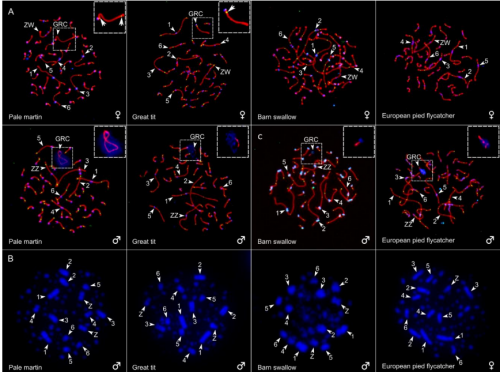
Avian chromosomes in Torgasheva, et al.’s preprint
Germline-Restricted Chromosome (GRC) is Widespread among Songbirds
Anna A Torgasheva, Lyubov P Malinovskaya, Kira S Zadesenets, Tatyana V Karamysheva, Elena A Kizilova, Inna E Pristyazhnyuk, Elena P Shnaider, Valeria A Volodkina, Alsu F Saifutdinova, Svetlana A Galkina, Denis M Larkin, Nikolay B Rubtsov, Pavel M Borodin
The Desmosome is a Mesoscale Lipid Raft-Like Membrane Domain
Joshua D Lewis, Amber L Caldara, Stephanie E Zimmer, Anna Seybold, Nicole L Strong, Sara N Stahley, Achilleas S Frangakis, Ilya Levental, James K Wahl III, Alexa L Mattheyses, Takashi Sasaki, Kazuhiko Nakabayashi, Kenichiro Hata, Yoichi Matsubara, Akemi Ishida-Yamamoto, Masayuki Amagai, Akiharu Kubo, Andrew P Kowalczyk
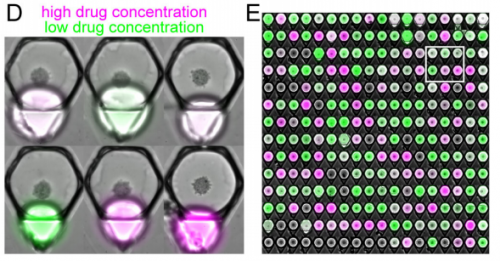
pheno-seq – linking morphological features to gene expression in 3D cell culture systems
Stephan M. Tirier, Jeongbin Park, Friedrich Preusser, Lisa Amrhein, Zuguang Gu, Simon Steiger, Jan-Philipp Mallm, Marcel Waschow, Bjoern Eismann, Marta Gut, Ivo G. Gut, Karsten Rippe, Matthias Schlesner, Fabian Theis, Christiane Fuchs, Claudia R. Ball, Hanno Glimm, Roland Eils, Christian Conrad
FAIRsharing, a cohesive community approach to the growth in standards, repositories and policies
Susanna-Assunta Sansone, Peter McQuilton, Philippe Rocca-Serra, Alejandra Gonzalez-Beltran, Massimiliano Izzo, Allyson Lister, Milo Thurston, Dominique Batista, Ramon Granell, Melanie Adekale, Delphine Dauga, Emma Ganley, Simon Hodson, Rebecca Lawrence, Varsha Khodiyar, Jessica Tenenbaum, J. Myles Axton, Michael Ball, Sebastien Besson, Theodora Bloom, Vivien Bonazzi, Rafael Jimenez, David Carr, Wei Mun Chan, Caty Chung, Geraldine Clement-Stoneham, Helena Cousijn, Saravanan Dayalan, Michel Dumontier, Esther Dzale Yeumo, Scott Edmunds, Nicholas Everitt, Dom Fripp, Carole Goble, Martin Golebiewski, Neil Hall, Robert Hanisch, Michael Hucka, Michael Huerta, Amye Kenall, Robert Kiley, Juergen Klenk, Dimitrios Koureas, Jennie Larkin, Thomas Lemberger, Nick Lynch, Lynn Schriml, Avi Ma’ayan, Catriona MacCallum, Barend Mons, Josh Moore, Wolfgang Muller, Hollydawn Murray, Tomoe Nobusada, Daniel Noesgaard, Jennifer Paxton-Boyd, Sandra Orchard, Gabriella Rustici, Stephan Schurer, Kathryn Sharples, Marina Soares e Silva, Natalie J Stanford, Inmaculada Subirats-Coll, Jason Swedlow, Weida Tong, Mark Wilkinson, John Wise, Pelin Yilmaz
Life Inside A Dinosaur Bone: A Thriving Microbiome
Evan Thomas Saitta, Renxing Liang, Chui Y Lau, Caleb M Brown, Nicholas R Longrich, Thomas G Kaye, Ben J Novak, Steven Salzberg, Paul Donohoe, Marc Dickinson, Jakob Vinther, Ian D Bull, Richard A Brooker, Peter Martin, Geoffrey D Abbott, Timothy DJ Knowles, Kirsty Penkman, Tullis C Onstott
Research Associate/Fellow position (3 years) to work on a BBSRC funded project investigating cell fate regulation during mammalian gastrulation in the laboratory of Dr. Ramiro Alberio (U. of Nottingham, UK), in collaboration with Prof. Jennifer Nichols (U. of Cambridge, UK) and Dr Matt Loose (U. of Nottingham).
Project description:
The project will investigate the molecular mechanisms of mammalian gastrulation. The project involves working with embryos and embryonic stem cells combined with next generation sequencing as a mean to understand cell fate decisions in early embryos. This post is suitable to candidates with experience in single cell RNA seq., embryology and micromanipulation. This post offers a unique opportunity to work in fast developing fields (stem cell biology, single cell genomics and gene editing) and to develop skills in state-of-the-art technologies.
Ideal applicant:
Highly motivated and self-driven, with a PhD (or near completion) in cell/developmental or related biological science with experience in some of the following areas: stem cell biology (preferably hESC), single cell RNA seq, gene editing, and bioinformatics. Experience in embryo dissection, generation of transgenic reporter cell lines, gene targeting and other genome editing techniques are also relevant for the project.
On the Sunday night of 2nd September of 2018, one month ago, most Brazilians were watching TV shows while a large part of our national story was burning out in the National Museum’s fire. In a few hours, a 200-year old institution and several biological, anthropological, and geological collections were consumed by the fire. Publications have been written in respectable journals and newspapers about the fact and its consequences for the whole of society (https://www.theguardian.com/world/2018/sep/03/fire-engulfs-brazil-national-museum-rio).
In this post, I would like to provide a brief personal view from a Brazilian Evolutionary Developmental Biology (Evo-Devo) researcher who also acts as the Director of one of UFRJ’s Institutes. Our Institute also hosts important scientific collections (http://www.macae.ufrj.br/nupem/index.php/colecao-de-peixes-npm), which could be or might be affected in the future if we do not improve our administrative practices.
First, as a Brazilian Evo-Devo researcher, the loss of holotype specimens from some of the most extensive invertebrate collections worldwide will not be recovered sooner or later. Some of the specimens collected by famous naturalists – such as one the Darwin´s greatest colleagues, the German Naturalist Fritz Muller – are of special interest for Evo-Devo researchers (https://onlinelibrary.wiley.com/doi/full/10.1002/jez.b.22687
), since it has been argued that many evolutionary secrets and different morphotypes might lie in the unexplored museums of the world. Unfortunately, in this situation we cannot come back and retrieve the samples and a part of Latin American Biodiversity is gone forever.
Although the reason for the fire is a case for the specialists, I would like to point out some issues which do not apply only for the National Museum of Brazil, but also for other public institutions. After the fire, some authorities and some of the public opinion of the country tried to put the responsibility onto our Rector, who has only been ahead UFRJ for three years and has been trying to obtain special funding to make the required changes in this historical building. This led to a strong response of our employees and students supporting our Rector and our democratic institution, our Federal University and the Museum, the first research institute in Brazil.
If you are a researcher from a developed country, you can´t imagine how much paperwork a Professor or a Director in a country like Brazil has to deal with to buy a simple equipment, or to develop a fire alarm system. The paperwork to hire a company or to develop such a project in Brazil impairs our scientific progress. This can be justified by the lack of qualified personal from the university, and our current low budget to hire a specialized company. In the past years, federal research money for Science has dropped over 60% and the Science and Technology Ministry has been largely neglected by the government.
To solve daily problems of infrastructure one must undergo a complex paperwork process which can take years and contain over a thousand pages and, at the end, the company might still not be hired due to lack of funding. Unfortunately, the corruption scandals in the past years led to a general impression that corruption is widespread all over the country. I can assure that most, if not all, professors and colleagues from my University are honest and, in many occasions, buy consumables for the university from their own salaries, to avoid undergoing this stressful and many times unsuccessful process of buying something using University money.
A second possibility, the donation of private money, rarely occurs. In general, wealthy people from Brazil do not donate to Universities or research institutes, as it is typical for US Universities. This situation is already changing with some great initiatives such as the Serrapilheira Institute (https://serrapilheira.org/en/), although the whole donation system is still in its infancy. Current Brazilian laws limit the use of the money that the University obtains from rents, museum tickets, donations, and any other source of funding. Money allocated in one year does not stay for the next year: it goes back to the Federal Government. Any money that enters in the University must undergo the same complex process that avoid any reasonable speed and progress that science needs. Thus, laws must change for science and technology improvement in Brazil.
Thus, although the museum tragedy cannot be solely attributed to lack of public funding and extensive inefficacy of paperwork and unreasonable laws to spend public resources by the University, these issues have contributed for the tragedy. Lastly, I believe that researchers from public universities have undermined the role and the importance of museums and collections for the Universities. I often see comments that museums are just repository of specimens, but particularly in the case of the National Museum a large part of Zoological, Anthropological, Paleontological research of our country was being carried out in this historical building. Importantly, immediately after the fire, the community of National´s Museum has risen together, and the collections are being restarted by the researchers and students.
The National Museum is ALIVE and I hope from now on, the Museum acquires the status it should never have lost, the home of our history and our knowledge, which fortunately lies in our public universities.
Living Systems Institute, University of Exeter, UK
The importance of Wnt signalling in developmental processes, wound healing and stem cell control has long been established. Historically, scientists attributed the transport of Wnt proteins from the source to the receiver cell to simple diffusion, however, this explanation did not seem sufficient to support the precise delivery of Wnt proteins required to satisfy healthy development. In 2015, our group discovered that finger-like membrane protrusions termed cytonemes delivered the Wnt proteins to responsive cells, but the governance of Wnt-positive cytonemes was yet to be elucidated. A new paper published by our group indicates that Wnt retains sovereignty over its own delivery by binding to the kinase Ror2, which acts upstream of cytoskeletal regulators to manage the formation of Wnt-positive cytonemes.
Wnt signalling is absolutely fundamental to embryogenesis. Present in all metazoans, Wnt proteins have been closely examined in many model organisms such as the fruit fly, mouse, frog, and zebrafish. Since its discovery in mice by Roel Nusse and Harold Varmus, and in parallel by Christiane Nüsslein-Volhard and Eric Wieshaus in Drosophila, it made its début as the viral insertion site int-1 and segment polarity gene Wingless combined as Wnt-1 in the eighties. In the three decades since it was unearthed, Wnt has gained traction as a family of proteins with famously important roles in embryonic development, cell survival, proliferation and stem cell regulation, which act by the formation of concentration gradients over responsive cell types.
Notwithstanding the accumulation of knowledge concerning the action of Wnt proteins, exactly how Wnt protein gradients are secreted in a controlled manner is a source of debate; several theories persist, including simple diffusion and exocytosis. Despite the appealing adherence to the principles of Occam’s Razor, it seemed that a more complex mechanism was required to explain the precision of Wnt delivery. Indeed, in 2015, our group discovered such a mechanism in the zebrafish, Danio rerio. Wnt proteins were in fact delivered from the sender cell by finger-like membrane protrusions carrying Wnt proteins at their tips, allowing full end-end control of Wnt morphogenetic signalling by the sender cell. These membrane protrusions, termed cytonemes, had earlier been suggested to carry the Dpp and Hedgehog signalling molecules in Drosophila development. Now, the function of cytonemes in the facilitation of developmental processes has been expanded to the delivery of Wnt signals in vertebrates.
Cytonemes mobilize Wnt protein
Membrane protrusions are not unusual and are commonly referred to as filopodia. The distinction between cytonemes and filopodia is the cargo transported – the signalling molecules. Both, however, are actin-dependant and, we discovered, contingent on Cdc42, a small Rho family GTPase integral to dynamic F-actin assembly when we were based at the Karlsruhe Institute of Technology (KIT) still. Manipulating the length and number of Wnt-positive cytonemes led to malformed embryos because of aberrant tissue patterning, and therefore we hypothesised that the regulation of formation, timing, number and length of Wnt-positive cytonemes must be tightly controlled in order to produce the fine balance of Wnt gradients that produce wild type tissue patterning.
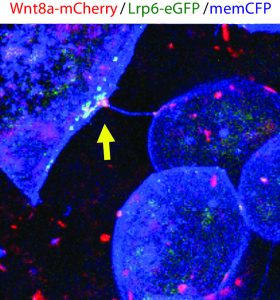
Fig. 1 Cytoneme delivering Wnt8a (red) to a neighbouring cell, causing clustering of the receptor Lrp6 (green) at the membrane of the target cell.
The method and importance of Wnt gradient formation thus elucidated, we set out to determine the upstream control of the genesis of Wnt-positive cytonemes. Benjamin Mattes, PhD student in the lab, decided to examine whether a kinase could in fact be a candidate due to their multifaceted roles in cellular processes in 2016. Preliminary findings indicated that his hunch was correct, and multiple kinases induced changes in the number of membrane protrusions. To narrow down the selection of kinases, we collaborated with computer scientists at KIT who used modelling techniques to select the tyrosine kinase receptor Ror2. Unlike the other kinases identified by the screen, Ror2 is involved in both Wnt signal transduction of the non-canonical Wnt signalling pathway and in regulation of the F-actin cytoskeleton, thus uniting two key molecular functions in the building of cytonemes.
Ror2 controls Wnt cytonemes in zebrafish
To truly hammer home the importance of Ror2, Benjamin decided to try some studies in both zebrafish embryos and in vitro in zebrafish PAC2 cell cultures. The result of Ror2 overexpression was increased number of Wnt-positive cytonemes, inferring that Ror2 was involved in the nucleation of cytonemes, and also that it worked upstream of small Rho GTPase Cdc42, which had earlier been implicated in the regulation of the actin cytoskeleton used to build the protrusions via the non-canonical Wnt signalling pathway. Surprisingly, filopodia which did not carry Wnt8a-GFP did not change in number. Consistently, when Ror2 was knocked down, there was a significant decrease in the number of cytonemes and again filopodia number was unaffected. Regulators of cytonemes presented so far do interfere also with filopodia. However, our data suggests that Ror2 is a cytoneme specific regulator – the first one at least to our knowledge.
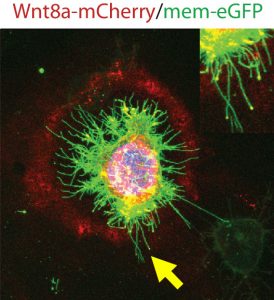
Fig. 2: Cytonemes transport Wnt protein (red) between gastric cancer cells. A halo of Wnt8a protein can be observed around these cells and its diameter correlates with the average length of their cytonemes (green).
Subsequently, Benjamin set out to investigate how exactly Ror2 was able to stimulate cytoneme formation by using image-based approaches, which showed that Wnt family member Wnt8a – which has an established role in zebrafish embryonic development – and Ror2 associate and move together in a complex. Still, he could not entirely prove that Ror2 and Wnt8a bind each other – until he collaborated with the physicist Uli Nienhaus at the KIT who works on developing novel super-resolution techniques. Over one nail-biting summer, they worked together to finally prove that Ror2 and Wnt8a bind together in the living zebrafish embryo – in membrane associations with presumably other mystery players.
At the end of this summer, the lab moved from the KIT in Germany to the newly established Living Systems Institute (LSI) in Exeter, UK. Benjamin continued with the experiments in the world-class institute immediately. In endless imaging sessions using the newly purchased confocal microscope he found that these Wnt8a-Ror2 membrane associations activate PCP signalling in ligand-producing cells, which induces the formation of cytonemes ready to deliver their cargo – Wnt proteins. Therefore, it appears that Wnt proteins retain sovereignty over their own delivery by controlling the nucleation of cytonemes. The complex gradients of Wnt proteins that dictate tissue patterning are governed by Wnt itself through binding with Ror2, activation of PCP signalling, and subsequent cytoneme nucleation.
Fig. 3: The Living Systems Institute, Exeter, UK – a world class hub of interdisciplinary research.
Wnt cytonemes in cancer tissue
The dependence of cytoneme nucleation on Ror2 signalling raises some interesting questions – for example, does Ror2 regulate Wnt signalling in other paracrine processes, such as cancer cell proliferation? Using a co-culture of AGS human gastric cancer cells, Benjamin found that Ror2 enhanced Wnt response in adjacent cells by greater nucleation of cytonemes and therefore increased cancer growth.
For some cells, paracrine Wnt signalling is required throughout their whole lifespan. To investigate whether Ror2 has a role in regulating cytoneme formation in these cells, we started a collaboration with mouse geneticist David Virshup of the Duke-NUS Medical School in Singapore. The intestinal crypt requires a constant supply of Wnt signalling, and David’s team demonstrated recently that the myofibroblasts that surround the crypt have an abundance of cytonemes. When we silenced Ror2 in myofibroblasts, they produced less cytonemes and the intestinal crypt cells that they surround die.
Here, we come to almost present day. All that remains to be said is that we are grateful that last summer, Christiane Nüsslein-Volhard visited the Living Systems Institute at Exeter as key note speaker for its official opening and remarked that she was very pleased to see that Wingless/Wnt trafficking is on its way to being finally solved, and that zebrafish are playing such a large part in that. This said, there is undoubtedly more to learn; cancer cell proliferation and the survival of the mouse intestinal crypt are just two examples where our insights into cytoneme nucleation and the Wnt signalling generated are proving to be instrumental. It seems that where Wnt signalling is concerned, it is in sickness and in health, to death us do part.
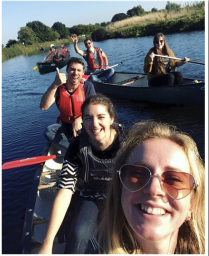
Figure 4 Scholpp lab outing 2018 – paddling on the Exe
The lab of Rohit Bose MD PhD at UCSF is hiring postdocs.The principal investigator is predominantly a lab-based assistant professor and also a practicing genitourinary medical oncologist at the UCSF Cancer Center.Both his clinical and lab focus is prostate biology, although open to related areas of study. Specifically, the lab focuses on themes of hypermutation, drug sensitization and transcription factor networks (Bose et al, Nature, 2017).
A postdoctoral fellow is sought to participate in a study to better understand the role of genetic changes on the development and dysfunction of cerebral vasculature. The successful candidate will work with Drs. Sarah Childs and Kristina Rinker, their teams and collaborators to advance our understanding of vascular dysfunction enabling future diagnostics and therapeutic strategies. The project entails the use of imaging to capture vascular characteristics and further evaluation with computational tools for quantification of the effect of genetic changes on the architecture, wall properties and blood flow in models of genetic disease. The Childs labs has extensive experience in creation of genetic models in zebrafish. We seek a creative, energetic, and self-directed postdoc for a two year term as part of the University of Calgary Eyes High Postdoctoral Fellowship program. A PhD degree in biomedical engineering or similar field within the past 3 years is desired. Experience in computational fluid dynamics required. Experience with cardiovascular systems, analysis of images, and machine learning is beneficial. Knowledge of developmental or vascular biology would be an asset.
We are located at the University of Calgary, in newly renovated labs within the Alberta Children’s Hospital Research Institute and in the Schulich School of Engineering. State of the art imaging and molecular biology facilities are available.
Interested candidates should send their CV, and a cover letter outlining their interests to Sarah Childs, schilds@ucalgary.ca. Review of applications will begin October 30th.