The community site for and by
developmental and stem cell biologists

New DMDD embryonic-lethal mouse data now available

Posted by , on 15 August 2016

DMDD logo


This post was originally posted on the DMDD blog.


New embryonic-lethal knockout mouse lines are now available on the DMDD database.

If you haven’t previously taken a look at our data (or even if you have) now would be a good time to explore our website.  We’ve added new embryo phenotype data and HREM images for many knockout lines, taking our total dataset to more than 4 million images of 550 embryos. We also have placental histology images and phenotypes available for over 100 mutant lines.

This post explores some of the phenotypes observed in the new data, and highlights new lines that could be relevant for clinicians researching rare diseases and developmental disorders. But there isn’t enough space here to include every interesting feature of the data – the best thing to do is to explore it yourself.


EMBRYO PHENOTYPES

Our phenotypers at the Medical University of Vienna have observed many interesting phenotypes in the new data.

Embryos from the line Adamts3 display both subcutaneous edema and bifid ureter. A bifid ureter is the most common malformation of the urinary system, [1] in which there is a duplex kidney drain into separate ureters. This observation highlights the incredible resolution of HREM images, which allow detailed phenotypes to be scored for each embryo.


Click to view larger image.
Bifid ureter (left side) observed in an Adamts3 mutant embryo. The red arrows highlight a single ureter on the right side, but two branches on the left side.


Embryos from the line H13 suffered from severe abnormalities in heart morphology, and had an abnormal heart position within the body. The stomach situs was also inverted, as shown in the image below. Note that severely malformed embryos often have different tissue characteristics, which can result in reduced image clarity.


Click to view larger image.
Comparison between a H13 mutant embryo (left) and its wild-type litter-mate (right). The yellow arrows indicate situs invertus of the stomach.


Embryos from the line Brd2 exhibited a profound ventricular septal defect, as shown in the video below.


PLACENTAL PHENOTYPES

Our placental image and phenotype dataset is growing rapidly and now contains more than 100 lines.

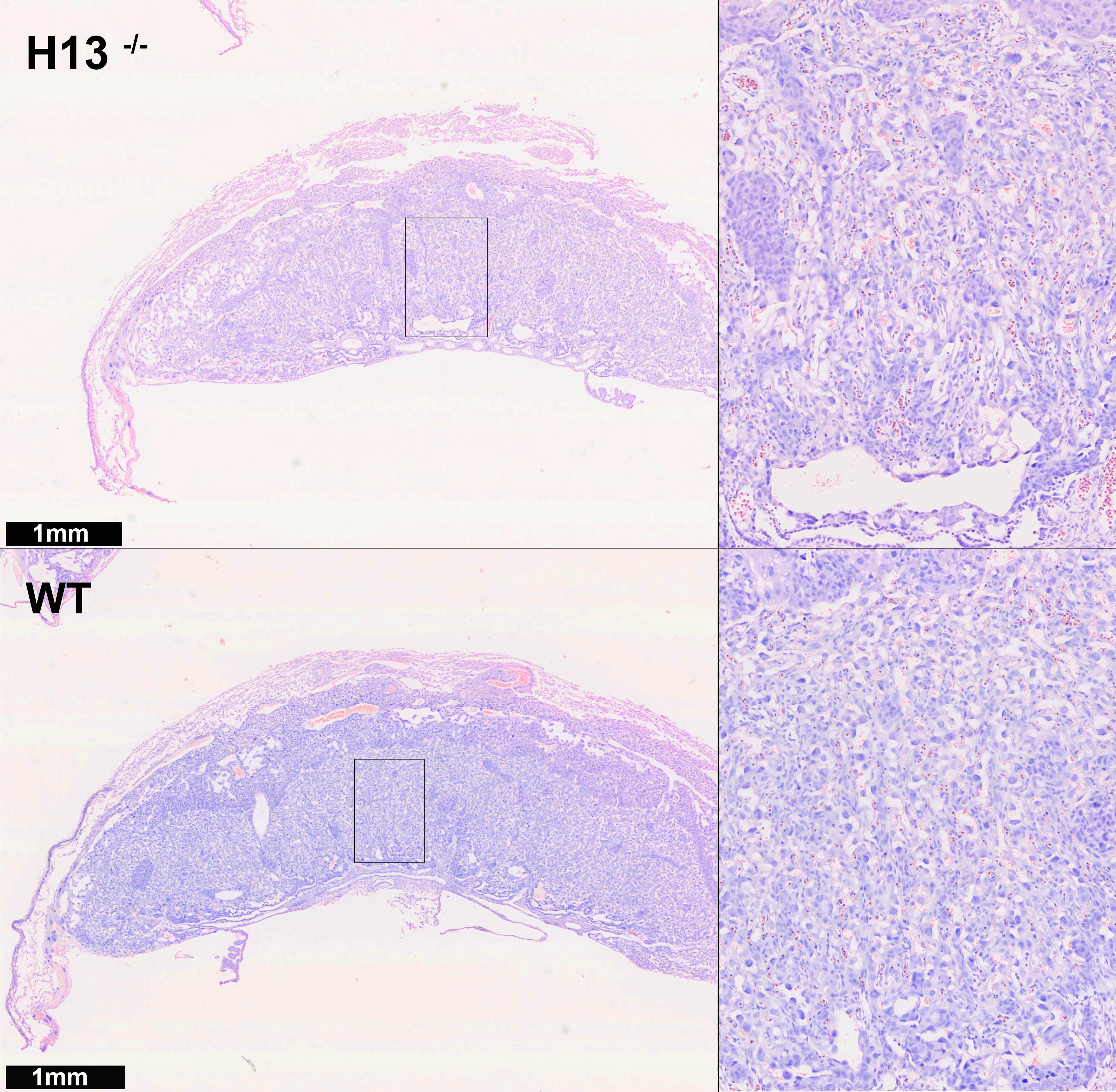
H13 knockout placentas were smaller than their wild-type counterparts and showed reduced vascularisation in the placental labyrinth, the region of the placenta that allows nutrient and gas exchange between the mother and the developing embryo.


Click to view larger image.
A comparison of the placenta from a H13 mutant embryo and that of its wild-type litter-mate.


Vascularisation of the labyrinth is crucial to allow the embryo to receive the oxygen and nutrients needed for normal development. This is just one example, but many more placental phenotypes are available on our website.


LINKS TO CLINICAL STUDIES

Systematic knockout mouse screens can offer a wealth of information about the genetic basis of rare diseases. Many DMDD lines have human orthologues known to be associated with developmental disorders, and the nature of our study means that it would not be possible to derive equivalent systematic data from human patients.

New knockout lines of potential clinical interest include:

Brd2: the human orthologue of this gene is associated with epilepsy, generalised, with febrile seizures plus, type 5.

Cog6: in humans, COG6 is linked to Shaheen Syndrome and congenital disorder of glycosylation, type IiI.

Npat: the human orthologue is associated with Ataxia-telangiectasia, a rare inherited disorder affecting the nervous and immune systems.

Nsun2: in humans, NSUN2 is linked to mental retardation, autosomal recessive 5 and Dubowitz syndrome.


A FULL LIST OF NEW DATA

Embryo phenotype data added for: Adamts3, Brd2, Cog6, Cpt2, Dhx35, H13, Mir96, Npat, Nsun2, Pdzk1.

HREM embryo images added for: Atg16l1, Capza2, Cog6, Coro1c, Cyfip2, Dhx35, Gm5544, Nadk2, Nrbp1, Rab21, Rpgrip1l, Syt1.

Placenta image and phenotype data added for: 1110037F02Rik, Actn4, Atg16l1, Camsap3, Capza2, Cfap53, Coro1c, Crim1, Crls1, Cyfip2, Dmxl2, Gm5544, Gtpbp3, H13, Nsun2, Rab21, Rala, Rpgrip1l, Syt1, Trim45.


REFERENCES

[1] Obstructed bifid ureteric system causing unilateral hydronephrosis, A. Bhamani1 and M. Srivastava2, Rev Urol. 2013, 15(3) p.131–134, PMC3821993.

1 Department of General Medicine, The Ipswich Hospital, Ipswich, UK.
2 Department of Radiology, Barking, Havering and Redbridge NHS Trust, Romford, Essex, UK.


Thumbs up (No Ratings Yet)
Loading...

Tags: , , , ,
Categories: Resources

Navigate the archive

Use our Advanced Search tool to search and filter posts by date, category, tags and authors.

Postdoc in Bioinformatics

Posted by , on 12 August 2016

Closing Date: 15 March 2021

A postdoctoral position is available for a bioinformatician to investigate the mechanisms by which microRNAs, transcription factors and developmental signals control skeletal and cardiac muscle differentiation. The post is based in the School of Biological Sciences at the University of East Anglia, Norwich, in the group headed by Professor Andrea Münsterberg. Their research aims to dissect genome-wide processes that regulate the cell fate choice of progenitor cells in early embryos.
more details here:
http://www.jobs.ac.uk/job/AOB513/senior-research-associate-bioinformatician/

The closing date is 12 noon on 31 August 2016.

Thumbs up (No Ratings Yet)
Loading...

Categories: Jobs, Uncategorized

A new role of an insect steroid hormone: The link between mating and germline stem cells

Posted by , on 11 August 2016

Tomotsune Ameku, Ryusuke Niwa’s lab, University of Tsukuba, Japan.


Steroid hormones have crucial roles in regulating a broad range of biological processes in most multicellular organisms. They are produced in specialized endocrine organs and act as ligands for the nuclear receptor family of transcription factors. In mammals, sex steroid hormones, such as estrogen and testosterone, regulate sex maturation, reproductive physiology and behavior in both sexes. In insects, the major insect steroid hormones are ecdysteroids, including the most biologically active form 20-hydroxyecdysone (20E). Ecdysteroids are called the “molting hormones”, as they are well-known for coordinating developmental transitions, such as molting and metamorphosis. In contrast, little attention has been paid to “post-developmental” roles of ecdysteroids until recently. However, studies in the past several years have demonstrated that ecdysteroids are also present in adult tissues and regulate diverse biological processes such as reproduction, learning, memory, stress resistance, and lifespan (Uryu et al., 2015).


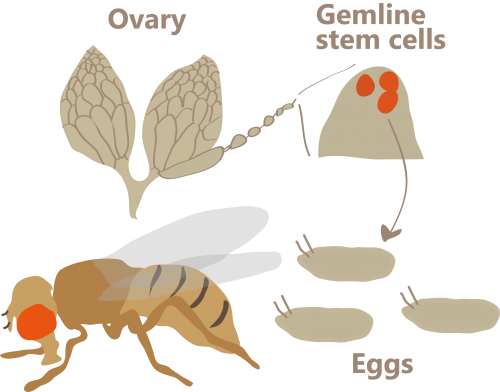
In 2010, Ables and Drummond-Barbosa at Johns Hopkins University beautifully demonstrated that ecdysone signaling directly controls female germline stem cells (GSCs) (Figure 1), which give rise to mature eggs in adults of the fruit fly Drosophila melanogaster (Ables and Drummond-Barbosa, 2010). Interestingly, their data showed that ecdysteroid signaling components including EcR and its downstream gene cascades regulate GSC maintenance with intrinsic chromatin remodeling factors. In addition, some other important studies have also showed that ecdysteroid signaling is required for GSC regulation (König et al., 2011; Morris and Spradling, 2012). I was an undergraduate student at the time, and very impressed by these works, because their findings supported a link between systemic steroid hormones and adult stem cell self-renewal. On the other hand, I realized that all of these works did not examine whether ecdysteroid biosynthesis is regulated by any environmental factors in the ovaries. It seems to me that this question is fundamental, as ecdysteroid biosynthesis during the larval stages is influenced by external environmental conditions (Niwa and Niwa, 2014a). In addition, I also wondered whether and how ecdysteroid “biosynthesis” in the adult ovaries contributed to the GSC regulation.


The Node Fig1


Figure 1. Germline stem cells (GSCs) give rise to mature eggs


In 2012, I joined Dr. Ryusuke Niwa’s laboratory at the University of Tsukuba and wanted to tackle my questions stated above using Drosophila. Ryusuke and I spent several months thinking about the direction of our research, and eventually focused on the stimulating effect of mating. The reason why is because it has been known that mating dramatically induces behavioral changes, increased egg laying and decreased receptivity in mated females (Kubli, 2003; Wolfner, 2009). To ask whether mating may affect ecdysteroid biosynthesis, we first measured ovarian ecdysteroid levels in virgin and mated females. I was very glad that our expectation was correct, as we found that mated females showed higher ovarian ecdysteroid levels compared to virgin females in our recent PLoS Genetics paper(Ameku and Niwa, 2016). Moreover, we have confirmed that the post-mating ovarian ecdysteroid production is induced by a peptide from male’s seminal fluid called Sex Peptide, and its specific receptor Sex Peptide receptor, is expressed in the female neurons in the same way as the canonical post mating response in mated females (Ameku and Niwa, 2016).


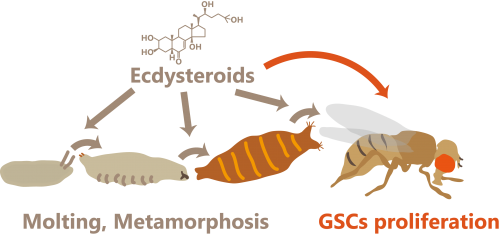
The next question we raised was about the function of mating-induced ecdysteroid biosynthesis. Taking previous studies into consideration, naturally we decided to investigate the relationship between biosynthesis and the regulation of GSC activity. We indeed found that mating stimulates GSC proliferation in mated females. We concluded that this mating-induced GSC proliferation requires ovarian ecdysteroid production, as GSC proliferation did not occur when we inhibited ecdysteroid production in the ovary by knocking down genes required for ecdysteroid biosynthesis (Niwa and Niwa, 2014b) (Figure 2). Interestingly, our data revealed that ovarian ecdysteroid biosynthesis is regulated by Sex Peptide signaling and mediates mating-induced GSC proliferation. This is the first study to show that GSC is under the control of a characterized neuroendocrine system in response to the mating stimulus (Ameku and Niwa, 2016).


The Node Fig2


Figure 2. The roles of ecdysteroid during developmental and post-developmental stages


Currently, we are investigating how neuronal input is transmitted to reproductive tissue to regulate GSC activity, which is required for reproductive success. What I have learned from this study is the importance of focusing on biological questions at different levels, such as behavior, neuron, endocrine and stem cells. I hope I will become a researcher who can see things from various perspectives after completing my Ph.D., by making use of my experiences in carrying out this work.


References:

Ables, E. T. and Drummond-Barbosa, D. (2010). The steroid hormone ecdysone functions with intrinsic chromatin remodeling factors to control female germline stem cells in Drosophila. Cell Stem Cell 7, 581–592.

Ameku, T. and Niwa, R. (2016). Mating-Induced Increase in Germline Stem Cells via the Neuroendocrine System in Female Drosophila. PLoS Genet. 12, e1006123.

König, A., Yatsenko, A. S., Weiss, M. and Shcherbata, H. R. (2011). Ecdysteroids affect Drosophila ovarian stem cell niche formation and early germline differentiation. EMBO J. 30, 1549–1562.

Kubli, E. (2003). Sex-peptides: seminal peptides of the Drosophila male. Cell. Mol. Life Sci. 60, 1689–1704.

Morris, L. X. and Spradling, A. C. (2012). Steroid signaling within Drosophila ovarian epithelial cells sex-specifically modulates early germ cell development and meiotic entry. PLoS One 7, e46109.

Niwa, Y. S. and Niwa, R. (2014a). Neural control of steroid hormone biosynthesis during development in the fruit fly Drosophila melanogaster. Genes Genet. Syst. 89, 27–34.

Niwa, R. and Niwa, Y. S. (2014b). Enzymes for ecdysteroid biosynthesis: their biological functions in insects and beyond. Biosci. Biotechnol. Biochem. 78, 1283–1292.

Uryu, O., Ameku, T. and Niwa, R. (2015). Recent progress in understanding the role of ecdysteroids in adult insects: Germline development and circadian clock in the fruit fly Drosophila melanogaster. Zool. Lett. 1, 32.

Wolfner, M. F. (2009). Battle and ballet: molecular interactions between the sexes in Drosophila. J. Hered. 100, 399–410.

Thumbs up (3 votes)
Loading...

Tags: , ,
Categories: Discussion, Highlights, Research

How many and which genes for multicellularity?

Posted by , on 9 August 2016

My research interest is the evolution of multicellularity. How did cells ‘learn’ to communicate with each other to build a structure that is more complex than its parts and shows new emergent behaviour? Which and how many new genes would be required to transform a unicellular ancestor into a well-organised multicellular structure? The Nature Communications Article from our lab that was published recently (1) sets out to answer some of those questions.

Most of us will be familiar with the type of multicellularity, which evolved in animals, some fungi and plants: cells derived from a zygote continue to divide, but remain attached to each other and eventually differentiate into the different cell types that form the tissues of the organism. All cells are genetically identical and altruistic differentiation into somatic cells that support the propagation of the germline has no cost to them. A quite different case is the colonial multicellularity of social amoebas, which we are studying in our lab. Here, individual cells that can be genetically distinct come together and create a multicellular fruiting structure, consisting of spores and stalk cells.  The stalk cells have to altruistically die to support spores. When the amoebae are not genetically identical, conflicts of interest can arise, such as cheating by avoiding stalk cell differentiation. Just like multicellularity by adhesion, colonial multicellularity evolved multiple times (2,3), suggesting that colonial organisms have devised mechanisms to deal with genetic conflict.

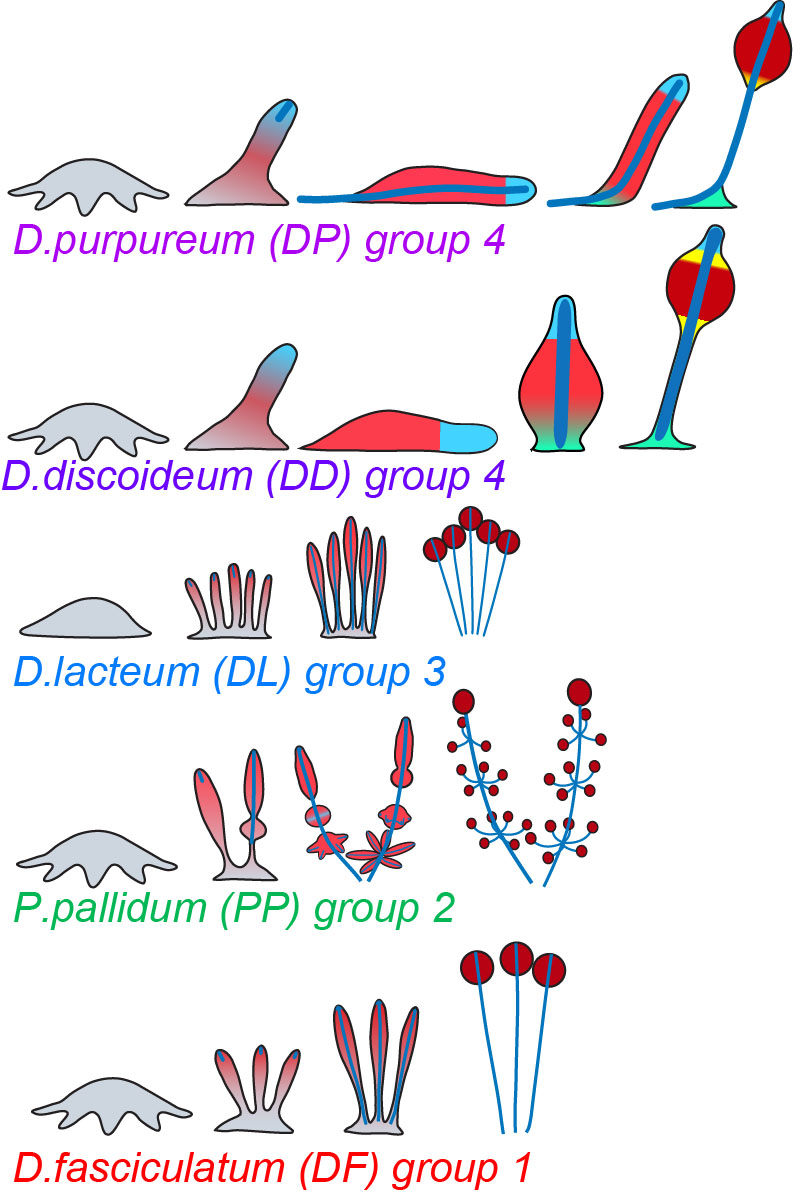
The Dictyostelid social amoebas can be subdivided into four major groups, which differ in the size and shape of fruiting bodies, the presence of an intermediate migratory form, the “slug” and the number of cell types, which is largest in group 4. In addition, group 4 species pre-differentiate amoebas into the correct ratio of prespore, prestalk and the other supporting cell types, whereas in groups 1-3 all amoebas first differentiate into prespore cells that then only locally dedifferentiate into stalk cells (Figure 1).

Figure 1. Schematic of life cycle complexity of the Dictyostelid test species. Dictyostelium fasciculatum (DF), Polysphondylium pallidum (PP) and Dictyostelium lacteum (DL) form multiple fruiting bodies directly from the aggregate. All cells first differentiate into prespore cells and then form the stalk by dedifferentiation of prespore cells at the tip. Dictostelium discoideum (DD) and Dictyostelium purpureum (DP) form single fruiting bodies from aggregates and display an intermediate migratory “slug” in which cells pre-differentiate into prestalk and prespore cells. During fruiting body formation, two more cell types emerge which support the stalk and spore mass. 1: aggregate, 2: early sorogen (slug), 3: migrating slug, 4: mid-culminant, 5: fruiting body. Light red: prespore; dark red: prespore/spore; light blue: prestalk; dark blue: prestalk/stalk; green: basal disc or/ supporter; yellow: upper and lower cup.


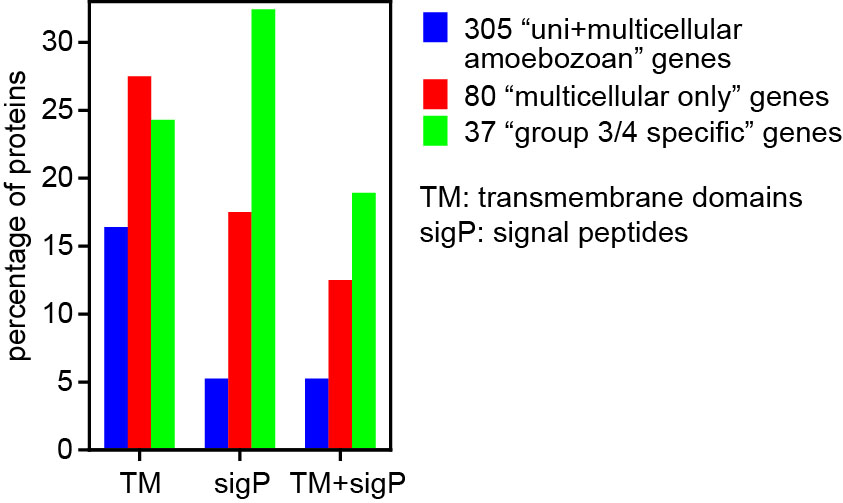
In Dictyostelia, cell proliferation is entirely separated from multicellular development and we can therefore loosely define “multicellularity genes” as genes that are essential for multicellular development, but not for cell proliferation. We wanted to know to what extent such genes were already present in the unicellular ancestors of Dictyostelia and how such genes changed or appeared in the course of Dictyostelid evolution to increase the morphological and behavioural complexity of the organisms.  To achieve this we sequenced three genomes that represented groups 1, 2 and 3 of Dictyostelia. The genome of two group 4 species, D. discoideum and D.purpureum were already available as well as the genomes of three unicellular Amoebozoa. Additionally we investigated how expression of all genes in these genomes is regulated during their development by high throughput RNA sequencing. This allowed us to trace gene evolution across the whole phylogenetic tree of social amoebas and their unicellular Amoebozoan relatives. From previous studies, 385 genes in D.discoideum were known to produce a defect in multicellular development when disrupted. We found that 305 of these genes were already present in unicellular Amoebozoa. The majority is conserved in all Dictyostelia regarding the conservation of domains and expression regulation. However, 80% of those genes, which are mainly cytosolic and nuclear proteins and protein kinases, are already present in their unicellular relatives.  Eighty genes were unique to Dictyostelia and this set was enriched in plasma membrane and secreted or extracellularly exposed proteins, G-protein coupled receptors and sensor histidine kinases. Also, a set of 37 proteins that were only conserved in group 4 or groups 3 and 4 were highly enriched in plasma membrane and secreted or exposed proteins (Figure 2).


Figure 2. Signal peptide (SigP) and transmembrane (TM) domains. Proteins in the 305 and 80 sets, as well as 37 proteins with limited conservation within Dictyostelia (green) were analysed with Phobius63 for transmembrane domains and signal peptides. Percentages of proteins with either SigP or TM domains, or with both are presented.


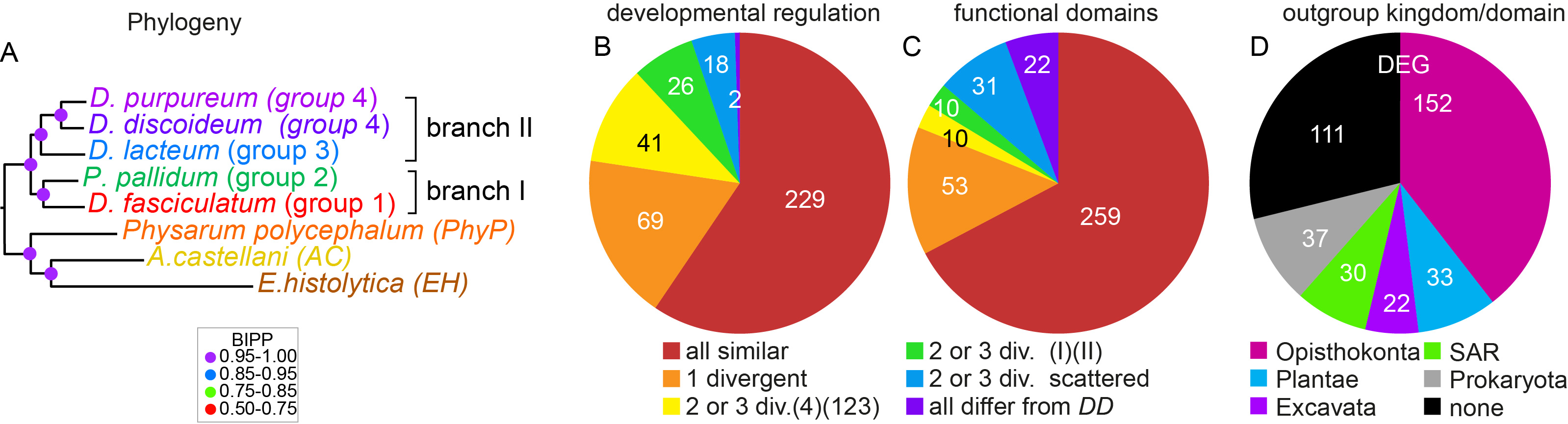
For conserved genes, we also investigated whether their developmental regulation and their protein functional domains were conserved. If not, we scored how such changes were distributed across the Dictyostelium phylogeny. Logically, one expects such changes to be greater when the species are evolutionary more distant from each other. In case of functional domains, the changes were mostly scattered across the phylogeny (Figure 3), suggesting that changes in protein function did not contribute greatly to changes in phenotypic complexity. However, changes in developmental regulation occurred much more frequently between group 4 on one hand and groups 1-3 on the other, than between branches I and II that are evolutionary more distant. Because group 4 species are also phenotypically most distinctive (Figure 1), this indicates that phenotypic innovation in group 4 was more likely to be caused by changes in gene expression than changes in protein function. Finally, investigating the closest relatives of the 385 genes in species outside the Amoebozoa, we found that a relatively large percentage had closest homologs in bacteria. Further scrutiny identified four genes that were only present in Dictyostelia and bacteria and likely entered Dictyostelia by lateral gene transfer. Three of these genes synthesise three out of the five non-peptide signals that induce cell differentiation in D.discoideum: c-di-GMP, DIF-1 and discadenine (4-7).


Figure3
Figure 3. Phylogenetic distribution of conserved features and outgroup homologs. A. Phylogenetic tree of Dictyostelida and unicellular amoebozoan species with sequenced genomes, as inferred from 30 concatenated proteins by Bayesian inference. B. Gene expression. Phylogenetic distribution of numbers of developmentally essential genes (DEG) with different patterns of conservation of gene expression. (4)(123) signifies that developmental expression was different between group 4 and groups 1-3, while (I)(II) signifies different expression between branches I and II. C. Protein domain architecture. Phylogenetic distribution of DEG with different patterns of functional domain conservation. D. Origin of outgroup homologs. Numbers of DEG (out of 385) without no homologs outside Amoebozoa, or with outgroup homologs in each of the eukaryote kingdoms or in prokaryotes.


In conclusion, it seems that innovation to multicellularity largely relied on repurposing of existing genes that were already present in the unicellular ancestor. Conversely, genes encoding exposed and secreted proteins with likely roles in adhesion and cell communication and the sensors to detect these signals appeared only in the multicellular forms, with genes for some novel signal molecules being acquired directly from bacteria. Furthermore, changes in gene regulation appear to have been more important for evolution of phenotypic complexity than changes in gene function.


References:

  1. Glockner, G., et al., The multicellularity genes of dictyostelid social amoebas. Nature communications, 2016. 7: p. 12085.
  2. Du, Q., et al., The Evolution of Aggregative Multicellularity and Cell-Cell Communication in the Dictyostelia. Journal of molecular biology, 2015. 427(23): p. 3722-33.
  3. Schilde, C. and P. Schaap, The Amoebozoa. Methods in molecular biology, 2013. 983: p. 1-15.
  4. Abe, H., et al., Structure of discadenine, a spore germination inhibitor from the cellular slime mold. Tetrahedron Letters, 1976. 17(42): p. 3807-3810.
  5. Chen, Z.H. and P. Schaap, The prokaryote messenger c-di-GMP triggers stalk cell differentiation in Dictyostelium. Nature, 2012. 488(7413): p. 680-3.
  6. Neumann, C.S., C.T. Walsh, and R.R. Kay, A flavin-dependent halogenase catalyzes the chlorination step in the biosynthesis of Dictyostelium differentiation-inducing factor 1. Proceedings of the National Academy of Sciences of the United States of America, 2010. 107(13): p. 5798-803.
  7. Saito, T., A. Kato, and R.R. Kay, DIF-1 induces the basal disc of the Dictyostelium fruiting body. Developmental biology, 2008. 317(2): p. 444-53.


Thumbs up (1 votes)
Loading...

Tags: ,
Categories: Research

Lab Manager Position (50% employment)

Posted by , on 3 August 2016

Closing Date: 15 March 2021

The Laboratory of Regulatory Evolution (Tschopp group) at the Zoological Institute, University of Basel, Switzerland, is hiring for a lab manager position.

We are interested in how phenotypic diversity is generated during vertebrate embryogenesis. As a model system, we are studying the development of the vertebrate skeleton with its associated neuromuscular system. We address these questions using a range of methods, including experimental embryology; functional genomics; cell culture and viral gene delivery; genome editing (CRISPR-Cas9); bioinformatics and in silico modeling.
For more information please visit http://evolution.unibas.ch/tschopp/research/index.htm

The tasks associated with this position will include managing and streamlining standard lab procedures, ordering, as well as experimental work (cell culture, histology, immunohistochemistry).

Your profile
Successful candidates will have a background in molecular biology and/or lab managing. You enjoy working in a team environment, and are proficient in German and have a basic knowledge of English. You are interested in learning and developing new technology to address long-standing questions in developmental and evolutionary biology.

We offer you
– Highly interactive and interdisciplinary research environment
– Attractive employment conditions, very competitive salary by international standards
– The position might get expanded to 100% employment, external funding permitting

Application / Contact
Please send your application with a brief statement of motivation, a current CV and contact(s) for references (where applicable) to patrick.tschopp@unibas.ch
Evaluation will begin on Sept. 1st 2016 and suitable candidates will be contacted shortly after.

The University of Basel is an equal opportunity employer and encourages applications from female candidates.

Thumbs up (No Ratings Yet)
Loading...

Categories: Jobs

Multiple PhD Positions in Biology, Biochemistry and Bioinformatics

Posted by , on 2 August 2016

Closing Date: 15 March 2021

The Fribourg Graduate School of Life Sciences (FGLS) is an interdisciplinary and international graduate school, which offers a coordinated doctoral programme in life sciences at the University of Fribourg. It addresses doctoral fellows in the fields of biology, biochemistry, molecular medicine, chemistry, physics, bioinformatics and mathematics who have a life science focus. State-of-the-art theoretical and experimental research will lead to a Doctor of Philosophy (PhD).

The Faculty of Sciences offers the following degrees related to biology:

  • PhD in Biology
  • PhD in Biochemistry
  • PhD in Bioinformatics

Currently, we are recruiting students in the fields of:

  • Protein Homeostasis in Autophagy
  • Plant Cell Polarity
  • Developmental and Behavioural Neurobiology
  • Chronobiology
  • Lipid Homoestasis in yeast
  • Nutrient signalling and growth control
  • Molecular and cellular Neurobiology
  • Regulation of plant symbiosis
  • Community Ecology

We offer an integrated research and training programme which leads to a PhD after three to four years. The entire programme is run in English and includes a supervision and mentoring programme, as well as courses of novel technologies and soft skills. We expect applicants to have an excellent university degree and to be motivated and interested in interdisciplinary research subjects.
Excellent communication skills in English are of benefit.

Application procedure:

If you are interested send an application including

  • a CV and names of three referees
  • a copy of your master degree (or the current academic transcript)
  • a statement of your research interests in the selected field(s)

to Ms Adeline Favre. Only complete application files will be considered.

Application is open until September 18th, 2016.

Interviews will take place in October 2016. Selected students will start latest January 2017.

More information

Thumbs up (No Ratings Yet)
Loading...

Categories: Jobs

In Development this week (Vol. 143, Issue 15)

Posted by , on 2 August 2016

Here are the highlights from the current issue of Development:


Defining Polycomb complexes with AEBP2

Embedded Image

Polycomb repressive complex 2 (PRC2) directs methylation of histone H3 K27 (H3K27me), a repressive histone mark. Mutations in PRC2 complex components cause a spectrum of developmental defects, including posterior transformation of the skeleton due to misexpression of Hox cluster genes. In addition to the core complex components, a number of substoichiometric accessory proteins have been identified, but the functions of these remain incompletely understood. One of these factors is AEBP2, a zinc-finger domain-containing protein that has been proposed to play a role in PRC2 recruitment. On p. 2716, Sarah Cooper, Neil Brockdorff and colleagues evaluate the role of AEBP2, generating a knockout mouse and mutant embryonic stem cells (ESCs). Surprisingly, the phenotype observed upon Aebp2 depletion is not loss of PRC2 function, but rather a Trithorax phenotype (anteriorisation of the skeleton) associated with increased Polycomb activity. In the absence of Aebp2, an atypical PRC2 complex appears to form, which may be responsible for the mild enhancement in H3K27me levels. The authors therefore propose that AEBP2 functions primarily to define the composition of PRC2 complexes, and hence modulate their activity.


A role for DISC1 in astrogenesis

Embedded Image

Mutations in human DISC1, a protein associated with the dynein motor complex, have been implicated in schizophrenia. In mouse, knockdown of DISC1 causes a number of phenotypes, including premature neuronal differentiation and impaired neurite and axonal outgrowth, while Disc1 mutants, although viable and fertile, show strong behavioural defects. However, the potential functions of DISC1 in glia, including astrocytes, have been less studied, even though disruption of astrocytes has been reported in schizophrenic patients. Jianwei Jiao and co-workers (p. 2732) therefore set out to assess the consequences of Disc1 loss- or gain-of-function in mouse astrocytes. Both in vivo and in vitro, they find that Disc1 depletion impairs astrogenesis, while overexpression promotes differentiation down the astrocyte lineage. Mechanistically, the authors show that DISC1 modulates RAS/MEK/ERK signalling, which is known to be important for astrogenesis: upon Disc1 deletion, MEK and ERK phosphorylation (and hence activation) is impaired. In this context, interaction between DISC1 and the RAS-association domain protein RASSF7 appears to be important: as with DISC1, overexpression of RASSF7 promotes astrocyte differentiation. Although the potential contribution of this astrogenic activity of DISC1 to the schizophrenia phenotype has yet to be analysed, these data suggest that modulation of astrocyte differentiation may be relevant for this neuropsychiatric disorder.


Set(db1)ting up the genome for meiosis and mitosis

Embedded Image

During oocyte maturation, meiotic arrest and fertilisation, multiple processes – deposition of maternal transcripts and proteins, various signalling events, DNA replication, chromosome segregation and so on – must be tightly orchestrated to ensure that the resultant zygote is viable. Many of these processes require chromatin-driven modulation of transcription. Antoine Peters and colleagues (p. 2767) have uncovered an important role for the H3K9 methyltransferase Setdb1 in oocyte meiosis and early zygotic development. Mouse embryos depleted for maternal Setdb1 fail to progress to the blastocyst stage. In mutant oocytes, meiotic progression is impaired and multiple defects in spindle organisation and chromosome segregation can be observed. To try and understand the reason for these defects, the authors performed RNAseq analysis, finding misregulation of multiple genes with roles in cell division. Moreover, Setdb1-deficient oocytes show increased expression of multiple retrotransposons, consistent with the known role of Setdb1 in restraining retrotransposon expression in embryonic stem cells (although the families of elements regulated differ in the two contexts). Finally, the authors show that maternal Setdb1-deficient embryos suffer from similar defects in mitosis to those observed in oocyte meiosis. Thus, these data establish Setdb1 as a crucial regulator of meiotic and mitotic progression in the oocyte and early embryo.


On the IMPortance of localised axonal mRNAs

Embedded Image

In the nervous system, certain mRNAs are transported along axons and show localised translation. This is thought to be important for axon-autonomous regulation of, for example, growth cone turning and guidance. However, we still have an incomplete understanding of which mRNAs are localised, how their transport and translation are controlled, and how this impacts neuronal development and function. The IMP1 RNA-binding protein is known to play a role, particularly in controlling local expression of β-actin in neurons and other cell types, and John Flanagan and colleagues (p. 2753) now investigate the function of its relative IMP2. In the developing mouse nervous system, IMP2 shows specific localisation to axon tracts. Identification and analysis of the mRNAs to which IMP2 binds reveals a large number of putative targets, including many associated with axon guidance, cell migration and cytoskeletal organisation. Consistent with this, IMP2 knockdown in the developing chick spinal cord leads to growth cone stalling and failed axon midline crossing at the floor plate. This phenotype is reminiscent of loss of one of the identified IMP2 targets, namely the Robo1 receptor, whose axonal protein levels are reduced upon IMP2 knockdown. Together, these data identify a new player in axonal mRNA regulation and provide a valuable dataset for further analysis of the role of IMP2 and its targets.


Plus…


Size regulation blossoms in Kobe

Fig. 2.Coincident with the blossoming of the sakura was the 14th annual CDB Symposium hosted by the RIKEN Center for Developmental Biology in Kobe, Japan. This year’s meeting, ‘Size in Development: Growth, Shape and Allometry’ focused on the molecular and cellular mechanisms underlying differences in size and shape and how they have evolved. Here, Iswar Hariharan highlights the advances presented at this meeting and the open questions in the field. See the Meeting Review on p. 2691


Direct lineage reprogramming via pioneer factors; a detour through developmental gene regulatory networks

Growing evidence suggests that current methods of direct lineage conversion may rely on the transition through a developmental intermediate. Here, Sam Morris explores pioneer transcription factor-driven direct lineage reprogramming between mature cell states, proposing that this depends on reversion to a developmentally immature state. See the Hypothesis article on p. 2696


Blood vessel formation and function in bone

Blood vessels in the skeletal system control multiple aspects of bone formation and provide niches for hematopoietic stem cells that reside within the bone marrow. Here, Kishor Sivaraj and Ralf Adams provide an overview of the architecture of the bone vasculature and discuss how blood vessels form within bone, how their formation is modulated, and how they function during development and fracture repair. See the Review on p. 2706


Thumbs up (No Ratings Yet)
Loading...

Tags:
Categories: Highlights

Two PhD positions in Regulatory Evolution, Tschopp group, University of Basel, Switzerland

Posted by , on 1 August 2016

Closing Date: 15 March 2021

The Laboratory of Regulatory Evolution (Tschopp group) at the Zoological Institute, University of Basel, is hiring for two fully funded PhD positions.

Our research interests focus on two main questions: 1. How is phenotypic diversity generated during vertebrate embryogenesis? And 2. how can developmental processes be modified to drive morphological evolution? We are particularly interested in investigating how the evolution of gene regulation is underlying these phenomena. As a model system, we are studying the development of the vertebrate skeleton with its associated neuromuscular system.

In a first project, we will investigate the gene regulatory networks underlying the generation of skeletal cell types, originating from distinct embryonic sources and in different species. This will allow us to assess the developmental and evolutionary constraints on gene regulation during cell type specification. Secondly, we are interested how cell specification and embryonic patterning are intertwined. To this end, we will study the specification of synovial joints during the embryonic outgrowth of digits, a process contributing important aspects of the patterning diversity seen in the hands and feet of vertebrates.
Both projects build on solid foundations of confirmed preliminary data. For more information please visit http://evolution.unibas.ch/tschopp/research/index.htm

We will address these questions using a range of experimental methods, including embryology in chicken, mice and fish; functional genomics (RNA-seq, ChIP-seq, ATAC-seq, STARR-seq); cell culture and viral gene delivery; genome editing (CRISPR-Cas9); bioinformatics and in silico modeling.

Successful candidates will have a background in molecular and/or developmental biology, and ideally will have a basic understanding of Unix and the R language for statistical computing.

Please send your application with a brief statement of motivation, a current CV and contact(s) for references (where applicable) to patrick.tschopp@unibas.ch
Evaluation will begin on Sept. 1st 2016 and suitable candidates will be contacted shortly after.

The University of Basel is an equal opportunity employer and encourages applications from female candidates.

Thumbs up (No Ratings Yet)
Loading...

Categories: Jobs

MBL Embryology Course 2016

Posted by , on 1 August 2016

“My dear, here we must run as fast as we can, just to stay in place.

And if you wish to go anywhere you must run twice as fast as that.”
L. Carroll ‘Alice Through the Looking Glass’


We write this while we finish the last experiments for the final Show n’ Tell on Saturday full of reluctance to finish this course. Samples fly all over the lab; solutions are changed and something blue boils somewhere in the room.

Looking back, six weeks ago we had an approximate idea of what the MBL Embryology Course was about: people doing science 24/7, lectures and a lot of organisms with names you can barely pronounce. What we did not know is that the experience was all of that and more.

The first day was weird. People hanging their posters on the walls, rushing to get ready to tell other people about what is basically their life in the lab. After a while, everybody was talking with each other about science and how much they want to try new things. Our excitement grew as we realized that we would not only get to experience a plethora of organisms, but we would also learn from peers who are expert at widely diverged backgrounds. Little did we know about what we were really in for, though!

After that, the routine was as follows:

You wake up, rush to stuff yourself with breakfast, get a coffee and run to the Speck Auditorium to hear about the nuts and bolts of a new organism. From sea urchins to worms (flat or not), through articulated arthropods, squishy jellyfish and ctenophores, hemichordates, urochordates, glowing zebrafish or little mice, we learned about how they develop. One of the first things you realize is the kind of amazing things people are doing on this crazy endeavor of understanding how life works. All organisms share common features and are different from each other, highlighting how important all of them are. The second thing you realize is how passionate people are about their work, and you cannot help but remember why you became a scientist on the first place.

After the lectures we had what’s been called The Sweat Box for many years. This consists on a freestyle Q&A session about the contents of the lecture that usually would diverge on questions about anything related to the subject. During this time, we had the opportunity to discover how much people know about their (and other) organisms, and how they have contributed to their field and biology in general. As the course went on, our confidence grew to ask seemingly the strangest and deepest of questions. These turned out to be questions of broad interest or potential projects, which may highlight the key points of developmental research for the next decade.

After lunch, we had laboratory until the (usually very, very late) evening. The laboratories consisted on a brief introduction to the organism and the available tools. Then, it was up to you which type of question you wanted to ask: Big or small, simple or complex, you were given complete freedom and the TAs and PIs would usually challenge us to try new and classic experiments. You didn’t need to have any hypothesis or rigorous experimental design, as there should be no limitation for your curiosity. You just followed your intuition to give it a try for anything jumping up from your mind. It was a great chance to examine your crazy ideas, which your advisor might not allow you to test at your home laboratory, applying new available technologies to try experiments that were not previously feasible. Looking back, this curiosity-driven science is what we think that makes being a scientist an awesome job and we encourage everybody to do it, because that’s where magic happens. What would happen if you fuse two sea urchin embryos? Would a worm develop normally if you spin it down in the centrifuge? What is the smallest piece of an animal that would regenerate? Is that experiment mentioned earlier during the lecture really impossible? These questions are also important, and we had so much fun trying to answer them. Most of our experiments did not work, but science is about that, too: What basic principle have you learned by doing that experiment?

(It is important to mention that it is great seeing how the kind of experiments we the students propose still can surprise somebody that has been working in the field for many years. This is one of the great things about science: the capacity of being amazed)

Most importantly for our research in the ‘real world’, we had the opportunity to try new techniques and explore the use of tools we had never otherwise been able to use. For each established organism*, there are usually are some common experimental skills which are not utilized by researchers studying other organisms. We had the chance to learn many interdisciplinary, useful experimental skills and tool-making methods that can be applied to different organisms to broaden the possibility and feasibility of experimental designs in each module. Moreover, the training on different types of microscopes and imaging techniques enabled us to utilize appropriate methods, generating high-resolution images for different purposes and organisms. We could even separate overlapping spectra to distinguish (up to eight!!) different fluorescent markers on one sample for co-localization studies.

Every two weeks we got to present our data in the so-called Show n’ Tell. The recipe for it is a powerpoint presentation, a timer and people waiting to be amazed by the kind of data you collected in two weeks. During the time you were given, it was up to you presenting (or even dancing!) one, two or n experiments. It was very common seeing jaws dropping or people clapping, and everybody was smiling as they saw what a great time people had trying new experiments or collecting beautiful images. Our evening was spent laughing and embracing each other’s scientific creativity, an essential factor for the development of us as scientists.

Starting from first cell division, we had the opportunity to visualize the various types and patterns of cleavage processes among different organisms. We got to witness the beauty of biodiversity and how precisely it is regulated. When observing how a new life begins and grows, it is difficult to describe how deeply we were touched by the exquisiteness of life.

But not everything was about science! We had Sundays off, that we usually spent (not necessarily in this order) doing laundry, sleeping or exploring the beautiful towns of Woods Hole and Falmouth. We also had the opportunity of going Whale Watching, participating in the Independence Day costume parade and swimming in the bioluminescent ocean. During these six weeks of being awake at all hours, failing and succeeding together and enjoying our time off together, we became closer and closer to each other. With our virtues and defects, we have become friends.

Because science should be about that: whether your organism is big or small, squishy or hard, pigmented or transparent, we all are in the same boat. We all are trying to understand how life works, and we all should collaborate towards a better understanding of (in this case) embryology and development.
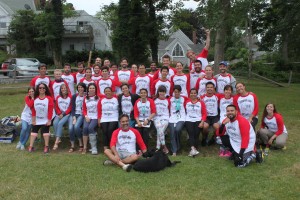
 

IMG_5198


We’d like to finish this little story thanking our Course Directors, Richard and Alejandro, who made all of this possible. We’d also like to thank all the Faculty and TAs that spent endless hours preparing all the experiments so we could have fun in the lab. We couldn’t have done any of this without our amazing Course Assistants Wes, Chris and Brittany, who took care of everything and are a fundamental part of the course. We also appreciate the endless support from outside of course: the specialists from Zeiss and Leica, teaching us how to generate amazing images, and other sponsor companies providing the latest-model equipment for us to perform fancy experiments. And last, but not least, we’d like to thank you reader, for being curious enough to read this little piece. Never stop being amazed and get out your comfort zone, and magic will happen.


Joaquín, Aleisha and Tsai-Ming
MBL Embryology Course, Class of 2016


Joaquín Navajas Acedo is a Grad Student from the Grad School of the Stowers Institute for Medical Research in Kansas City, Missouri (USA). He is currently working on the establishment of cell polarity using zebrafish at the Piotrowski Lab (http://research.stowers.org/piotrowskilab)

Aleisha Symon is a PhD student from Monash University in Melbourne (Australia). She is currently researching genes that are involved in the development of the mammalian testis at the Hudson Institute of Medical Research in the Harley lab (http://hudson.org.au/profile-prof-vincent-harley/)

Tsai-Ming Lu is a PhD student from Marine Genomics Unit at Okinawa Institute of Science and Technology (OIST) Graduate University, Okinawa, Japan. He is working on the genome project of dicyemid mesozoan, Dicyema japonicum, a parasite inhabiting in the renal sac of octopus, to understand the mechanisms of regressive evolution and adaptive radiation (https://groups.oist.jp/mgu)


PS: Some of us live-tweeted during the 6 weeks we spent at the MBL using the hashtag #embryo2016. If you want to get a good idea about what the course was like, please visit: https://twitter.com/search?q=%23embryo2016&src=typd


*The usage of the expression ‘model organism’ and ‘non-model organism’ was passionately discussed during one of the sessions in the Sweat Box. Since each organism can be a model, we decided that the term ‘canonical’ or ‘established’ would be more appropriate or not even adding a label. There is a recent article that discusses the matter (http://www.cell.com/current-biology/fulltext/S0960-9822(16)30604-2)

Thumbs up (10 votes)
Loading...

Tags: , , , , , ,
Categories: Education, Lab Life, Research

July in preprints

Posted by , on 1 August 2016

Our latest monthly trawl for preprints. See June’s post for background, and let us know if we missed anything


This month we found preprints on various themes in developmental biology, as well as a lot of work that we hope will be of general interest to the community.

One of July’s most talked-about preprints tackled a subject felt keenly by most scientists, let alone developmental biologists: the journal impact factor. Vincent Lariviere, Stephen Curry and colleagues from Springer, AAAS, PloS, The Royal Society, eLife and EMBO presented an alternative method to generate citation distributions. July’s tranche also features zebrafish lamination and echinoderm regeneration, a hefty dose of evo-devo,  plenty of techniques and resources, and expanded genomes for humans, flies and mice.

The preprints listed below are hosted on biorxiv, arxiv and F1000Research.

Happy preprinting!


Developmental Biology & Related


Techniques


In Silico Modelling/Tools/Stats


Genomics


Publishing


Thumbs up (4 votes)
Loading...

Tags:
Categories: Resources