
Getting on the short list: academic job applications
Posted by Megan Wilson, on 18 June 2014
After serving on some academic selection committees recently, I’m worried about the future of some of our young scientists. Especially concerning are the number of applications where the candidate, pursuing a academic or research career, does not seem to have a understanding of what is required to put together a stand-out application for a position, and it in some cases may even be to late for them to be competitive for such positions.
It is getting tough out there on the academic job front; each position may receive well over 50-100 applications (even getting into the hundreds at larger high profile Universities).
How can we help our PhD students who want a career in academia? They need to get on top of things early on and learn what they need to achieve to be considered for research and group leader positions.
Job applications are becoming like grant applications – in a pool of excellent candidates the selection committee will look for a reason not to put you through to the short list. How are you going to make your CV and application stand out in a competitive field?
Below I have listed a few tips to get the discussion started.
“The post-doc position”
Outline your Research expertise and interests
An overview of your research interests (what about this research excites you?), can also (briefly) outline your previous research projects and their outcomes
Publications – vital
This could be split into manuscripts in preparation, manuscripts under review and accepted/published. It is critical to publish during your PhD. Your PI is likely to be very busy so it may be up to you to push to get the first drafts of the manuscript together. Plus those employers that are looking for post-doc want to see evidence that you can write!
Qualifications and Employment record
Include expected date of thesis completion or examination.
Presentations:
Contributed and invited talks at meetings/conferences and at departmental level. Never turn down opportunities to speak, it is your best shot at getting you and your research noticed. As they say, every talk is a job talk.
Laboratory skills
Describe the skills/techniques that you are proficient in and have experience with. The employer may be looking for new skills you can bring to the group as well as experience required for the project.
Teaching and mentoring experience
Evidence of teaching and mentorship can be important.
This may include student demonstrating and guest lectures. List the students that you helped to supervise and the relevant output (eg thesis or if their data ended up in your publication).
Grants, awards, scholarships
List any travel awards, PhD scholarship, anything you applied for $ and got it. Any prizes at conferences and meetings = Peer esteem.
Professional activities and skill development
Workshops, reviewing grant applications, committee work, outreach activities. Take the opportunities to be involved all these activities when they are offered or seek them out yourself.
Professional memberships – Membership to societies. Join up – it is often very cheap for students and early career researchers plus they offer travel grants and awards.
The COVERLETTER – Please write one and address the advertised project, otherwise it looks like you are just applying for everything. Be enthusiastic about the proposed project/research area and address how your skill sets met the selection criteria. If you don’t have all the skills listed (and it is rare to have them all), then you can address this to say why you aren’t proficient in this area, and refer to your ability to quickly pick up new skills.
“Lecturership position”
Publications (vital):
The number of publications since PhD is often used as a marker of research output (often around 2 publications per year is considered great but this will vary depending upon the research field). Impact factor is also taken into consideration eg a fewer number of high impact papers can be weighted similarly to a CV with an overall higher number of publications. Where possible you might want to include impact factor, number of citations of each paper, H-index, ranking of the journal within your field of research (Eg this journal is ranked 2nd out of 50 journals in the field of developmental biology) = essentially showing the measure of the impact of your work in the field of research.
For multi-author publications – what was your contribution? (this can be important if you aren’t the first or last author in a long list of authors, even if it is a Nature or Science paper).
Previous grant funding
Provide evidence of research grant success – this proves you have ideas and they are fundable. It is expensive to do research, you need to show you can fund your research (and bring some extra income into the department). These don’t have to be large grants; keep an eye out for smaller funding opportunities to get you your first grants as PI.
Research interests and projects
You need to outline the research directions for the programme of research you will establish in your new group. Include how they fit with the department (and existing facilities) and other members of the university. What funds will you apply for? Do you have any established collaborations?
Leader qualities
Examples of how you have lead research projects/programmes in the past.
Supervision of research students – what was the outcome (eg did they contribute to publications?)
Teaching
Develop a teaching profile or teaching philosophy. Why do you want to teach, what kind of teacher do you want to be? Include any evidence of teaching experience. Look at the courses within the department you are applying, discuss what courses can you contribute too.
Other helpful additions to the CV
Any community engagement or outreach activities.
Presentations such as conferences but include others too and note if you were an invited speaker. University service such as work on committees (there will be a lot of this if you get the job!) Evidence that you understand the compliance issues that must be met and administrated by you as a group leader such as animal ethics, lab safety, biological compliance.
Your employment record – if you have any career gaps it may help to explain them.
The Coverletter. Do one!
Why do you want to move to this department/university? Specifically address the selection criteria.
The Final word – It is going to take planning! Start planning early in your career for the position you want in 5 years time. Don’t turn down opportunities and take a few risks.
Dr Megan Wilson (@DrMegsW)
 (2 votes)
 Loading...
 (1 votes)

 Familial dysautonomia (FD) is a germline autosomal recessive disease that is characterized by impaired peripheral sensory and sympathetic neuron development. The disease is known to be caused by mutations in the gene encoding Elp1 (also known as IKBKAP), but how Elp1 functions in neurons is unclear. Now, Warren Tourtellotte and colleagues investigate the role of Elp1 in mice (p.
  The recent advent of tools for manipulating and monitoring gene expression calls for efficient ways to document, access and analyse these gene expression patterns. Although a number of databases and gene expression atlases have been compiled in recent years, many of them are limited with regards to their content and utility. Here, Chris Doe and colleagues develop new software that overcomes these limitations (p.
  Haematopoiesis – the formation of blood cells – is regulated by a number of ubiquitous and tissue-specific transcription factors, but the extent of interplay between these factors is unclear. Sp1 is a transcription factor that is ubiquitously expressed and regulates the expression of thousands of genes, and it has been shown that Sp1-deficient mouse embryos die during early development. Now, on p.
  Root nodulation in plants is a form of de novoorganogenesis and involves the dedifferentiation of root cortical cells in response to rhizobia-derived factors. However, due to the complexity of this event, our understanding of the factors and mechanisms that initiate nodule formation is limited. Now, Takuya Suzaki and co-workers (p.
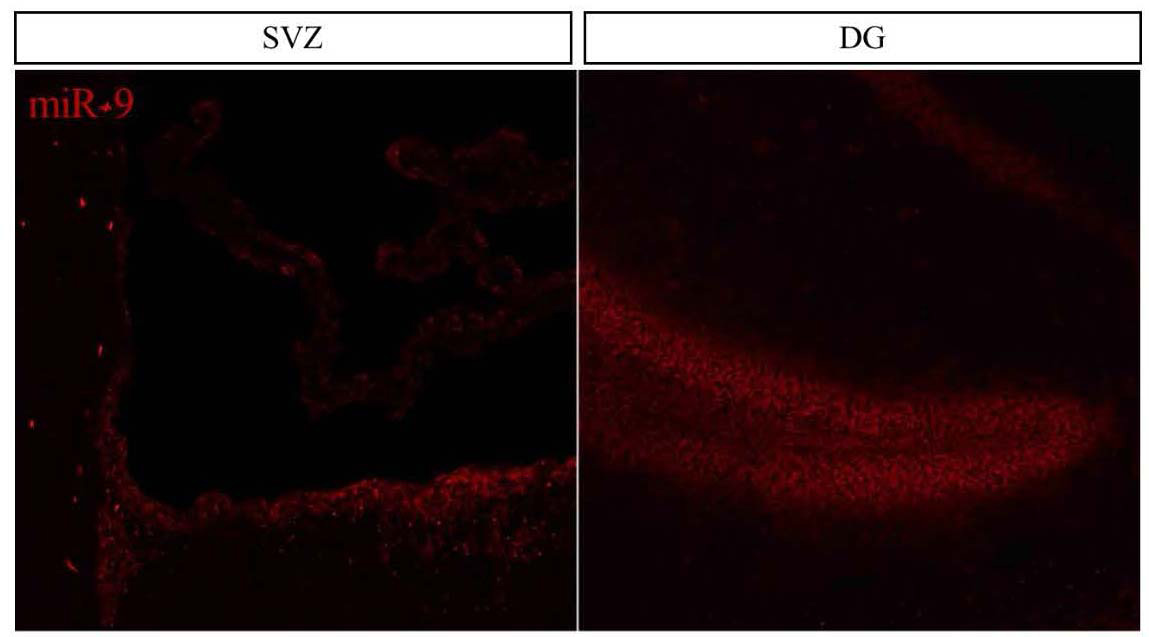
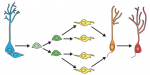 Granule neurons in the hippocampal dentate gyrus (DG) are known to be continuously generated throughout adult life, and the ongoing integration of newborn neurons into the existing hippocampal neural circuitry provides enhanced neuroplasticity, which plays a crucial role in learning and memory. In their Primer article, Gage and colleagues summarize the developmental principles that regulate the process of DG neurogenesis and discuss recent advances in harnessing these developmental cues to generate DG granule neurons from human pluripotent stem cells. See the Primer on p.
 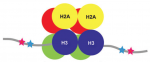 In pluripotent stem cells, the interplay between signaling cues, epigenetic regulators and transcription factors orchestrates developmental potency. Here, Maria-Elena Torres-Padilla and Ian Chambers review what is known about transcriptional heterogeneity in pluripotent stem cells, focusing on the underlying causes of heterogeneity and how transcriptional heterogeneity can be to the benefit of the whole stem cell population. See the Review on p.