My background is in systems engineering, and i have over forty years experience of building and trouble shooting mechanical/hydraulic systems. I have an interest in the evolution and function of biological systems, hence my involvement in this. I have no issues with the genetic basis of biology, but i am pretty sure that genes cannot produce structures that can defy the laws of physics! There are physical laws that any system has to take account of, and that can also be taken advantage of in the function of the system. In my opinion the structures ultimately created by genetics, have evolved to take advantage of such physical laws. The example described here can be demonstrated in modern humans, and has wider implications in gender related physiology.
There is a physical connection in the mammalian dermal system, that has not been factored into certain dermal changes. This involves the mammalian hair cycle. There are many references to this disintegration and re-enlargement of the hair follicle “pocket” within the dermal tissue. The ongoing mystery of this is how cycle by cycle, the resulting follicle can change size so changing the amount of hair produced?
What is not refered to in any of the literature, is the natural resistence of the dermal tissue to such an enlargement of a pocket within it? Two things cannot occupy the same space at the same time. A hollow pocket in particular, is going to be very sensitive to external pressure. I suggest once you consider this basic physical connection, the mystery begins to clear.
Given recognised dermal physiology, the implication is that the hair producing structure evolved as a re-cycling pocket to use the prevailing resistence of the surrounding tissue. This is the most simple way to integrate hair production with the primary temperature response in mammals. The variable resistence of dermal tissue effects the follicle size, through the normal spacial restrictions upon tissue growth described here:
There are other advantages in evolution for the pocket based structure of the hair producing unit in mammals. More details are given in my basic outline article here:
This includes examples in modern humans, of the principles involved in this dermal resistence factor. I suggest people try out the eyebrow test described for themselves. There is much that can be added to this basic outline article. This just intends to describes the basics, and my thoughts on the wider implications.
One important implication, is that a particular androgen significantly increases lymphatic drainage efficiency. This represents a gender difference that has not been previously considered, but would fit very well with the known gender differences in immune function. This could shed an important light upon female susceptibility to autoimmune disease, and i am trying to promote the testing of this question.
– This month’s Stem Cell Beauty post focused on the role of two transcription factors in muscle development… and how the way such discoveries help us get closer to a therapeutic application is not unlike football.
– and the European Molecular Biology Organisation (EMBO) celebrated 50 years this month, so we collated some of the Node posts in the last few years with a connection to EMBO.
Videos:
– What happens when you mix comedy with developmental biology? The answer is the Devo Show, a comedy performance that took place at the Society for Developmental Biology meeting and which you can watch in full on the Node.
– and we posted the Waddington Medal lecturegiven by Phil Ingham at the recent Spring meeting of the British Society for Developmental Biology. It provides an interesting overview not only of his career but also of the Drosophila and zebrafish fields.
Also on the Node:
– Simon wrote about Microscopes4Schools, an outreach project that aims to bring microscopy to the classroom.
– Henrique and Rodrigo showed that Brazil is not just about football and sun, by providing an overview of the past and present of developmental biology in this country.
– And a second roundof beautiful images from last year’s Woods Hole embryology course was up for voting. Congratulations to Brijesh Kumar– his zebrabow image will feature in the cover of a future issue of Development.
Every year the British Society for Developmental Biology (BSDB) awards the Waddington Medal, its highest accolade, at the society’s Spring meeting. This year the Waddington Medal was awarded to Prof Phil Ingham, a geneticist and developmental biologist well known for his contributions to the field: from his PhD work on Drosophila‘s trithorax, to the identification of the vertebrate hedgehog genes. Phil gave a fascinating talk at the meeting, not only providing an overview of his career but also interesting insights into the Drosophila and zebrafish fields.
We were involved in recording this lecture, which is now available in full at The Company of Biologists YouTube channel and below. You can also find out more about Phil by reading our interview with him, which was posted here on the Node (and in Development) last month.
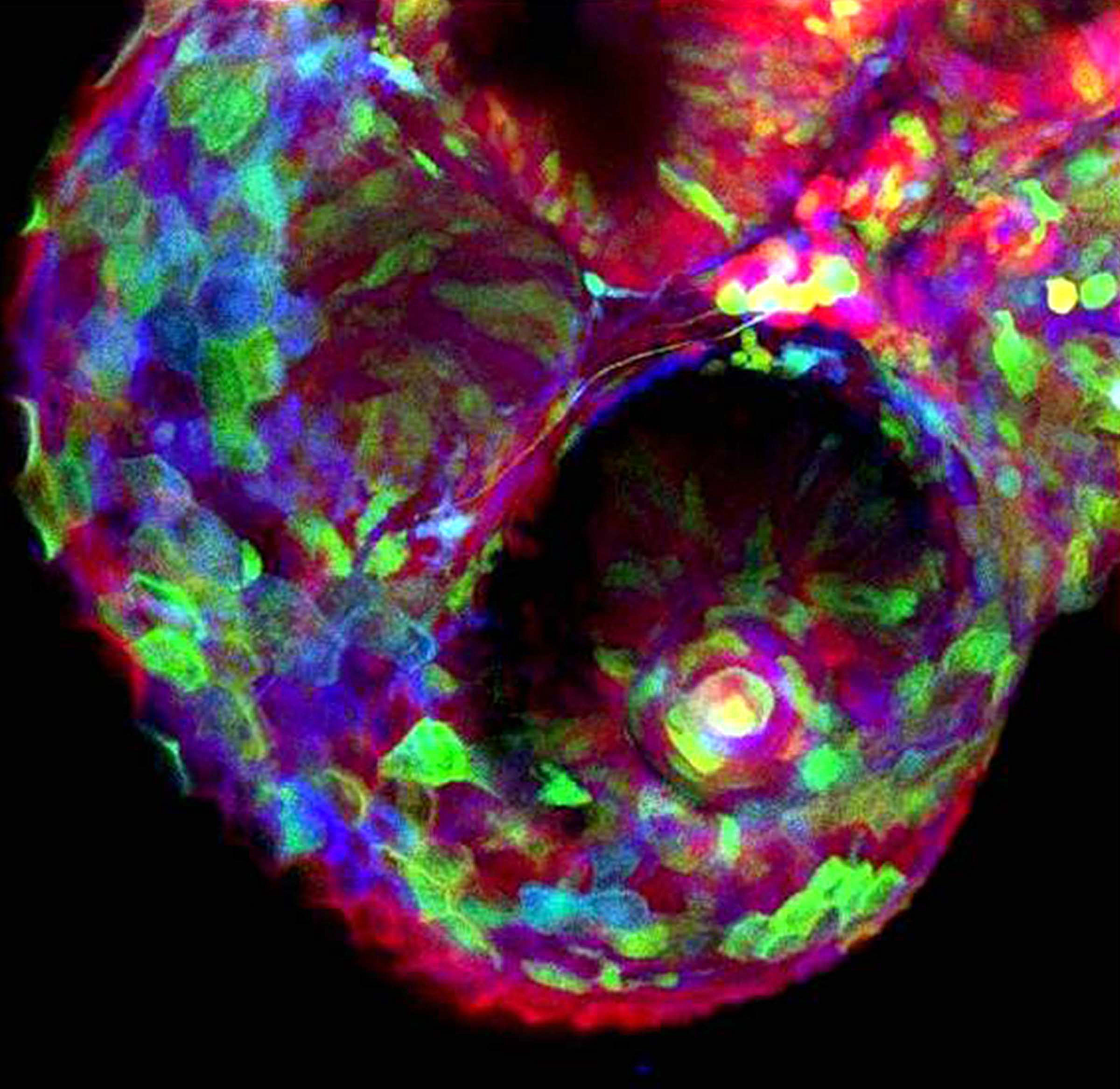
Many congratulations to Brijesh Kumar (Indian Institute of Technology, Kanpur), who took this image at last year course. The image shows a “zebrabow” zebrafish (Danio rerio) embryo, 2 days post-fertilization. 4-Hydroxytamoxifen (4-OHT) was administered at 24 hr post-fertilization, leading to ubiquitous expression of active Cre recombinase, and subsequent expression of GFP, RFP and CFP after recombination. It was imaged on a Zeiss LSM 700 confocal.
The other great images in this round were taken by Mary Colasanto, University of Utah, and Sophia Tintori, University of North Carolina (short-tailed fruit bat); Ezgi Kunttas-Tatli, Carnegie Mellon University, and Duygu Ozpolat, University of Maryland (butterfly ovariole); and Georgina Stooke-Vaughan, University of Sheffield (mouse embryo).
The winning zebrabow image will feature in the cover of a coming issue of Development. Look out for another round of beautiful images soon!
The ‘Development Show’ (or ‘Devo Show’) was a 1-hour comedy presentation from Curtis Loer and Morris Maduro at the 2014 Society for Developmental Biology (SDB) meeting held at University of Washington, Seattle, and is now available on YouTube.
The Devo Show is an adaptation of several “Worm Shows” as given by Curtis Loer and Morris Maduro at the biennial International C. elegans Meetings since 2005. They were invited by the current SDB President, Dr. Martin Chalfie, to present a similar show to the 2014 SDB Meeting. The show featured such things as interviews with people at the meeting, a music video parody (Smells Like Development), “Talks Not Selected”, a Top 10 list, and a 10-minute sitcom parody (The Lab). More information is here.
I have been a postdoc in London, alas at King’s College London (more on the reason for this regret in future), for 5 years now. There are some great things about London that overcome the horrendous prices and the relentless advance of painfully (un)cool hipster culture. If you are a bit of an obsessive developmental biologist, then YEM is one of them. Started by PhD students at UCL just before my time, this meeting, held with the kind support of Yoshiyuki Yamamoto (‘Yama’ to his friends and colleagues), I am reliably informed was initially nothing more than a geeks’ talking shop. The 2014 edition happened on the 27th June. It was massive. Delegates travelled from as far afield as Mill Hill. That is genuinely (I looked it up) in zone 4. There were even rumours that one of the speakers was from some obscure further education college near David Cameron’s home village.
Anyway, enough of the bad digression. The meeting has grown each year and now seems almost as large as a national society conference. This is to the enormous credit of the founders, the participants, but perhaps most of all, the organisers. To summarise, it was ace. As such, I thought I would post a very unofficial review. I have only picked talks that I particularly felt strongly about/enjoyed/didn’t fall asleep in, so my apologies to those I don’t mention. I have many anachronistic (many would say at best out-of-date and at worst downright ignorant) scientific views, so you shouldn’t feel at all slighted. Any opinions that follow are entirely my own and any disgruntled speakers, please find me at a conference where I will be happy to apologise and, if necessary, lubricate the apology with beer.
Dang Vinh Do (NUS & Cambridge)
We kick off (sorry, I was writing this during the World Cup though) with very early mammalian development, specifically the specification of lineages within the early mammalian blastocyst. This is a fascinating topic and one that has received huge attention over the last few years, not least because of the obviously huge potential medical implications. In the first talk, Dang Vinh Do described his work outlining the role of the JAK-STAT signalling pathway in maintaining the fate of the Inner Cell Mass that will form the embryo proper. This sounds a simple story, but it actually involved some really elegant genetics. The authors demonstrated that STAT3 was actually expressed maternally (in the egg). This nicely explained a paradox in the field: STAT3 was known to be crucial for embryonic stem cells in culture, but the knockout mouse made it to e6.5. What’s going on? To nail this contention that it was the maternal expression that was crucial, Dang Vinh Do ingeniously crossed female knockouts to male heterozygotes, and recapitulated the ESC phenotype. In his mice, the ICM was formed, but then subsequently Oct4 (one of the Yamanaka factors crucial for its development) disappeared and Cdx2 (a marker of the trophoectoderm) expanded. The mice made an embryo, but then lost it. Paradox solved. Dang has now (I think) moved to the germ cell lineage and to that technical college in East Anglia. I expect great things.
Mubeen Goolam (Cambridge)
Moving along in development, Mubeen Goolam (form a different lab in that technical college in East Anglia) spoke about his doctoral work examining Satb1, which is expressed preferentially in the ‘inner’ cells at the 16-cell stage of the developing embryo. Mirroring the situation with STAT3, a clear ES cell phenotype where Satb1 is required for differentiation into primitive endoderm is not revealed in the knockout mouse, which dies postnatally. Again, the answer was maternal expression, which when knocked down with siRNA yields a decreased amount of primitive endoderm, as judged by Sox17 expression. Now, a big theme in vertebrate development is the functional redundancy between paralagous developmental genes (a hangover from the whole genome duplications that kicked off vertebrate evolution in a lineage of unimpressive tiny chordates swimming around in the sea some 500 million years ago). However, remarkably in this case, the paralogue of Satb1, Satb2 has an antagonistic function – the satb1 knockdown phenotype is rescued by knocking down satb2. Not for the first time recently, I am left with the abiding feeling that early mouse development is profoundly unusual.
Erica Namigai (Oxford)
Staying on very early development (I do have other interests) Erica Namigai presented her doctoral work on the marine worm Pomatoceros lamarckii. This work, for me, highlighted the folly of concentrating scientific work on a small number of model organisms and the possibilities that accompany scientific decisions based solely on curiosity. There are basically no experimental techniques available in annelid worms. None. Well, you can chuck drugs on the embryos and see what happens, but for the moment that’s it. However, Erica’s work highlights the value of looking at things very carefully. In characterising early development, she noticed that remarkably (to my knowledge anyway) the second cell division is not coordinated. In 38% of embryos, there is a 3-cell stage. Now, this might just illustrate that Pomatoceros is not very good at developing under experimental conditions, but it set Erica thinking about how chirality is generated – how you make a left-right axis and break bilateral symmetry. Using some very trendy fluorescent labelling of vesicles as a way to visualise the cytoskeleton with light sheet microscopy, Erica showed that even at the two-cell stage, there is asymmetric distribution of cellular components that prefigures the eight cell stage when left-right asymmetry had previously been known to be established. Thus, in contrast to vertebrates and insects, the left-right axis can be set incredibly early and can in fact be the first body axis to form, not the last.
Daniele Soroidoni (Mill Hill)
Now, as I said, I am quite old-fashioned in some ways. I think, as I once heard Peter Lawrence say (at the first YEM I went to) that it’s really important to spend a lot of time just looking at stuff. Danielle Soroidoni, examining somitogenesis, did exactly this by taking advantage of the beautiful live imaging possible in the zebrafish. He generated a series of complex mathematical model describing the process and showing that the somitogenesis ‘clock’ was not in fact a clock and wave but a couple of waves with clockish oscillations that varied in amplitude across the anterior-posterior axis and eventually caught up with one another. I must confess, I finished feeling rather disorientated. In fact, my gathering thoughts were summed up by a questioner who posed a wonderful question, albeit a little bit confrontationally (I am paraphrasing slightly): ‘’does your descriptive analyses, however sophisticated and beautiful, tell us anything beyond the fact that the use of the word ‘clock’ in ‘segmentation clock’ is simply a metaphor?’’ Now, my sympathy is absolutely with the questioner (I like molecular mechanisms), but this kind of scientific difference of opinion (and even philosophy?) is absolutely why this kind of elegant descriptive work should exist. It makes people think.
Joseph Grice (Mill Hill)
The last talk I will mention is that by Joe Grice, which I loved. Despite not being able to turn on the computer (and being terribly English and affable about the whole thing – in my notes I wrote ‘I like him already!’), he nevertheless proceeding to give a fascinating talk using high-end comparative genomics. Through a combination of genomic analysis and transgenic assays in the zebrafish, he identified Hox/meis site combinations in regulatory elements that drive segment-specific expression in the vertebrate hindbrain. It is thus likely that these elements facilitated the evolution of such segmental gene expression patterns, linking the pre-existing Hox code with newly evolved segmentation in the hindbrain. Like the meeting as a whole, terrific stuff.
The 4th Wellcome Trust Epigenomics of Common Diseases conference will bring together leading scientists from the fields of epigenomics, genetics and bioinformatics to discuss the latest developments in this fast-moving field.
Epigenetic variation plays an important role in all disease processes in addition to cancer. Technological advancements have revealed significant associations between changes to the epigenome and the development of many diseases, but causality has not yet been established. The growing list of disease-associated epigenetic changes continues to emphasize the importance of understanding the role of the epigenome in disease regulation.
This meeting will focus on epigenomic studies across a wide range of common and other diseases. It will explore the validation and replication of epigenome-wide association studies, and discuss the latest functional studies and model systems to understand epigenomic regulation. The 2014 programme will also include a debate on transgenerational epigenetic inheritance.
We welcome abstracts from all areas relevant to epigenetic and epigenomic research. Several oral presentations will be chosen from the abstracts submitted.
Topics will include:
Epigenomics of disease
Model systems: animal and cellular models
Epigenetic gene regulation
Epigenetic epidemiology
Transgenerational epigenomics
Integration of genomics and epigenomics
Informatics and technology
Environmental epigenomics
Single cell epigenomics
Scientific programme committee
Stephan Beck University College London, UK
Susan Clark The Garvan Institute of Medical Research, Australia
Andy Feinberg Johns Hopkins University School of Medicine, USA
Caroline Relton University of Bristol, UK
Abstract deadline: 9 September
Registration deadline: 30 September
For more information, visit: https://registration.hinxton.wellcome.ac.uk/display_info.asp?id=441
The Anand lab is broadly interested in identifying and characterizing non-coding RNAs, especially microRNAs, in the regulation of developmental and pathological angiogenesis. Our work involves molecular biology techniques (Expression profiling, functional genomics, qPCR, cloning), cell biology (Confocal imaging, 3D cell culture, flow cytometry, bioluminescence assays) and uses in vitro, in vivo model systems. Our goal is to both understand the functional role of non-coding RNAs in the vasculature and seek ways to exploit these molecules for diagnostic and/or therapeutic purposes.
Qualifications
Required:
PhD, MD or MD/PhD in Molecular Biology/Cell Biology/Immunology or relevant areas.
At least one first author paper in a good journal and not more than 2 years post PhD experience.
Passion and high degree of enthusiasm for science.
Good analytical skills.
Ability to prioritize multiple tasks at one time.
Must have excellent communication skills: both written and verbal.
Ability to work independently and as part of a team.
Experience with gene expression screens/functional genomics.
Experience with synthetic biology tools is desirable.
Additional Details:
OHSU is an equal opportunity, affirmative action institution. All qualified applicants will receive consideration for employment and will not be discriminated against on the basis of disability or protected veteran status. Applicants with disabilities can request reasonable accommodation by contacting the Affirmative Action and Equal Opportunity Department at 503-494-5148.
Marco Milán leads the Development and Growth Control Laboratory (Battista/Minocri, IRB Barcelona)
The Phd student Lara Barrio worked on the role of p53 in metabolism (Battista/Minocri, IRB Barcelona)
Scientists at IRB Barcelona have observed that, when deprived of food, flies that do not express p53 show poor management of energy store.
The study, published today in Cell Reports, further supports the involvement of this molecule—traditionally associated with tumour suppression—in metabolism.
The researchers provide new insights to study p53 function in metabolic diseases such as diabetes and obesity.
Most scientific literature devoted to the protein p53 refers to cancer biology, and the functions of this molecule as a tumour suppressor have been described in detail. Furthermore, also in cancer biology, it is known that p53 inhibits the metabolic pathways of tumour cells in order to block their metabolism and prevent their rapid growth and proliferation.
The most innovative research on p53 attempts to unveil its functions in the management of energy stores and nutrients in healthy cells. Recent studies with cell cultures have demonstrated that p53 is activated in response to nutrient depletion. This observation thus opens up a promising field of research into the role of p53 in metabolism and cell health.
This is precisely the field tackled in a study performed by scientists headed by ICREA Research Professor Marco Milán, at the Institute for Research in Biomedicine (IRB Barcelona). In this work, published today in Cell Reports, the authors show that in the fly Drosophila melanogaster p53 is activated in certain cells to adapt the metabolic response to nutrient deprivation, thus having a global effect on the organism.
The researchers also reveal the molecular mechanisms through which the activity of p53 is regulated. The results obtained in Drosophila are useful to address the study of the molecular mechanisms of p53 in vertebrate models and to examine whether this protein is involved in diabetes and obesity.
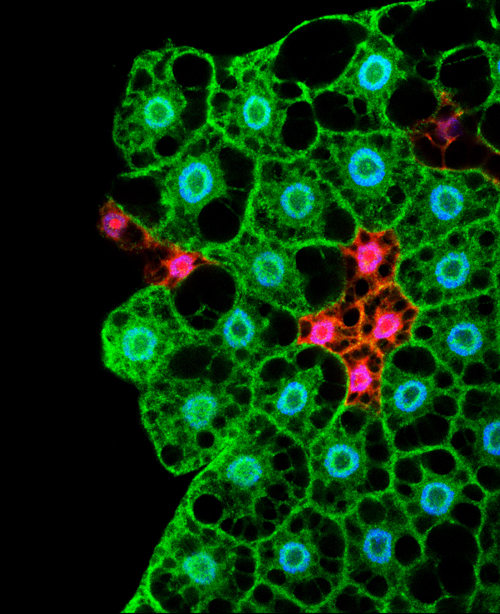
Microscopy image showing cells of the fat body. In Drosophila the storage and management of energy is regulated by cells from this tissue (Lara Barrio, IRB Barcelona)
Drosophila as a model to study diabetes and obesity
In humans, nutrient management is organised by a coordinated system involving cells from adipose tissue and from organs such as the pancreas and liver. When we eat, a complex system is triggered in which the hormones insulin and glucagon are responsible for distributing nutrients among tissues and storing them for later use. In Drosophila the storage and management of energy is regulated by cells from a tissue known as the fat body.
“Through this study we demonstrate that Drosophila is useful to study the adaptive response of an organism to the presence or absence of food and to examine the systemic response. In addition, this model contributes to revealing the molecular mechanisms activated and that work in the same way in vertebrates,” explains Milán, head of the Development and Growth Control Lab at IRB. “In fact, we can now generate diabetic and obese flies to study these metabolic diseases at the molecular level.”
p53 allows energy use to be adjusted in order to optimise energy stores
The scientists studied the function of p53 in fasting flies in order to unveil the metabolic response of the organism. When no food is available, p53 is activated exclusively in cells of the fat body. The activity of this protein induces a change in the metabolism of these cells in such a way that they stop using glucose and make new nutrients to fuel the surrounding tissues.
“p53 acts as a sensor of the fat body of the fly. It makes cells “tighten their belts” in order to use energy stores prudently and makes them act unselfishly in order to ensure a supply to other cells,” describes Lara Barrio, first author of the article and a PhD student in Marco Milán’s lab. The key role of p53 in metabolism is reflected by the fact that flies in which p53 is inhibited die more quickly.
The team believes that this work with Drosophila will pave the way to more in-depth research into the biology and functions of p53 in metabolism and associated diseases. “It would be particularly interesting,” say the scientists, “to address vertebrates and analyse the participation of p53 in diabetes and obesity and the cardiovascular conditions associated with these metabolic disorders.”
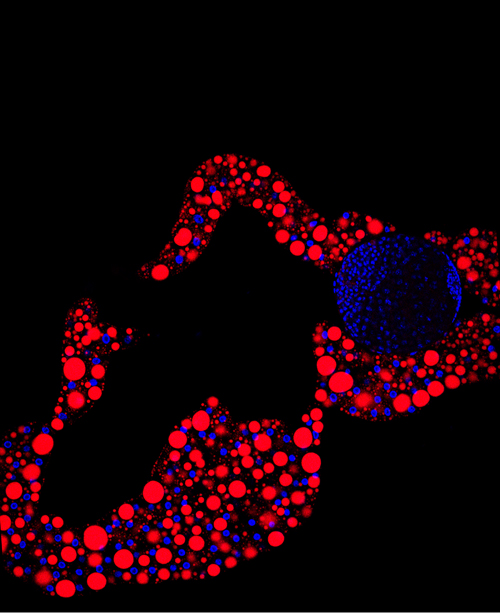
Image of the fat body tissue. In red, structures responsible for storing lipids (Lara Barrio, IRB Barcelona)
Reference article:
MicroRNA-Mediated Regulation of Dp53 in the Drosophila Fat Body Contributes to Metabolic Adaptation to Nutrient Deprivation
Lara Barrio, Andrés Dekanty, and Marco Milán
Cell Reports (2014) http://dx.doi.org/10.1016/j.celrep.2014.06.020
This article was first published on the 24th of July 2014 in the news section of the IRB Barcelona website
Turtles are strange organisms, and their development is wonderfully idiosyncratic. What other vertebrate alters its bone development to make an ossified mobile home? The turtle has perplexed biologists for many reasons. Where did turtles come from and to whom are they related? How did this different body plan arise developmentally and evolutionarily? The pieces of this puzzle are coming together with the help of technological advances that are revealing cryptic aspects about the development of these fascinating animals.
One can often recognize different species of turtles by the shape and pigmentation of their scutes (“Scutum” being the Latin word for shield), or modified scales, that cover the turtle shell in a tessellation. Scutes are interesting developmentally because they grow radially to cover the entire shell, and this growth must be coordinated with that of the underlying bones of the shell (though, the patterns of scutes and bones are different). Evolutionarily, scutes are interesting because few groups of turtles vary in the number of scutes on the carapace (dorsal part of the shell), and certain freshwater and marine taxa have lost these structures altogether.
Our Development paper ”The origin and loss of periodic patterning in the turtle shell” examines the development and variation (normal and abnormal) of turtle scute formation, integrating two areas of evolutionary developmental biology that are usually separated: The developmental origins of evolutionary novelty and the mechanisms of developmental constraints. To do this, we have combined several approaches, integrating techniques from developmental biology (in situ hybridization and organ culture), theoretical biology (computational modeling), evolutionary biology (comparative morphology and phylogeny), and physics (micro-computed tomography).
Have we mentioned that turtles are seasonal breeders? Much progress has been made in the application of molecular genetic technologies to non-model organisms; however, the reproductive ecology of animals such as turtles can make the investigation of their developmental dynamics an odyssey. Though our laboratories are located in Helsinki (Finland) and Pennsylvania, our eggs come from turtle farms in Louisiana. In one season, we discovered that an array of patterned placodes generates the scutes of the shell. The following summer, we added drugs to the culture media to look at candidate developmental signaling pathways, and found that the placodal pattern requires Shh, Bmp, and Fgf signaling to form properly. We also acquired specimens of a turtle species that has lost its scutes, and found that these placodes are absent from that turtle. During the “off-season,” we developed computational models of scute formation, and hypothesized how both natural and abnormal variation is generated in turtle scutes. Finally, last summer, we tested hypotheses generated by the model with the addition of protein-soaked beads to our cultures.
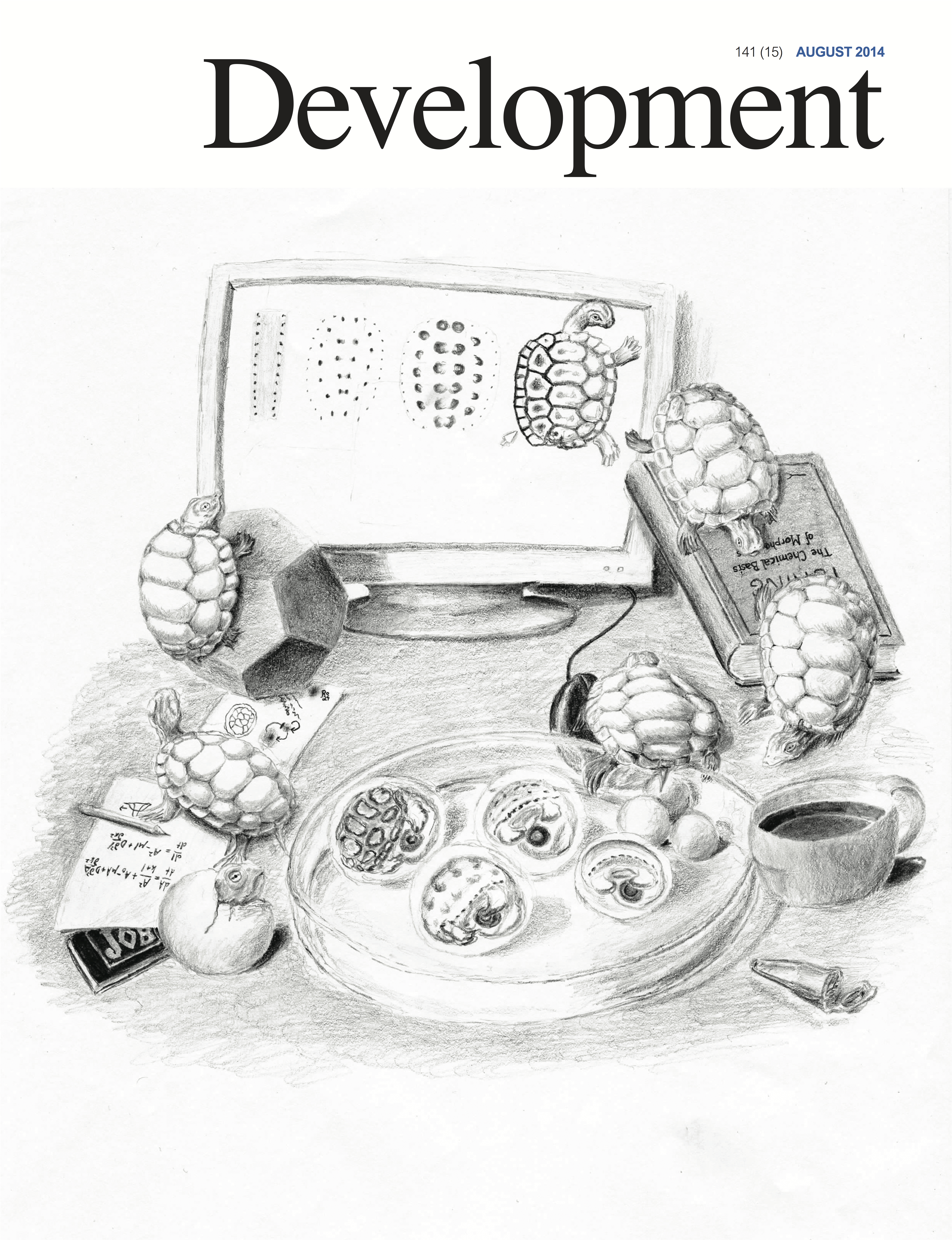
Such unbroken interlocking of shapes in a two-dimensional space is called tessellation, and one of the best-known artists whose work is linked to tessellation patterns is the Dutch graphic artist M. C. Escher. The illustration for the cover of the journal pays homage to Escher, and was done by Roland Zimm, the researcher who did the majority of the mathematical modeling in this article. Taking advantage of the geometrical parallels in his art, he re-drew a famous drawing of Escher’s, Reptiles in a modified way to depict key elements of our experiments. He gave himself the challenge of visualizing a unification of development in vivo and in silico, by integrating computational simulations within an idealized life circle of “real” turtles. A second homage is given to Alan Turing, who was a pioneer both in the fields of the foundations of computers and natural pattern formation. Turing’s reaction-diffusion mechanism is central to our hypothesis of scute patterning. This integration of computational modeling, experimental evo-devo, and classical art emphasizes the importance of cohesive interdisciplinarity in life sciences.


 Research and news: