FRT sites are used often (at least in Drosophila) for inducing deletions or “flipping out” of markers in transgenic constructs.
When there are two FRTs sequences in tandem, after inducing flippase the DNA sequence that is between these two sites will be deleted. If two FRT sites are facing each other (or looking away), the DNA that sits in between them can be inverted after induction of flippase.
Fig. 1: different behavior of flippase induced recombination of FRT sites. Left: sin the situation where two FRT sites are in different orientation, the DNA laying between them (the thick line with a red to yellow coloration) can be inverted. As the FRT sites are not deleted in the process, the inversion can happen many times. Right: If the FRT sites sit in tandem on the DNA (thick line), the DNA laying in between them can be deleted. Only one FRT site is left on the original DNA.
Figure 1 illustrates how important the orientation of the FRT sites is for experimental design. So there should be a convention on how to label the orientation of those elements (as I did in the figure above, where the arrow shows from 5′ end to 3′ end of the element). Most scientist draw the FRT sites in a similar way on their plasmid maps. The big problem is, that this is not done in a consistent way.
This is a clear definition of orientation, and the article writers took this information out of a paper published in 1994 (Schlake and Bode, Biochemistry 33 (43): 12746–12751).
Others use a different annotation of the FRT element, where exactly the other strand is the leading strand (for example in “Drosophila, a laboratory handbook”, Ashburner et al., second edition).
This can cause some problems, especially when sharing plasmids and flies between laboratories or even between people in the same lab. One has to be consistent, and not trust the graphic map of a plasmid, but its sequence.
I hope this blog post helps other scientists to prevent the bad luck I had with experimental design. Always check the sequence and be consistent :)
Do you need to learn a new technique? Are you planning a collaborative visit?
Then The Company of Biologists and Development can help! We offer Travelling Fellowships of up to £2,500 to cover the costs of travel, accommodation, subsistence and visa fees. The next deadline for applications is the 30th of April! Find more information about how to apply in the Travelling Fellowships website.
Another installment from the Developmental Neurobiology Students at Reed College. Hope you enjoy!
It’s not often that you get to recount the classic tale of Stone Soup when thinking about developmental biology, but that’s exactly what we did when discussing an almost classic 2011 Nature paper from Yoshiki Sasai’s group.
In the story, a grumpy widow is about to turn a hungry traveler away until he says, “But all I need is a pot, and I will make you a delicious soup.” Producing a single stone, he says “put some water on to boil; you’ll be amazed at the result.” After a few minutes of stirring the traveler smells his mix. “Could use some carrots,” he murmurs to himself, and overhearing him, the widow replies “Oh! Those I’ve got!” And so on with onions, and potatoes, and greens until a full-bodied stew results. The soup begins as a rock but adopts its recognizable form in response to the continually changing conditions.
Morphogenesis is the process through which an organism, or a part of an organism, acquires its specific shape. Although the making of stone soup doesn’t seem to have much in common with embryonic morphogenesis, both processes require the sequential addition of specific ingredients to generate a complex result. A multicellular organism begins as a collection of undifferentiated cells (kind of like the stone and water). Then, in response to genetically-encoded programs, its cells acquire identities, forming tissues and undergoing morphogenetic movements. In a way, cells follow a temporal and spatial recipe, slowly changing to make a specific functional part of the organism.
Since the early 20th century, the study of morphogenesis has focused on how mechanical and chemical signals work together to produce identifiable organisms. Because development of the eye occurs in discrete steps that are easy to follow, eye morphogenesis has been the focus of many studies. After eye cells are initially specified, distinct ocular tissues – neural retina (NR), retinal pigmented epithelium (RPE), and optic stalk – take shape from three distinct tissue types – neural ectoderm, mesenchyme, and epithelium, respectively (see this comprehensive review of eye morphogenesis by Sabine Fuhrmann, 2010).
Although a number of studies have begun to shed light on the steps of eye morphogenesis, the mechanisms that initiate tissue folding and bending remain elusive. To tackle this question, Yoshiki Sasai’s lab induced eye growth from mouse embryonic stem cells with a specific recipe of basement-membrane components and a cocktail of signaling molecules, including the TGF-beta family member, Nodal. In just nine days, the stem cells underwent four distinct phases to produce an optic cup replete with stratified neural retina and RPE.
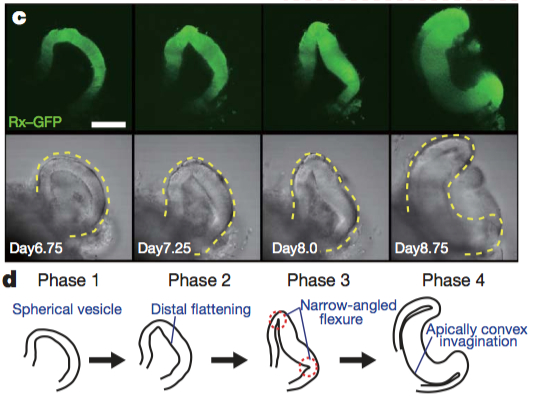
Together, the four phases of morphogenesis consist of three distinct processes that produce and depend on the formation of a hinge-like structure that ultimately becomes the rim of the optic cup (see Figure below). In phase one, spherical pockets, reminiscent of optic vesicles, form. In phase two, the distal surface of the spheres flatten to begin the invagination process, requiring actomyosin activity. In phase three, the edges between the flattened surface and the rounded part form hinges through apical constriction. In phase four, the optic cup becomes fully-developed, with the rim of the optic cup encircled by a “closed” hinge.
Images reprinted from from Figure 2 of “Self-organizing optic-cup morphogenesis in three-dimensional culture” in Nature, April 6, 2011 (vol 472, issue 7341) by Mototsugu Eiraku, Nozomu Takata, Hiroki Ishibashi, Masako Kawada, Eriko Sakakura, Satoru Okuda. Used with permission of Nature Publishing Group.
As we thought about how the optic vesicle folds to make the optic cup, it was helpful for us to think of another analogy: the wrinkly fingertips you get after doing dishes. Water is absorbed into your skin as you scrub that fourth pot (left over from making stone soup). The outermost layer of skin expands until its volume exceeds the flat surface that it occupies on each finger pad. For the skin to continue to fit over the small area of your fingertip, it puckers, forming hills and valleys at regular intervals. The developing eye appears to use this same principle, with one large, carefully guided wrinkle generating an eye’s shape.
Higher levels of proliferation in the distal part of the optic vesicle cause the developing neural retina to first swell and then fold inward. This inward folding is driven by two opposing physical properties that manifest in the NR and the RPE. Overtime, the NR and RPE exhibit distinct differences in rate of expansion (volume) and rigidity. Initially the entire optic vesicle is uniformly rigid (Phase 1), reinforced by an actin cortex with phosphorylated myosin light chain (pMLC) cross-bridges. Changes in activity and/or distribution of myosin light chain kinase leads to an accumulation of pMLC only along the apical surface of RPE cells (Phase 2). As proliferation in the presumptive NR continues, cells at the junction between the NR and RPE undergo apical constriction (Phase 3) and the NR completely invaginates (Phase 4).
This is the first study to recapitulate eye morphogenesis in vitro, providing evidence that complex, laminated pockets of neural tissue can self-organize to produce a retina. Although Eiraku et al. (2011), offer clear evidence that an optic cup can form spontaneously, without surface ectoderm (lens) or other neural ectoderm (brain), it is important to note, the earliest stages of specification and morphogenesis occurred only in a particular “soup” of extrinsic factors and specific culture conditions. This paper provides the foundation for understanding how delicate genetic cascades and self-organizing principles work together – like a time-sensitive recipe – to generate functional retina, and it reveals the power of stem cells, opening up new avenues for research into retinal regeneration as demonstrated by this 2012 Cell Stem Cell paper.
References:
Eiraku, M., Takata, N., Ishibashi, H., Kawada, M., Sakakura, E., Okuda, S., Sekiguchi, K., Adachi, T., & Sasai, Y. (2011). Self-organizing optic-cup morphogenesis in three-dimensional culture Nature, 472 (7341), 51-56 DOI: 10.1038/nature09941
Fuhrmann, S. (2010). Eye Morphogenesis and Patterning of the Optic Vesicle Current Topics in Developmental Biology DOI: 10.1016/B978-0-12-385044-7.00003-5
Nakano, T., Ando, S., Takata, N., Kawada, M., Muguruma, K., Sekiguchi, K., Saito, K., Yonemura, S., Eiraku, M., & Sasai, Y. (2012). Self-Formation of Optic Cups and Storable Stratified Neural Retina from Human ESCs Cell Stem Cell, 10 (6), 771-785 DOI: 10.1016/j.stem.2012.05.009
Each year, the British Society for Developmental Biology (BSDB) awards the Beddington Medal to the best PhD thesis in developmental biology. This year’s award went to William Razzell, who completed his PhD in Paul Martin’s lab at the University of Bristol. At the BSDB Spring Meeting last month, Will presented his thesis studies of wound healing, in which he’d used Drosophila as a model. We caught up with Will after his talk to ask him more about his work, to find out what he’s doing now, and to ask him if he has any advice for PhD students.
Congratulations on winning the Beddington Medal. Can you tell us a bit more about your thesis work?
Thank you. I used the Drosophila embryo to model two aspects of wound healing. First, I looked at how innate immune cells are rapidly recruited to wounds in response to a hydrogen peroxide signal, which is made by an enzyme called DUOX. I found that calcium signals in the wounded epidermis, that it can kick start the wound inflammatory process by activating DUOX, and that removing DUOX’s ability to sense calcium prevents hydrogen peroxide release and recruitment of innate immune cells. The second aspect I studied is how epithelial wounds in the Drosophila embryo repair, as they close extremely rapidly and efficiently compared to mammalian adult skin wounds. This is because they close by assembling an actomyosin cable that contracts the wound edges together until actin protrusions extending from the wound margin interdigitate to seal the epithelial hole. We know that these wound edge actin machineries are important for wound closure, but we know less about how cells surrounding the wound contribute to wound repair. I looked at cell shape changes associated with wound closure in the Drosophila embryo and saw that the cells have to stretch towards the wound but also shrink their junctions with neighbours in a myosin-dependent manner. This is important for remodelling the epithelium surrounding the wound edge, allowing for cell intercalation events, so that the actin cable can efficiently pull the wound edges together. The same events occur during an earlier developmental event in the embryo to drive tissue elongation, consistent with the idea that cells at the wound edge can reactivate developmental pathways in order to close the wound.
Obviously there are lots of different models you could have used, but you chose Drosophila as a model for studying wound repair. Why?
Drosophila have two really big advantages. One is that they are genetically-tractable, which means that we can do very rapid genetic studies on the embryo, such as genetic screening or efficiently mutating genes with ever advancing tools including CRISPR technology. The other huge advantage is that you can live image embryos. For example, we can simultaneously label and follow different populations of cells during wound closure, such as the damaged epithelium as it closes and the innate immune cells as they migrate to wounds. This gives us the opportunity to observe cell behaviours that contribute to wound closure live in the embryo and analyse how these very dynamic events contribute to wound repair.
What can your studies tells us about wound healing in humans?
Through these sorts of studies we can identify genes or signalling pathways that are involved in wound closure that might be conserved during mammalian wound healing. We can also use live imaging studies in Drosophila to get clues about how cell behaviours may contribute to closure of human wounds, which we cannot yet live image. For example, the junctional rearrangements I observed in Drosophila wound repair may give us clues into the junctional changes that could be involved during the repair of human epithelial wounds.
And I guess, in the long term, the aim is to improve that process?
Of course! We would really like to improve and speed up the wound healing process. At the moment, there are a lot of people who have chronic wounds or suffer from impaired wound healing or excessive scarring – we want to be able to enhance wound repair in these patients.
You recently moved to New York. Can you tell us about the work that you are doing there now?
I joined Jennifer Zallen’s lab at the Sloan Kettering Institute in New York. I’m using the Drosophila embryo again, but I’m now looking at the earlier developmental event of germband extension, in which cells undergo intercalation events driven by polarised recruitment of myosin to cell junctions. I want to understand the signalling pathways leading to this myosin behaviour, and how this contributes to global tissue architecture.
Do you have any advice for PhD students?
One thing I found particularly helpful during my PhD is talking about my science to absolutely everyone. Visiting PIs, other PhD students…just anyone! I have shown my confocal movies to my parents, and although they are not scientists they can still look at them and see things that I can’t. You focus on the same things every day, and just showing your results to someone else can really open up your view. Giving presentations is also a great way to meet people and discuss your science with others. I didn’t do enough of this during my PhD but I think it is definitely something that can be a huge advantage to any PhD student.
Razzell, W., Wood, W., & Martin, P. (2014). Recapitulation of morphogenetic cell shape changes enables wound re-epithelialisation Development DOI: 10.1242/dev.107045
– The British Library (London, UK) has launched a great exhibition about the beauty behind science visualisation. You can visit ‘Beautiful Science’ until the 26th of May.
– The Wellcome Trust’s Human Induced Pluripotent Stem Cells Initiative is calling for clinicians and scientiststo provide samples from patients with inherited genetic diseases for the project.
– Remember the fantastic ‘Inner Life of the Cell‘ animation? Harvard University and XVIVO got together again to create an updated version of the animation that reflects the chaos of a real cell.
I recently took part in the ‘I’m a scientist, get me out of here!’ outreach event. As soon as the school children found out I was a developmental geneticist and worked out what I did, one question I was repeatedly asked was: “what’s your favourite gene and why?” so for a bit of fun, I thought I’d share my thoughts and see what everyone else’s are too.
Now, I could have gone into detail about a gene of utmost importance in my work or one we literally couldn’t live without (although picking either of those would be tricky as that hardly narrows the list down). However, my first thought when picking my ‘favourite gene’ is always listing the funny-named ones that stuck out from my university lectures. That’s not to say these genes don’t also fit into the important and essential-to-life categories, but they have that added ‘pazzaz’ of an ear-catching name that would wake you from your university slumber, thinking “did he actually just say what I think he said…?”. So here is my shortlist, the top 5 genes based almost entirely on their names:
5. Tinman
Tinman is an absolute gem in the history of creative gene naming. As with all the best gene names, tinman is named after the phenotype seen in Drosophilia when it is suppressed. In case you haven’t guessed, mutating tinman in Drosophilia embryos results in flies without a heart, despite the rest of the embryo continuing to develop. The vertebrate relatives of this gene have been named under a much less creative process with NK2 homeobox genes making up the homologous family. Just in case the origin of the name is still unclear, think back to the magical land of Oz, where Dorothy meets the tinman whose only wish is to have a heart. A sweet tale; however, while the tinman in The Wizard of Oz was always sentimental anyway, tinman mutant Drosophilia don’t have the advantages of a fairytale ending…
4. Swiss cheese
You may find a theme with these genes as yet another gene with a brilliant name comes from the phenotypic description in flies. Think about the classic cartoon cheese and you’ve got a fairly good description of the adult fly brain seen in Drosophilia with a faulty version of the gene: full of holes. To be more precise, the swiss cheese mutant results in brain degeneration through apoptosis spreading from the CNS. Notably, the swiss cheese gene paved the way for the blue cheese gene, another gene which, when mutated, affects the fly brain in a way that may resemble the mouldy, marbled appearance of blue cheeses.
3. INDY
This gene has made the cut through its clever acronym name. INDY simply stands for ‘I’m not dead yet!’. In addition, the reference to the ‘Monty Python and the Holy Grail’ scene where a corpse being collected shouts “I’m not dead yet!” means this gene gets a strong haul of bonus points! This gene is shown to greatly extend the lifespan of fruit flies when mutated, so I guess the name makes sense as well. INDY is a nice example of scientists trying to hide jokes in their work; as of course we are a hilarious bunch of people.
2. Clark kent, superman and kryptonite (I know that’s cheating a bit!)
Finally stepping outside the realms of fruit flies, Arabidopsis thaliana has a lovely offering in a trio of genes that are named together. The clark kent and superman mutant genes make these plants extra macho – increasing the number of stamens found on their flowers. Superman mutants have an even greater increase than clark kent but if the kryptonite gene gains a mutation… uh oh! The mutation in the kryptonite gene causes both the clark kent and superman genes not to be expressed and makes the plant impotent. I think the naming of these genes greatly reflects the link many scientists share to the characters on ‘The Big Bang Theory’ and their passion for comic books!
1. Sonic hedgehog
Sonic hedgehog is possibly the most famous funny gene name and a personal favourite for sentimental reasons as well as the obvious brilliance of its name. Often shortened to SHH (although who would miss an opportunity to say ‘sonic hedgehog’ in full?), this gene is part of a gene family of hedgehogs with other mammalian relatives named desert hedgehog and indian hedgehog. I can vividly remember the development lecture I was sitting in when sonic hedgehog was first mentioned and how it took us all a good half an hour before someone bravely put their hand up to say what we were all thinking: “I’m sorry, are you actually saying this gene is named after a blue, speedy, cartoon hedgehog?!”. Well to put it simply, yes it is. Sonic hedgehog is heavily involved in vertebrate development and in flies the hedgehog mutant phenotype covers the surface of the Drosophilia in tiny pointy projections – similar to a hedgehog! In Zebrafish, hedgehog genes are also named tiggywinkle hedgehog and echidna hedgehog (although the latter is no longer commonly used) making full use of the creative possibilities stemming from naming a gene family ‘hedgehogs’.
The issue of gene naming has however come up in the news, and public opinion is divided. Whilst some of these creative gene names are amusing, memorable and sometimes quite clever, we have to remember that for every gene there is the potential for it to be implicated in a real disease or disorder. That means that somewhere, someone could be told that their child will not survive into adulthood because of mutations in their sonic hedgehog gene. I wouldn’t want to be the bearer of that bad news, let alone have to stand there and use a gene name like that in the explanation. Phenotypic description gene names have been useful in the past, especially as we began our exploration and discovery of genes. However, in a world now dominated by computers and bioinformatics, a more standard method for naming genes has to be implemented. Hence why many mammalian genes (whose functions were discovered after the original Drosophilia outbursts) are named based on structure and function, an attempt at moving gene naming into the same realms as taxonomy.
There are still plenty of genes around with somewhat hysterical names. Thankfully we now have alternatives for most, if not all, of these options, meaning the ‘in-jokes’ of science can be put in the past when necessary! For now though, peruse the options out there and be prepared for the inevitable question, ‘what’s your favourite gene…?’
Notable others (to google in your own free time!):
Science outreach often involves using metaphors, where a real life object or situation is used to explain a complex scientific concept. Last December we launched an outreach competition, and we asked the Node readers to submit pairs of images: a photograph of a real life scene and an image of the scientific concept that it helps explaining.
We can now announce the winners of this competition. Many congratulations to Ewart Kuijk, a post-doc at the Hubrecht Institute and author of the post Cellular Reincarnations, and Roel Hermsen, who is about to complete his PhD at the Hubrecht Institute ‘after which he will return to the “real world”’. They won a £50 Amazon voucher and a copy of Benny Shilo’s book on the outreach project that inspired this competition.
Here is their winning entry:
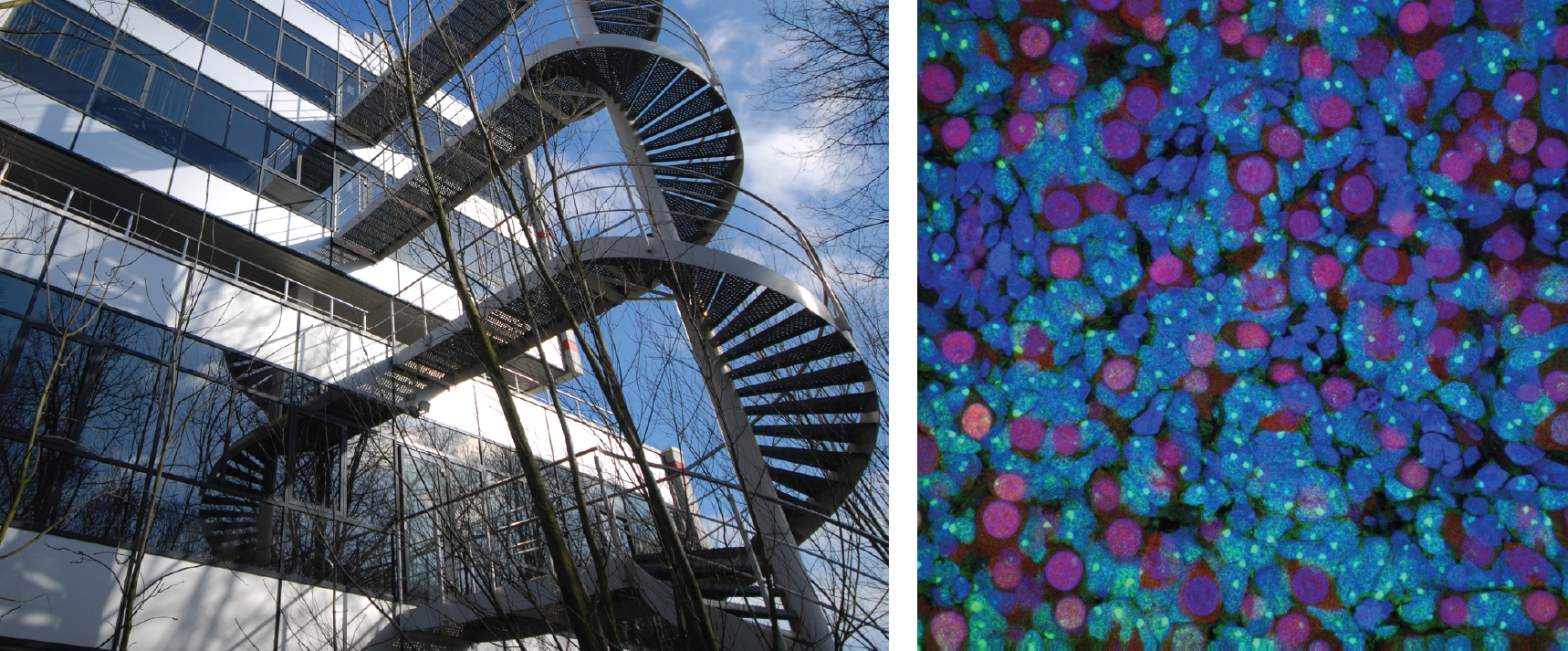
“The basis for life is encrypted in the DNA. Cells can activate or inactivate certain regions of their DNA by making it more or less accessible. Consequently, cells can be very different (e.g. heart cells versus neurons), while share the same genetic content. DNA accessibility and concomitant gene activity depends on the binding of specific proteins. The photograph of the “real world” shows an office building attached to a spiral staircase. The staircase represents the double-helix of the DNA and the building represents a DNA binding factor that modulates DNA accessibility. The scientific image is a picture of an embryonic ovary stained for H3K27me3 (green), DNA (blue), and a germ cell marker (red). Foci of H3K27me3 mark the inactivated X chromosome, of which the DNA is not accessible resulting in suppression of gene activity from this chromosome.”
We hope that this competition will inspire you to find a real life metaphor that can help you explain your work to the wider public! And our thanks to everyone who entered this competition.
This post is part of a series on science outreach. You can read the introduction to the series here and read other posts in this series here.
The “Nuit Blanche” in Paris. A city wide exposition of contemporary arts from dusk till dawn. Performances, light shows, dance, installations. Along the Canal Saint-Martin the visitors stroll from one exhibition to the next or sit down and take a break, chatting and drinking. A bit further up Boulevard Avenue Richerand the south-west entrance to the Hospital Saint Louis gives entry to a backyard. On the facade of the 17th century building, retinal pigmented epithelial cells perform their dance. Nothing but their cytoskeleton exposed in white before the dark building, magnified 10000-fold, accelerated 100-fold. One cell gets hold of a support beam, gradually spreading out over all its length. Loosing grip, rounding up and going into mitosis. Each daughter cell spreading out again. Other cells remain at one place, yet their cytoskeleton still moves, searching an exit from the confined space of a window.
When Manuel Thery came to me with the idea that we have to project cells onto a building – and cells which had been grown on micro-patterns in the shape of that same building – it was obvious that this idea simply had to be done. First, the general public has little access to all those beautiful images one takes when working with cells. Second, curiosity and “wanting to understand” needs to be promoted as a value by itself. Physics is not engineering, and biology is not R&D for pharmaceuticals. And the cytoskeleton with its appearing and disappearing regularities has the graphical power to draw you in and want you to grasp its function, without necessarily thinking about the benefit. Third, we try to find cues of how cells react to extracellular geometrical constraints in our day-to-day science, and we were curious ourselves, what we would see on these complex shapes. Fourth, as a structural scaffold for the cell (amongst other functions), the cytoskeleton shares some properties and constraints of engineering and architecture, and the metaphor has been made before. Fifth, simply, because we can.
The plan was simple:
1) take a photo of a public building
2) extract some interesting shapes from the building
3) produce micro-patterns of these shapes, the size of a single or several cells – micro-patterns are protein patterns for cell attachment on a substrate that otherwise repels cells
4) culture cells with fluorescently labeled cytoskeletal elements on these micro-patterns
5) do some live cell video microscopy
6) select the nicest videos and project the cells back on the original place of the pattern on the building, the size of the building, accelerated, for everyone to see.
Although that project may sound simple, it is by no means a one person, one weekend prep. At least, if you are a newbie to micro-patterning, live cell imaging, and your cell culture experience dates back more than a PhD’s time. Keep in mind that photo toxicity of the stain will kill the cells pretty quickly if you illuminate too strongly and frequently. On the other hand, if you want to play your time-lapse movies at a speed that people do not recognize it as a sequence of images, you need hundreds of frames for tens of seconds of footage, so you require days with an image every 5-10 min. And have cells survive under a microscope for 48h, on previously untested patterns of adhesive regions… is performing an experiment. And as such may just not work the first few times you try. Add the little pressure of a deadline (the day of the event that cannot be shifted).
But it gets even more involved with the work of the artists from the amazing Groupe Laps:
cut of the movie (the choreographies for the cells); giving the cells music to move to; correcting the image of the house for spherical aberration, so that the projection would align with the building; organizing the equipment for the projection; finding, in all those hundreds of movies, those that would be used; organizing the permissions to project onto the building; sticking non-reflecting foil over the windows on the day of the event; aligning the images with the features of the building; …
For someone having been involved in any sort of larger scale artistic event, all this may sound evident, but I was amazed by just how complex the basic idea would get.
Another change is the mindset between me and the artist. For them a cool sequence of cells would do. For me it also had to reflect a typical cell on these patterns – while still yielding footage with good enough contrasted structures to allow the projection.
Only on the evening itself did I see how well the composition by Groupe Laps had worked. It was very different from what I had imagined on the outset, and much richer for the fact that it did not look like all the images you would see in a publication – if you cared to project them on a house, that is.
Since we could not assume that the public would grasp that the images showed live cells, we also provided two information boards to describe the project in a short text as you might expect in an exhibition. However, we were surprised by the number of people who were at the event, and because a 10m high projection of something moving draws more attention than 1m high panel of written text, only a minority took advantage. Therefore, the level of understanding ranged from fellow scientists “yay, z-stack of microtubules”, over raising curiosity with many, to some complete ignorance that this had anything to do with biology. On the other hand, many spectators were clearly drawn in by the videos, watching the installation several times over. And I like to believe there was a lot wider spectrum of interpretation and thought, specifically because there was no classroom-ready explanation available.
In the case that you plan an outreach activity with collaborators foreign to your field or even science, my main advise would be to make sure you take the time to collaborate closely; to get to know each other and mutually showing additional possibilities and clarifying impossibilities on either side takes some iterations. This may apply less to smaller events, or repeating ones, where you can learn on the job and grow the event slowly. But for larger scale one-offs this is paramount. In fact, the sole regret I have about my experience with the nuit blanche project is that – because of distance and safety regulations – I could never show the involved artists our laboratories, so my work still remains abstract to them, and that we did not have regular “lab”-meetings, as is the case with my research.
If you ask yourself whether you should get involved in some outreach activity of the sort, involving people foreign to science, and specifically if you are not familiar with their line of work: Do it! It broadens the horizon and experiencing some recognition from someone outside of ones usual line of work has a special quality for both sides.
This post is part of a series on science outreach. You can read the introduction to the series here and read other posts in this series here.
The latest issue of Development includes a paper by Clare Blackburn and colleagues at the Medical Research Council Centre for Regenerative Medicine, University of Edinburgh, showing that the aged mouse thymus can be regenerated in vivo by the upregulation of a single transcription factor, FOXN1. This work has generated quite a lot of interest in the media, so we reproduce below the press release by the Medical Research Council. You can read the research article here.
Caroline Hendry, PhD
Stem Cells & Regeneration Reviews Editor at Development
Scientists regenerate immune organ in mice
Scientists have for the first time used regenerative medicine to fully restore a degenerated organ in a living animal, a discovery that could pave the way for future human therapies.
The team from the Medical Research Council (MRC) Centre for Regenerative Medicine, at the University of Edinburgh, rebuilt the thymus of very old mice by reactivating a natural mechanism that gets shut down with age.
The regenerated thymus was very similar to one in a young mouse in terms of structure and the genes expressed. The function of the organ was also restored, and mice receiving the treatment began making more T cells – a type of white blood cell important in fighting infection. However, the researchers do not yet know if the immune system of the older mice was strengthened. The research is published today in the journal Development.
Professor Clare Blackburn from the MRC Centre for Regenerative Medicine, at the University of Edinburgh, who led the research, said:
“By targeting a single protein, we have been able to almost completely reverse age-related shrinking of the thymus. Our results suggest that targeting the same pathway in humans may improve thymus function and therefore boost immunity in elderly patients, or those with a suppressed immune system. However, before we test this in humans we need to carry out more work to make sure the process can be tightly controlled.”
The thymus, located in front of the heart, is the first organ to deteriorate as we age. This shrinking is one of the main reasons our immune system becomes less effective and we lose the ability to fight off new infections, such as flu, as we get older.
Researchers targeted a key part of this process – a protein called FOXN1, which helps to control how important genes in the thymus are switched on. They used genetically modified mice to enable them to increase levels of this protein using chemical signals. By doing so they managed to instruct immature cells in the thymus – similar to stem cells – to rebuild the organ in the older mice. The regenerated thymus was more than twice the size than in the untreated mice.
Dr Rob Buckle, Head of Regenerative Medicine at the MRC, said:
“One of the key goals in regenerative medicine is harnessing the body’s own repair mechanisms and manipulating these in a controlled way to treat disease. This interesting study suggests that organ regeneration in a mammal can be directed by manipulation of a single protein, which is likely to have broad implications for other areas of regenerative biology.”
Previous attempts to provoke thymus regeneration have involved using sex hormones, but these have resulted in only temporary recovery of size and function of the organ. In this study, the recovery of the thymus was sustainable, but more work is needed to ensure there are no unintended consequences of increasing FOXN1.
The research was funded by Leukaemia and Lymphoma Research, the Darwin Trust of Edinburgh, the MRC and the European Union.
Bredenkamp, N., Nowell, C., & Blackburn, C. (2014). Regeneration of the aged thymus by a single transcription factor Development, 141 (8), 1627-1637 DOI: 10.1242/dev.103614
The pathological atrophy of skeletal muscle is a serious biomedical problem for which no effective treatment is currently available. Those most affected populations are the elderly diagnosed with sarcopenia and patients with cancer, AIDS, and other infectious diseases that develop cachexia.
A study by scientists at the Institute for Research in Biomedicine (IRB), headed by Antonio Zorzano, also full professor of the University of Barcelona, reveals a potential therapeutic target to tackle muscle wasting in these risk populations.
In the study published today in the Journal of Clinical Investigation (JCI), one of the journals with highest impact in experimental medicine, the researchers associate the activity of the DOR protein with muscle atrophy and point to DOR as a plausible target against which to develop a drug to prevent muscle deterioration in certain diseases.
DOR (Diabetes- and Obesity-regulated gene), also known as TP53INP2, is a protein involved in autophagy, a quality control process that ensures cells stay healthy. The researchers have found that increased DOR expression in the muscle of diabetic mice leads to enhanced autophagy, which in turn favours the loss of muscle mass in these animals.
The advantage of developing a DOR inhibitor is that autophagy, a process necessary to keep cells healthy, would not be completely blocked in the absence of this protein. DOR is not essential for autophagy, but acts more as an accelerator. Thus, the inhibition of DOR would only partially reduce autophagy as other molecules involved would exert their activity normally, thus maintaining the levels of autophagy in a beneficial range for cells.
“If we could treat patients with sarcopenia and cachexia, or people at risk of these conditions, using a drug to inhibitor DOR then we would be able to stop or prevent muscle wasting,” explains the expert in diabetes and obesity Zorzano, head of the “Heterogenic and Polygenic Diseases” lab at IRB.
“We are showing pharmaceutical researchers a new possible therapeutic target for two diseases that seriously impair the quality of lives of those who suffer from them,” says the scientist.
An answer to why type 2 diabetic patients lose less muscle than those with type 1
The study also solves a biomedical enigma related to diabetes. Physicians did not understand why patients with type 2 diabetes—who become resistance to insulin or have very low levels of this hormone—are able to maintain muscle mass or minimize muscle wasting compared to patients with type 1 diabetes—who do not produce insulin—who show a clear loss of muscle mass. The IRB researchers demonstrate that the repression of DOR in muscle cells of type 2 diabetic animals allows the maintenance of muscle mass.
“We interpret DOR repression, which occurs naturally, as an adaptation mechanism to preserve muscle mass and to maintain greater muscular strength in type 2 diabetics,” explains David Sala, first author of the study, who has recently started a post-doctoral training period at Sanford-Burnham Medical Research Institute, in La Jolla, California.
Besides working with mice, the scientists have performed experiments on biopsies from skeletal muscle of patients with diabetes and patients resistant to insulin, thanks to collaboration with clinicians from the Université Lyon 1, in France, and from the Medical University of Byalistok, Poland, also included among the authors.
The project developed in Dr. Zorzano’s lab at IRB has been funded by the Centro de Investigación Biomédica en Red de Diabetes y Enfermedades Metabólicas (CIBERDEM), the Spanish Ministry of Economy and Knowledge, and the European project DIOMED, part of the Interreg-SUDOE programme.
Reference article: Sala D, Ivanova S, Plana N, Ribas V, Duran J, Bach D, Turkseven S, Laville M, Vidal H, Karczewska-Kupczewska M, Kowalska I, Straczkowski M, Testar X, Palacín M, Sandri M, Serrano AL, & Zorzano A (2014). Autophagy-regulating TP53INP2 mediates muscle wasting and is repressed in diabetes. The Journal of clinical investigation PMID: 24713655
This article was first published on the 9th of April 2014 in the news section of the IRBBarcelona website.


 Fig. 1: different behavior of flippase induced recombination of FRT sites. Left: sin the situation where two FRT sites are in different orientation, the DNA laying between them (the thick line with a red to yellow coloration) can be inverted. As the FRT sites are not deleted in the process, the inversion can happen many times. Right: If the FRT sites sit in tandem on the DNA (thick line), the DNA laying in between them can be deleted. Only one FRT site is left on the original DNA.