Last month we attended the joint meeting of the British Society for Developmental Biology and the British Society for Cell Biology in Warwick. At the time we had the opportunity to chat with Node readers, and gather their thoughts on two different questions:
– What is the most exciting scientific advance of the last few years?
– What is the best scientific advice that you have ever received?
We collated their answers in the short video below:
Which scientific advance would you highlight? And have you received advice that you would like to share? Share your thoughts by leaving a comment below!
Department/Location: Wellcome Trust – Medical Research Council Cambridge Stem Cell Institute, University of Cambridge, Tennis Court Road, Cambridge, CB2 1QR
Salary: £24,289-£27,318
Reference: PS03240
Closing date: 22 May 2014
Fixed-term: The funds for this post are available until 30 November 2016 in the first instance.
The Wellcome Trust – Medical Research Council Stem Cell Institute draws together outstanding researchers from 25 stem cell laboratories in Cambridge to form a world-leading centre for stem cell biology and medicine. Scientists in the Institute collaborate to generate new knowledge and understanding of the biology of stem cells and provide the foundation for new medical treatments.
Applications are invited for the position of research assistant in Dr. B. Hendrich’s research group.
You must be committed to a career in science and have previous experience with multidisciplinary projects. A wide range of techniques will be used and therefore you should have considerable laboratory experience. Practical experience in biochemistry (western blots, immunoprecipitations), molecular biology (real time PCR, RT-PCR, transfections, gene cloning), and mammalian stem cell culture is essential. Experience in human ES cell or iPS cell culture would be advantageous.
The ideal candidate will have experience in molecular and cell biology and be familiar with the principles of good laboratory practice. Good interpersonal/communication and note-keeping skills are essential, as is the ability to work independently as well as within a laboratory team, as required. You may be required to give oral presentations of your research work to other lab members and prepare written reports for your supervisor. You should also be willing to present your work in oral or poster form at international meetings. The post will require frequent weekend work and a flexible approach to working hours. Careful observation and accurate record keeping are essential.
You should have been awarded a BSc degree or equivalent and have several years basic laboratory experience.
The position will be under the direct supervision of Dr. Brian Hendrich, and is funded by the European Commission 7thFramework Programme Project “4DCellFate.”
Once an offer of employment has been accepted, the successful candidate will be required to undergo a health assessment.
To apply online for this vacancy and to view further information about the role, please visit: http://www.jobs.cam.ac.uk/job/3792. This will take you to the role on the University’s Job Opportunities pages. There you will need to click on the ‘Apply online’ button and register an account with the University’s Web Recruitment System (if you have not already) and log in before completing the online application form.
Please upload your current CV and cover letter with your application by 22nd May 2014.
Interviews will be held week commencing 2nd June 2014. If you have not been invited for interview by 30th May 2014, you have not been successful on this occasion.
Please quote reference PS03240 on your application and in any correspondence about this vacancy.
The University values diversity and is committed to equality of opportunity.
The University has a responsibility to ensure that all employees are eligible to live and work in the UK.
Here are the highlights from the new issue of Development:
Hemogenic endothelium flexes some muscle
Mesoangioblasts (MABs) are progenitor cells of embryonic derivation with mesodermal potential. They have been successfully used to restore skeletal muscle loss in dystrophic mice, but despite the clinical potential of these cells, their origin and role during development has not been defined. Now, on p. 1821, Silvia Brunelli and colleagues identify embryonic MABs that originate from the hemogenic endothelium during the early stages of mouse embryogenesis. The authors use a lineage tracing approach based on VE-cadherin expression to show that the MABs originate from endothelial cells (ECs) in the yolk sac and the placental tissues from approximately embryonic day (E) 8.5 until E10.5, and that these cells contribute to multiple mesodermal lineages during development, including skeletal muscle. The authors further show that this VE-Cadherin-positive extra-embryonic endothelium also generates the first wave of hematopoietic cells that colonise the embryonic mesenchyme. This study demonstrates for the first time that the embryonic hemogenic endothelium can generate extra-vascular mesodermal tissue in vivo.
Motor efferent axons lead the way
The assembly of the peripheral nervous system occurs in a precise order: motor efferent axons (MEs) emerge first, followed by somatosensory afferent axons (SAs), and then by sympathetic efferent axons (SEs). While this order is clearly defined, it is not clear whether the pioneering axons provide instructive cues for the trailing axons to follow, and thus whether the network represents a true hierarchy. In this issue (p. 1875), Till Marquardt and colleagues take an evolutionary approach to address this issue, and find that peripheral nerve assembly is governed by a stringent hierarchy of axon-dependent interactions. Using elegant in vivo genetic analyses to manipulate sensory and motor axons networks in three different vertebrate organisms – fish, chick and mouse – the authors show that MEs act as pioneer axons, laying down tracks that are followed by SAs, which in turn act as pioneers for SEs. The authors argue that this hierarchy mirrors the phylogenetic emergence of peripheral nerve types during vertebrate evolution.
On growth and gradients
How does a developing tissue know how much to grow and when to stop? On p. 1884, Marcos Gonzalez-Gaitan and colleagues address this question using theDrosophila eye as a model. This study follows their earlier work proposing a temporal model for growth control in the wing, whereby cells divide when the levels of Decapentaplegic (Dpp) signalling increase by a defined percentage. In the eye, spatial growth patterns are very different from those in the wing, and growth is partially dependent on a Dpp gradient, the source of which – the morphogenetic furrow – moves as development progresses. The authors find that, as in the wing, the signal gradient scales with tissue size – which grows and then shrinks with the progression of the furrow. They then show that their temporal model is quantitatively consistent with observed patterns of proliferation in wild-type and in various mutant conditions. Intriguingly, they also show that the Dpp-independent component of growth control can be explained by a temporal model – implying a similar cellular response to a different signalling gradient. Thus, a model of tissue growth that involves cells dividing in response to defined increases in signalling levels may be applicable across multiple tissues and multiple signalling inputs.
Developing concepts of wound healing
Wound repair is a fundamental process that is required for tissue homeostasis and regeneration following damage. Most studies of wound healing have focussed on changes in the leading edge of wounded cells, but here William Razzell, Will Wood and Paul Martin show that morphogenetic cell shape changes that occur multiple cell rows back from the wound are important for efficient wound re-epithelialisation (p. 1814). Using laser-induced wounding of the Drosophila embryo epidermis as a model, the researchers first show that multiple rows of cells around the wound stretch towards the closing tissue. They further reveal dramatic shrinking of the cell-cell junctions that are perpendicular to the pulling force of the wound. This shrinking, which is driven by pulses of myosin that are directed to the cell junctions, leads to cell intercalations. Importantly, these morphogenetic changes, which resemble those observed during the developmental event of germband extension, are essential for wound closure; blocking myosin activity in cells behind the leading edge results in delayed wound contraction. This work highlights an important role for cells surrounding the wound in its closure, and suggests that the cellular morphogenetic mechanisms used during development are recapitulated during wound healing.
miR-8 enables correct synaptogenesis
Synaptogenesis is a complex process that involves the coordinated assembly of pre- and postsynaptic compartments. Various extracellular pathways and cues have been shown to regulate synapse formation but here, on p. 1864, David Van Vactor and colleagues show that the microRNA miR-8 controls synapse structure by repressing the actin regulator Enabled (Ena) and hence modulating synapse morphogenesis at the Drosophila neuromuscular junction (NMJ). The authors previously identified miR-8 as a potent regulator of NMJ architecture and presynaptic morphogenesis, and now find that Ena is direct target of miR-8 that is crucial for mediating its activity in synapse formation. Ena is enriched in the postsynaptic peribouton area surrounding the presynaptic compartment, and this localisation appears to depend on conserved actin-binding domains in the C-terminus of Ena. Further studies suggest that miR-8 controls NMJ architecture by inhibiting Ena expression and, hence, limiting the levels of postsynaptic Ena-dependent actin assembly, which in turn can regulate the expansion of presynaptic arbours. Together, these studies uncover a novel morphogenetic mechanism that coordinates the remodelling of pre- and post-synaptic compartments.
Plus…
Actomyosin networks and tissue morphogenesis
Tissue morphogenesis is driven by coordinated cellular deformations and recent studies have shown that these changes in cell shape are powered by intracellular contractile networks comprising actin filaments, actin cross-linkers and myosin motors. In their Development at a Glance poster article, Munjal and Lecuit provide an overview of the mechanics, principles and regulation of actomyosin-driven cellular tension driving tissue morphogenesis. See the article on p. 1789
Bioengineering approaches to guide stem cell-based organogenesis
Bioengineering approaches promise to bridge the gap between stem cell-driven tissue formation in culture and morphogenesis in vivo, offering mechanistic insight into organogenesis and unveiling powerful new models for drug discovery, as well as strategies for tissue regeneration in the clinic. Here, Lutolf and colleagues draw on several examples of stem cell-derived organoids to illustrate how bioengineering can contribute to tissue formation ex vivo. See the Review article on p. 1794
Genomic imprinting in development, growth, behavior and stem cells
Genes that are subject to genomic imprinting in mammals are preferentially expressed from a single parental allele. These imprinted genes can directly regulate fetal growth, and recent work has also demonstrated intricate roles for imprinted genes in the brain and in induced pluripotent stem cells and adult stem cells. As Bartolomei and colleagues review here, these findings highlight the complex nature and developmental importance of imprinted genes. See the Review on p. 1805
FRT sites are used often (at least in Drosophila) for inducing deletions or “flipping out” of markers in transgenic constructs.
When there are two FRTs sequences in tandem, after inducing flippase the DNA sequence that is between these two sites will be deleted. If two FRT sites are facing each other (or looking away), the DNA that sits in between them can be inverted after induction of flippase.
Fig. 1: different behavior of flippase induced recombination of FRT sites. Left: sin the situation where two FRT sites are in different orientation, the DNA laying between them (the thick line with a red to yellow coloration) can be inverted. As the FRT sites are not deleted in the process, the inversion can happen many times. Right: If the FRT sites sit in tandem on the DNA (thick line), the DNA laying in between them can be deleted. Only one FRT site is left on the original DNA.
Figure 1 illustrates how important the orientation of the FRT sites is for experimental design. So there should be a convention on how to label the orientation of those elements (as I did in the figure above, where the arrow shows from 5′ end to 3′ end of the element). Most scientist draw the FRT sites in a similar way on their plasmid maps. The big problem is, that this is not done in a consistent way.
This is a clear definition of orientation, and the article writers took this information out of a paper published in 1994 (Schlake and Bode, Biochemistry 33 (43): 12746–12751).
Others use a different annotation of the FRT element, where exactly the other strand is the leading strand (for example in “Drosophila, a laboratory handbook”, Ashburner et al., second edition).
This can cause some problems, especially when sharing plasmids and flies between laboratories or even between people in the same lab. One has to be consistent, and not trust the graphic map of a plasmid, but its sequence.
I hope this blog post helps other scientists to prevent the bad luck I had with experimental design. Always check the sequence and be consistent :)
Do you need to learn a new technique? Are you planning a collaborative visit?
Then The Company of Biologists and Development can help! We offer Travelling Fellowships of up to £2,500 to cover the costs of travel, accommodation, subsistence and visa fees. The next deadline for applications is the 30th of April! Find more information about how to apply in the Travelling Fellowships website.
Another installment from the Developmental Neurobiology Students at Reed College. Hope you enjoy!
It’s not often that you get to recount the classic tale of Stone Soup when thinking about developmental biology, but that’s exactly what we did when discussing an almost classic 2011 Nature paper from Yoshiki Sasai’s group.
In the story, a grumpy widow is about to turn a hungry traveler away until he says, “But all I need is a pot, and I will make you a delicious soup.” Producing a single stone, he says “put some water on to boil; you’ll be amazed at the result.” After a few minutes of stirring the traveler smells his mix. “Could use some carrots,” he murmurs to himself, and overhearing him, the widow replies “Oh! Those I’ve got!” And so on with onions, and potatoes, and greens until a full-bodied stew results. The soup begins as a rock but adopts its recognizable form in response to the continually changing conditions.
Morphogenesis is the process through which an organism, or a part of an organism, acquires its specific shape. Although the making of stone soup doesn’t seem to have much in common with embryonic morphogenesis, both processes require the sequential addition of specific ingredients to generate a complex result. A multicellular organism begins as a collection of undifferentiated cells (kind of like the stone and water). Then, in response to genetically-encoded programs, its cells acquire identities, forming tissues and undergoing morphogenetic movements. In a way, cells follow a temporal and spatial recipe, slowly changing to make a specific functional part of the organism.
Since the early 20th century, the study of morphogenesis has focused on how mechanical and chemical signals work together to produce identifiable organisms. Because development of the eye occurs in discrete steps that are easy to follow, eye morphogenesis has been the focus of many studies. After eye cells are initially specified, distinct ocular tissues – neural retina (NR), retinal pigmented epithelium (RPE), and optic stalk – take shape from three distinct tissue types – neural ectoderm, mesenchyme, and epithelium, respectively (see this comprehensive review of eye morphogenesis by Sabine Fuhrmann, 2010).
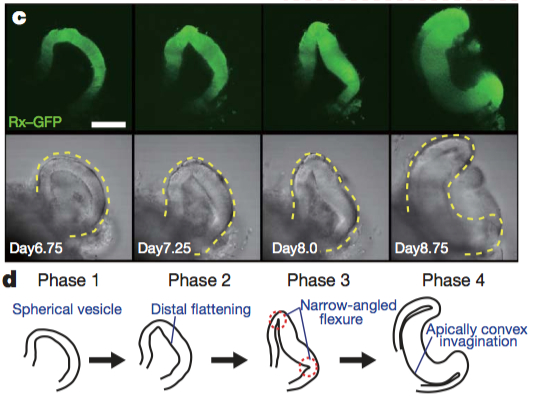
Although a number of studies have begun to shed light on the steps of eye morphogenesis, the mechanisms that initiate tissue folding and bending remain elusive. To tackle this question, Yoshiki Sasai’s lab induced eye growth from mouse embryonic stem cells with a specific recipe of basement-membrane components and a cocktail of signaling molecules, including the TGF-beta family member, Nodal. In just nine days, the stem cells underwent four distinct phases to produce an optic cup replete with stratified neural retina and RPE.
Together, the four phases of morphogenesis consist of three distinct processes that produce and depend on the formation of a hinge-like structure that ultimately becomes the rim of the optic cup (see Figure below). In phase one, spherical pockets, reminiscent of optic vesicles, form. In phase two, the distal surface of the spheres flatten to begin the invagination process, requiring actomyosin activity. In phase three, the edges between the flattened surface and the rounded part form hinges through apical constriction. In phase four, the optic cup becomes fully-developed, with the rim of the optic cup encircled by a “closed” hinge.
Images reprinted from from Figure 2 of “Self-organizing optic-cup morphogenesis in three-dimensional culture” in Nature, April 6, 2011 (vol 472, issue 7341) by Mototsugu Eiraku, Nozomu Takata, Hiroki Ishibashi, Masako Kawada, Eriko Sakakura, Satoru Okuda. Used with permission of Nature Publishing Group.
As we thought about how the optic vesicle folds to make the optic cup, it was helpful for us to think of another analogy: the wrinkly fingertips you get after doing dishes. Water is absorbed into your skin as you scrub that fourth pot (left over from making stone soup). The outermost layer of skin expands until its volume exceeds the flat surface that it occupies on each finger pad. For the skin to continue to fit over the small area of your fingertip, it puckers, forming hills and valleys at regular intervals. The developing eye appears to use this same principle, with one large, carefully guided wrinkle generating an eye’s shape.
Higher levels of proliferation in the distal part of the optic vesicle cause the developing neural retina to first swell and then fold inward. This inward folding is driven by two opposing physical properties that manifest in the NR and the RPE. Overtime, the NR and RPE exhibit distinct differences in rate of expansion (volume) and rigidity. Initially the entire optic vesicle is uniformly rigid (Phase 1), reinforced by an actin cortex with phosphorylated myosin light chain (pMLC) cross-bridges. Changes in activity and/or distribution of myosin light chain kinase leads to an accumulation of pMLC only along the apical surface of RPE cells (Phase 2). As proliferation in the presumptive NR continues, cells at the junction between the NR and RPE undergo apical constriction (Phase 3) and the NR completely invaginates (Phase 4).
This is the first study to recapitulate eye morphogenesis in vitro, providing evidence that complex, laminated pockets of neural tissue can self-organize to produce a retina. Although Eiraku et al. (2011), offer clear evidence that an optic cup can form spontaneously, without surface ectoderm (lens) or other neural ectoderm (brain), it is important to note, the earliest stages of specification and morphogenesis occurred only in a particular “soup” of extrinsic factors and specific culture conditions. This paper provides the foundation for understanding how delicate genetic cascades and self-organizing principles work together – like a time-sensitive recipe – to generate functional retina, and it reveals the power of stem cells, opening up new avenues for research into retinal regeneration as demonstrated by this 2012 Cell Stem Cell paper.
References:
Eiraku, M., Takata, N., Ishibashi, H., Kawada, M., Sakakura, E., Okuda, S., Sekiguchi, K., Adachi, T., & Sasai, Y. (2011). Self-organizing optic-cup morphogenesis in three-dimensional culture Nature, 472 (7341), 51-56 DOI: 10.1038/nature09941
Fuhrmann, S. (2010). Eye Morphogenesis and Patterning of the Optic Vesicle Current Topics in Developmental Biology DOI: 10.1016/B978-0-12-385044-7.00003-5
Nakano, T., Ando, S., Takata, N., Kawada, M., Muguruma, K., Sekiguchi, K., Saito, K., Yonemura, S., Eiraku, M., & Sasai, Y. (2012). Self-Formation of Optic Cups and Storable Stratified Neural Retina from Human ESCs Cell Stem Cell, 10 (6), 771-785 DOI: 10.1016/j.stem.2012.05.009
Each year, the British Society for Developmental Biology (BSDB) awards the Beddington Medal to the best PhD thesis in developmental biology. This year’s award went to William Razzell, who completed his PhD in Paul Martin’s lab at the University of Bristol. At the BSDB Spring Meeting last month, Will presented his thesis studies of wound healing, in which he’d used Drosophila as a model. We caught up with Will after his talk to ask him more about his work, to find out what he’s doing now, and to ask him if he has any advice for PhD students.
Congratulations on winning the Beddington Medal. Can you tell us a bit more about your thesis work?
Thank you. I used the Drosophila embryo to model two aspects of wound healing. First, I looked at how innate immune cells are rapidly recruited to wounds in response to a hydrogen peroxide signal, which is made by an enzyme called DUOX. I found that calcium signals in the wounded epidermis, that it can kick start the wound inflammatory process by activating DUOX, and that removing DUOX’s ability to sense calcium prevents hydrogen peroxide release and recruitment of innate immune cells. The second aspect I studied is how epithelial wounds in the Drosophila embryo repair, as they close extremely rapidly and efficiently compared to mammalian adult skin wounds. This is because they close by assembling an actomyosin cable that contracts the wound edges together until actin protrusions extending from the wound margin interdigitate to seal the epithelial hole. We know that these wound edge actin machineries are important for wound closure, but we know less about how cells surrounding the wound contribute to wound repair. I looked at cell shape changes associated with wound closure in the Drosophila embryo and saw that the cells have to stretch towards the wound but also shrink their junctions with neighbours in a myosin-dependent manner. This is important for remodelling the epithelium surrounding the wound edge, allowing for cell intercalation events, so that the actin cable can efficiently pull the wound edges together. The same events occur during an earlier developmental event in the embryo to drive tissue elongation, consistent with the idea that cells at the wound edge can reactivate developmental pathways in order to close the wound.
Obviously there are lots of different models you could have used, but you chose Drosophila as a model for studying wound repair. Why?
Drosophila have two really big advantages. One is that they are genetically-tractable, which means that we can do very rapid genetic studies on the embryo, such as genetic screening or efficiently mutating genes with ever advancing tools including CRISPR technology. The other huge advantage is that you can live image embryos. For example, we can simultaneously label and follow different populations of cells during wound closure, such as the damaged epithelium as it closes and the innate immune cells as they migrate to wounds. This gives us the opportunity to observe cell behaviours that contribute to wound closure live in the embryo and analyse how these very dynamic events contribute to wound repair.
What can your studies tells us about wound healing in humans?
Through these sorts of studies we can identify genes or signalling pathways that are involved in wound closure that might be conserved during mammalian wound healing. We can also use live imaging studies in Drosophila to get clues about how cell behaviours may contribute to closure of human wounds, which we cannot yet live image. For example, the junctional rearrangements I observed in Drosophila wound repair may give us clues into the junctional changes that could be involved during the repair of human epithelial wounds.
And I guess, in the long term, the aim is to improve that process?
Of course! We would really like to improve and speed up the wound healing process. At the moment, there are a lot of people who have chronic wounds or suffer from impaired wound healing or excessive scarring – we want to be able to enhance wound repair in these patients.
You recently moved to New York. Can you tell us about the work that you are doing there now?
I joined Jennifer Zallen’s lab at the Sloan Kettering Institute in New York. I’m using the Drosophila embryo again, but I’m now looking at the earlier developmental event of germband extension, in which cells undergo intercalation events driven by polarised recruitment of myosin to cell junctions. I want to understand the signalling pathways leading to this myosin behaviour, and how this contributes to global tissue architecture.
Do you have any advice for PhD students?
One thing I found particularly helpful during my PhD is talking about my science to absolutely everyone. Visiting PIs, other PhD students…just anyone! I have shown my confocal movies to my parents, and although they are not scientists they can still look at them and see things that I can’t. You focus on the same things every day, and just showing your results to someone else can really open up your view. Giving presentations is also a great way to meet people and discuss your science with others. I didn’t do enough of this during my PhD but I think it is definitely something that can be a huge advantage to any PhD student.
Razzell, W., Wood, W., & Martin, P. (2014). Recapitulation of morphogenetic cell shape changes enables wound re-epithelialisation Development DOI: 10.1242/dev.107045
– The British Library (London, UK) has launched a great exhibition about the beauty behind science visualisation. You can visit ‘Beautiful Science’ until the 26th of May.
– The Wellcome Trust’s Human Induced Pluripotent Stem Cells Initiative is calling for clinicians and scientiststo provide samples from patients with inherited genetic diseases for the project.
– Remember the fantastic ‘Inner Life of the Cell‘ animation? Harvard University and XVIVO got together again to create an updated version of the animation that reflects the chaos of a real cell.
I recently took part in the ‘I’m a scientist, get me out of here!’ outreach event. As soon as the school children found out I was a developmental geneticist and worked out what I did, one question I was repeatedly asked was: “what’s your favourite gene and why?” so for a bit of fun, I thought I’d share my thoughts and see what everyone else’s are too.
Now, I could have gone into detail about a gene of utmost importance in my work or one we literally couldn’t live without (although picking either of those would be tricky as that hardly narrows the list down). However, my first thought when picking my ‘favourite gene’ is always listing the funny-named ones that stuck out from my university lectures. That’s not to say these genes don’t also fit into the important and essential-to-life categories, but they have that added ‘pazzaz’ of an ear-catching name that would wake you from your university slumber, thinking “did he actually just say what I think he said…?”. So here is my shortlist, the top 5 genes based almost entirely on their names:
5. Tinman
Tinman is an absolute gem in the history of creative gene naming. As with all the best gene names, tinman is named after the phenotype seen in Drosophilia when it is suppressed. In case you haven’t guessed, mutating tinman in Drosophilia embryos results in flies without a heart, despite the rest of the embryo continuing to develop. The vertebrate relatives of this gene have been named under a much less creative process with NK2 homeobox genes making up the homologous family. Just in case the origin of the name is still unclear, think back to the magical land of Oz, where Dorothy meets the tinman whose only wish is to have a heart. A sweet tale; however, while the tinman in The Wizard of Oz was always sentimental anyway, tinman mutant Drosophilia don’t have the advantages of a fairytale ending…
4. Swiss cheese
You may find a theme with these genes as yet another gene with a brilliant name comes from the phenotypic description in flies. Think about the classic cartoon cheese and you’ve got a fairly good description of the adult fly brain seen in Drosophilia with a faulty version of the gene: full of holes. To be more precise, the swiss cheese mutant results in brain degeneration through apoptosis spreading from the CNS. Notably, the swiss cheese gene paved the way for the blue cheese gene, another gene which, when mutated, affects the fly brain in a way that may resemble the mouldy, marbled appearance of blue cheeses.
3. INDY
This gene has made the cut through its clever acronym name. INDY simply stands for ‘I’m not dead yet!’. In addition, the reference to the ‘Monty Python and the Holy Grail’ scene where a corpse being collected shouts “I’m not dead yet!” means this gene gets a strong haul of bonus points! This gene is shown to greatly extend the lifespan of fruit flies when mutated, so I guess the name makes sense as well. INDY is a nice example of scientists trying to hide jokes in their work; as of course we are a hilarious bunch of people.
2. Clark kent, superman and kryptonite (I know that’s cheating a bit!)
Finally stepping outside the realms of fruit flies, Arabidopsis thaliana has a lovely offering in a trio of genes that are named together. The clark kent and superman mutant genes make these plants extra macho – increasing the number of stamens found on their flowers. Superman mutants have an even greater increase than clark kent but if the kryptonite gene gains a mutation… uh oh! The mutation in the kryptonite gene causes both the clark kent and superman genes not to be expressed and makes the plant impotent. I think the naming of these genes greatly reflects the link many scientists share to the characters on ‘The Big Bang Theory’ and their passion for comic books!
1. Sonic hedgehog
Sonic hedgehog is possibly the most famous funny gene name and a personal favourite for sentimental reasons as well as the obvious brilliance of its name. Often shortened to SHH (although who would miss an opportunity to say ‘sonic hedgehog’ in full?), this gene is part of a gene family of hedgehogs with other mammalian relatives named desert hedgehog and indian hedgehog. I can vividly remember the development lecture I was sitting in when sonic hedgehog was first mentioned and how it took us all a good half an hour before someone bravely put their hand up to say what we were all thinking: “I’m sorry, are you actually saying this gene is named after a blue, speedy, cartoon hedgehog?!”. Well to put it simply, yes it is. Sonic hedgehog is heavily involved in vertebrate development and in flies the hedgehog mutant phenotype covers the surface of the Drosophilia in tiny pointy projections – similar to a hedgehog! In Zebrafish, hedgehog genes are also named tiggywinkle hedgehog and echidna hedgehog (although the latter is no longer commonly used) making full use of the creative possibilities stemming from naming a gene family ‘hedgehogs’.
The issue of gene naming has however come up in the news, and public opinion is divided. Whilst some of these creative gene names are amusing, memorable and sometimes quite clever, we have to remember that for every gene there is the potential for it to be implicated in a real disease or disorder. That means that somewhere, someone could be told that their child will not survive into adulthood because of mutations in their sonic hedgehog gene. I wouldn’t want to be the bearer of that bad news, let alone have to stand there and use a gene name like that in the explanation. Phenotypic description gene names have been useful in the past, especially as we began our exploration and discovery of genes. However, in a world now dominated by computers and bioinformatics, a more standard method for naming genes has to be implemented. Hence why many mammalian genes (whose functions were discovered after the original Drosophilia outbursts) are named based on structure and function, an attempt at moving gene naming into the same realms as taxonomy.
There are still plenty of genes around with somewhat hysterical names. Thankfully we now have alternatives for most, if not all, of these options, meaning the ‘in-jokes’ of science can be put in the past when necessary! For now though, peruse the options out there and be prepared for the inevitable question, ‘what’s your favourite gene…?’
Notable others (to google in your own free time!):



 Mesoangioblasts (MABs) are progenitor cells of embryonic derivation with mesodermal potential. They have been successfully used to restore skeletal muscle loss in dystrophic mice, but despite the clinical potential of these cells, their origin and role during development has not been defined. Now, on p.
  The assembly of the peripheral nervous system occurs in a precise order: motor efferent axons (MEs) emerge first, followed by somatosensory afferent axons (SAs), and then by sympathetic efferent axons (SEs). While this order is clearly defined, it is not clear whether the pioneering axons provide instructive cues for the trailing axons to follow, and thus whether the network represents a true hierarchy. In this issue (p.
  How does a developing tissue know how much to grow and when to stop? On p.
  Wound repair is a fundamental process that is required for tissue homeostasis and regeneration following damage. Most studies of wound healing have focussed on changes in the leading edge of wounded cells, but here William Razzell, Will Wood and Paul Martin show that morphogenetic cell shape changes that occur multiple cell rows back from the wound are important for efficient wound re-epithelialisation (p.
  Synaptogenesis is a complex process that involves the coordinated assembly of pre- and postsynaptic compartments. Various extracellular pathways and cues have been shown to regulate synapse formation but here, on p.
  Tissue morphogenesis is driven by coordinated cellular deformations and recent studies have shown that these changes in cell shape are powered by intracellular contractile networks comprising actin filaments, actin cross-linkers and myosin motors. In their Development at a Glance poster article, Munjal and Lecuit provide an overview of the mechanics, principles and regulation of actomyosin-driven cellular tension driving tissue morphogenesis. See the article on p.
  Bioengineering approaches promise to bridge the gap between stem cell-driven tissue formation in culture and morphogenesis in vivo, offering mechanistic insight into organogenesis and unveiling powerful new models for drug discovery, as well as strategies for tissue regeneration in the clinic. Here, Lutolf and colleagues draw on several examples of stem cell-derived organoids to illustrate how bioengineering can contribute to tissue formation ex vivo. See the Review article on p.
 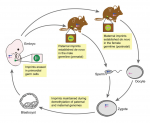 Genes that are subject to genomic imprinting in mammals are preferentially expressed from a single parental allele. These imprinted genes can directly regulate fetal growth, and recent work has also demonstrated intricate roles for imprinted genes in the brain and in induced pluripotent stem cells and adult stem cells. As Bartolomei and colleagues review here, these findings highlight the complex nature and developmental importance of imprinted genes. See the Review on p.