As most of you will know, the Node is run byThe Company of Biologists, a not-for-profit publisher of several journals, including Development. The Company of Biologists exists to benefit the scientific community, and as such all profits are given back to the community in different ways: by sponsoring meetings and societies, funding travelling fellowships and, most important for those reading this, allowing the Node to exist!
At the recent joint meeting of the British Society for Cell Biology and British Society for Developmental Biology, the company interviewed several researchers based in the UK that are associated with, and benefit from, the activities of the company. Watch the short video below for a quick snapshot of how The Company of Biologists helps the scientific community attending the Warwick meeting:
You can find more information about The Company of Biologists, and how you can apply to their grants and fellowships, by visiting their website.
Seán Mac Fhearraigh, from PostPostDoc, recently asked me to write a post about my experiences outside academia. Because I don’t have a lot of experience yet (I have only been working as the Node community manager for less than a year) I decided instead to focus on what I did during my PhD that helped the transition. I have reposted the article here as I thought it might of interest to the Node readers, but you can also read the article in its original page at PostPostDoc.
I spent a lot of my PhD feeling guilty. Guilty that I wasn’t working hard enough. Guilty that I wasn’t reading enough papers. Guilty that I might not be thinking hard enough about my experiments. And most importantly, guilty of all those times when I wasn’t in the lab doing experiments. At my undergraduate graduation party one of my lecturers, finding out that I was going to do a PhD, gave me some advice: ‘the PhD is a marathon, not a sprint’. I interpreted this as: make sure you take it easy and do other stuff during your PhD, or otherwise you will run out of energy before the end.
Following her advice, I made sure that experiments were not everything. During my PhD I was involved in all sorts of other activities: I ran a lecture series, I organised a small conference, I ran my lab’s twitter account, just to name a few. This followed on from some of the projects I had been involved with during my undergraduate degree, such as writing a blog or recording short science radio programmes. To be fair, all these projects were related with science, but they were not happening in the lab, and were not going in my thesis. I did all these projects because I enjoyed them, and also because they gave me a sense of achievement. Most of my experiments lasted several months from the point I started collecting my sample, to the time I could actually image something, and were all consuming- I could only really deal with one mutant at a time. With each experiment taking that long, I needed to be involved in something with a slightly shorter time frame for the sake of my own mental health. Yet, despite all these good reasons, that nagging feeling of guilt was always there.
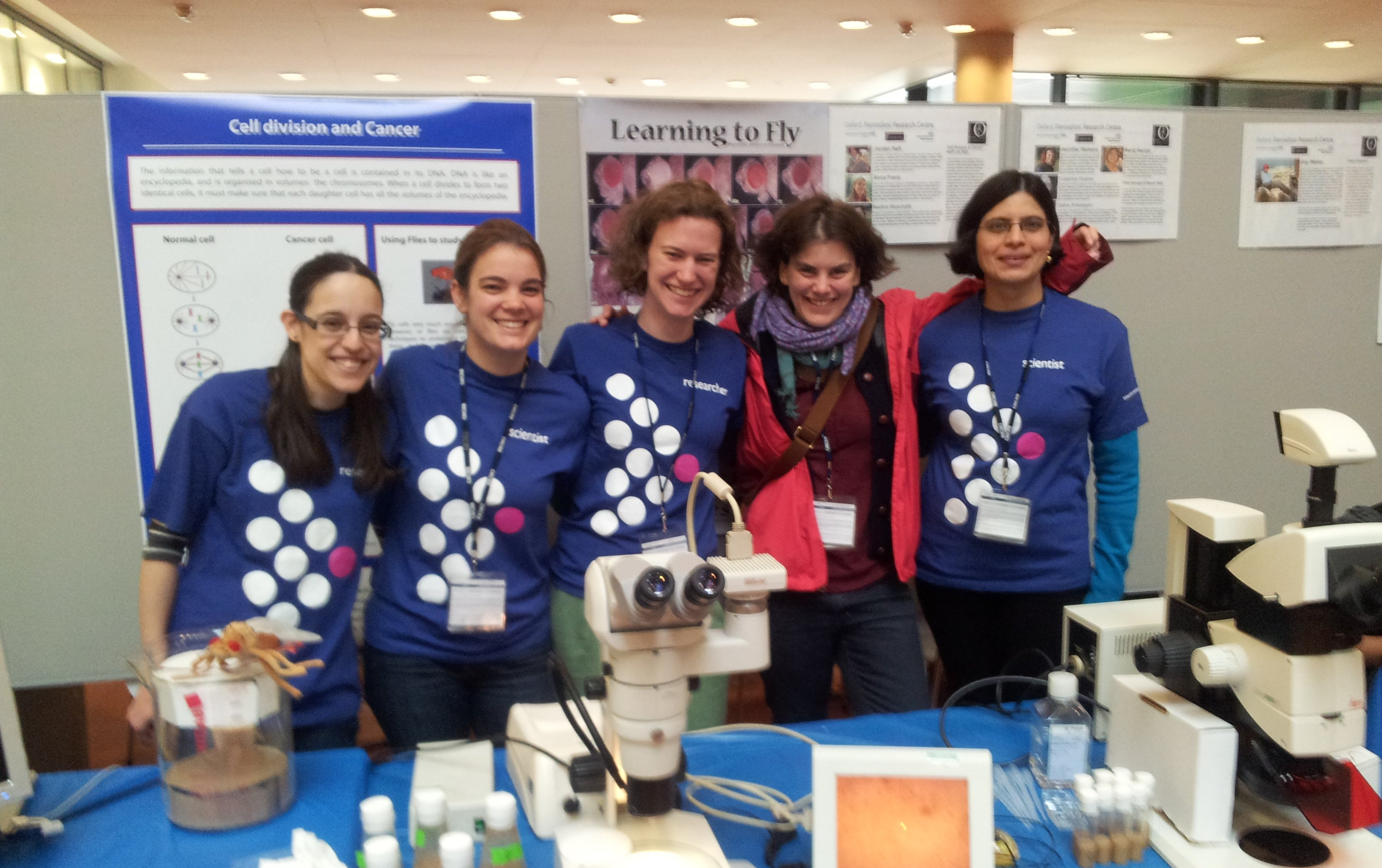
Cell division and cancer stall at a CRUK open day
When I reached the last year of my PhD, the obvious question of what to do next came to the forefront. I actually applied for a few postdocs, but as I discussed projects it became obvious that I had no wish to continue in the lab. The thought of starting a project all over again, in fact, of having to do even one more PCR, just depressed me. But if I wasn’t going to be a postdoc, what would I do? I remembered the words of Sarah Blackford, who I met at a careers session. Sarah said that she had decided to leave the lab because she enjoyed everything that she did as a scientist, except for the experiments. A bit of soul searching showed that this was exactly the same for me. I did enjoy the time during my PhD- just not doing the actual lab work! In fact, what I really enjoyed was doing all those things that had made me feel guilty!
I started searching for jobs, and soon realised that there were some out there that involved all the things that I enjoyed. They required someone with scientific training, involved interactions with scientists, and needed someone enthusiastic with interest in social media, writing, and so on. My worry was now whether I had enough experience. It must be said that PhD students tend to underestimate their own employability. We actually have many transferable skills- we can write, we can present, we can work in a team and be organised, and all of this under pressure. And we can show without a doubt that we can carry a project through to the end. We have a doorstopper (read: thesis) to prove it! But the most decisive criteria in getting my current job must have been all those extra activities and projects. Yes, not a comprehensive portfolio, but enough experience to show my ability to do my current job- community manager of a science blog, and responsible for the social media presence of a journal.
In retrospect, I was silly to feel so guilty about my extra projects and activities. I don’t recommend that you lazy about during your PhD if you want to finish it, but I would strongly encourage any students to get involved in other projects outside the lab. If you find at the end of your PhD that academia is not for you, maybe those projects will help you discover what else you enjoy doing, and may just give you that extra advantage when you apply for your first job. And if nothing else, the sense of achievement you get might help you deal with the ups and downs of science.
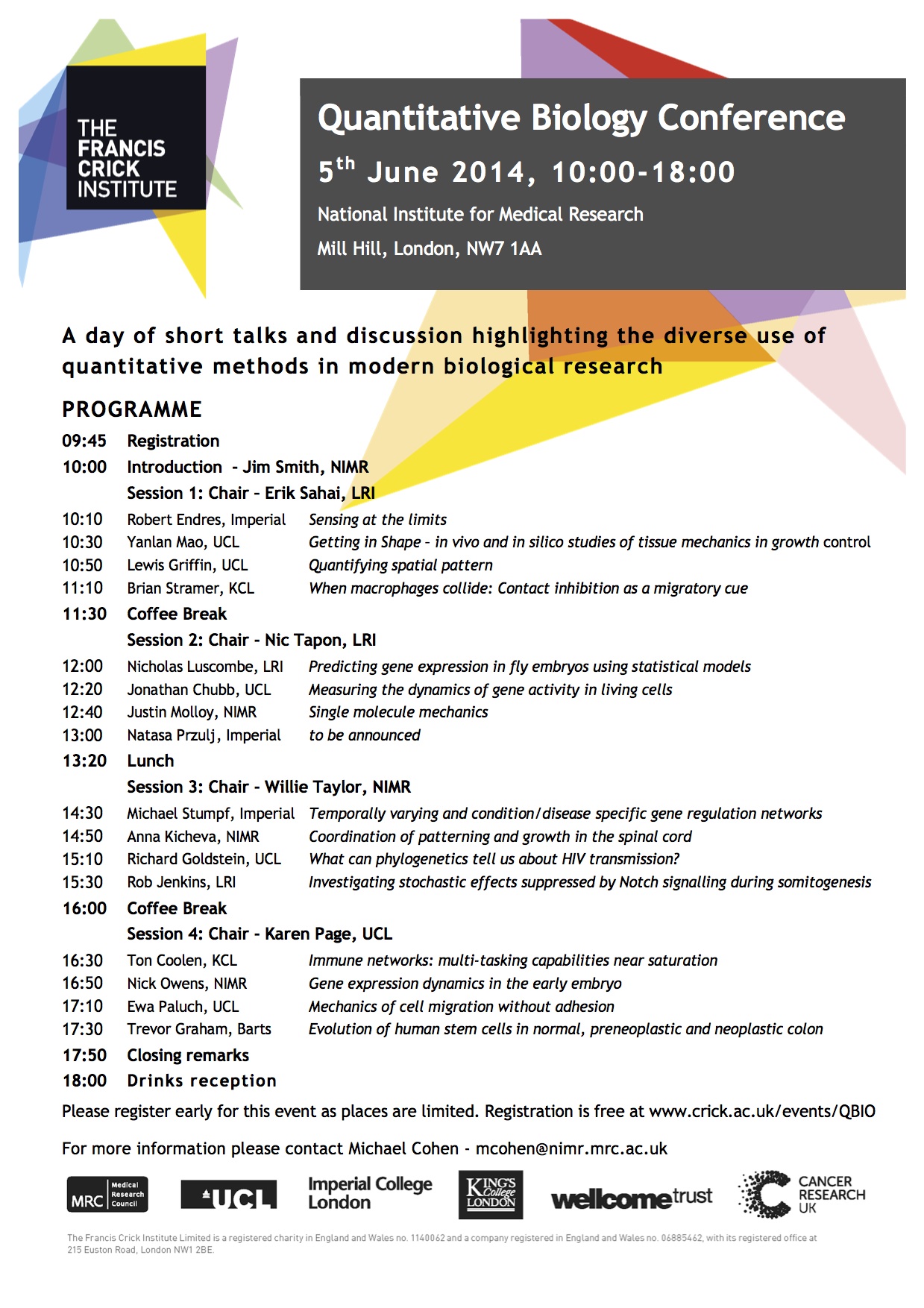
The NIMR are hosting the Crick Quantitative Biology Conference on June 5th. This will cover a broad range of interdisciplinary areas of research including tissue growth, cell mechanics, imaging, gene-networks, evolution etc. Please see the attached poster for details including a link to the online (free) registration page.
Development is a fascinating process that few people have a chance to see, let alone photograph! We recently participated with other scientists from the Crick Institute at a Science Museum Lates in London in February. For our activity, we built these inexpensive platforms that convert a user’s smartphone into a microscope screen.
We provided zebrafish embryos at different developmental stages for visitors to visualize and photograph. We showed visitors how to use the simple platforms that include a lens from a laser pointer for magnification. Once visitors had their phones lined up on the platform, they were able to view individual cells in early stage embryos or structures like the eye, brain, and heart in older specimens. We described the process of development from cell divisions to cell movements, gastrulation and segmentation. We found that the best practice was to mount embryos in sealed, agarose-coated petri dishes. This kept the embryo medium and zebrafish contained and the dishes were easy for visitors to manipulate. We also found that focal plane could be slightly different for various phones; it was helpful for visitors to remove phones from their cases.
Photo credit: Thomas S. G. Farnetti/Wellcome Images
Visitors were very excited to be able to take images like these with their smartphones. The event produced several shares on social media sites like Twitter and Instagram of pictures of zebrafish.
Photo credit: Alexis Webb
These microscope platforms are affordable and portable, making them suitable for demonstrations in schools and classrooms. Because they don’t require any power, they can be used outdoors or in areas that do not have electrical outlets. Imaging other types of live specimens is also possible. We hope that other researchers interested in showing off their model organism will consider using this type of low-tech, but high reward activity!
This post is part of a series on science outreach. You can read the introduction to the series here and read other posts in this series here.
Here are the highlights from the current issue of Development:
Sara sorts out stem cell asymmetric division
Adult stem cells play crucial roles in tissue homeostasis, giving rise to both new stem cells and differentiating daughter cells. The generation of these two cell types often involves the asymmetric distribution of cell fate determinants, but how these factors are partitioned asymmetrically has been unclear. Now (p. 2014), Chrystelle Montagne and Marcos Gonzalez-Gaitan reveal a role for Sara endosomes in the asymmetric division of Drosophilaintestinal stem cells (ISCs). Using live imaging of the adult fly midgut, the researchers first show that Sara endosomes, which are characterised by the localisation of the endosomal protein Sara, are unequally partitioned during ISC divisions, being preferentially targeted to the presumptive differentiating cell. They further examine the distribution of Notch and Delta, which have been implicated in regulating ISC fate, and show that both Notch and Delta traffic through Sara endosomes and, accordingly, are also asymmetrically dispatched to the differentiating cell. Importantly, they demonstrate that midgut homeostasis is perturbed in Sara mutants; the number of ISCs in the midgut is significantly higher in Sara mutants than in controls, indicating that Sara endosomes play a central role in assigning ISC fate. These, together with other findings, uncover a cell-intrinsic endosomal-based mechanism for regulating cell fate and asymmetric cell division.
WNT takes a free ride
It is widely accepted that, in amniotes, WNTs secreted by the dorsal neural tube form a concentration gradient that regulates somite patterning and myotome organisation. Here, Olivier Serralbo and Christophe Marcelle challenge this assumption and uncover a novel mode of long-range WNT signalling in which WNTs are delivered to their target sites by migratory neural crest cells (p. 2057). The researchers first show that WNT1 protein is present on the surface of early migrating neural crest cells (NCCs) in the chick embryo. Furthermore, they demonstrate that the migration of NCCs is required for correct myotome organisation and for the WNT1-dependent activation of WNT11 in a somite derivative known as the dorsomedial lip (DML). These processes, in turn, are dependent on expression of the heparin sulphate proteoglycan GPC4 by NCCs; knockdown of GPC4 in NCCs, but not in DML cells, causes a reduction in WNT11 expression in the DML, highlighting a crucial role for GPC4 in donor but not receiving cells. Overall, these findings suggest a model in which WNT proteins are loaded onto migratory NCCs and are physically delivered to the receiving cells of the DML in a GPC4-dependent manner.
ELAVating insight into Hox RNA processing
Hox genes play a crucial role in assigning cellular identities along the anterior-posterior axis of animal bodies. Hox gene expression can be regulated via transcriptional mechanisms and recent studies have also uncovered a regulatory role for Hox RNA processing, yet the mechanisms underlying this regulation remain unknown. Now, Claudio Alonso and colleagues identify the neural RNA-binding protein ELAV as a key regulator of Hox RNA processing in the Drosophila embryonic central nervous system (p. 2046). The researchers use the Drosophila Hox gene Ultrabithorax (Ubx) as a gene model for investigating RNA processing and discover that elav mutants produce patterns of Ubx alternative splicing and polyadenylation that are distinct from those observed in wild-type embryos. They further demonstrate that ELAV binds directly to discrete elements within Ubx RNA. In the absence of elav, they report, Ubx mRNA and protein levels are reduced, whereas nascent Ubx RNA transcripts accumulate, suggesting that ELAV-dependent processing of Ubx RNA is able to fine-tune the levels of Ubx expressed. Furthermore, an analysis of the cellular pathways affected in elav mutants reveals a role for ELAV in Hox-dependent apoptosis. The authors thus propose a model in which ELAV modulates Hox RNA processing, expression and function in order to regulate local programmes of neural differentiation.
Ssm1b: a novel modifier of DNA methylation
A locus in mice known as strain-specific modifier 1 (Ssm1) has previously been shown to be responsible for the strain-dependent methylation of E. coli gpt-containing transgenic sequences. Now, Ursula Storb and co-workers identify the Ssm1b gene that underlies this phenotype and characterise its expression in early mouse embryos (p. 2024). Through extensive mapping studies, the researchers identify Ssm1b as a KRAB-zinc finger gene that is located on distal chromosome 4. They further demonstrate that Ssm1b is expressed in early embryos up until embryonic day 8.5 and, in line with this, its target transgene gains partial methylation by this stage. The Ssm1b gene lacks the conserved transferase sequence present in all DNA methyltransferases, but the researchers demonstrate that Ssm1b mediates transgene methylation via the de novo methyltransferase Dnmt3b. By contrast, they report, the methylated DNA-binding protein Mecp2 is not involved in Ssm1b-dependent DNA methylation. These findings, together with preliminary analyses of Ssm1b function, uncover a novel gene and highlight the existence of a new family of genes that can initiate DNA methylation and chromatin modification and hence are likely to be involved in the epigenetic control of early development.
Plus…
Adult neurogenesis: mechanisms and functional significance
Adult neurogenesis has been implicated in physiological brain function, and failing or altered neurogenesis has been associated with a number of neuropsychiatric diseases. Simon Braun and Sebastian Jessberger provide an overview of the mechanisms governing the neurogenic process in the adult brain and describe how new neurons may contribute to brain function in health and disease. See the Development at a Glance poster article on p. 1983
Apical constriction: themes and variations on a cellular mechanism driving morphogenesis
Apical constriction is a cell shape change that promotes tissue remodelling in a variety of contexts. Martin and Goldstein review the cellular machinery required for apical constriction and discuss how it can be tunedto regulate apical constriction in diverse cellular contexts. See the Review article on p. 1987
Cell migration: from tissue culture to embryos
Cell migration is a fundamental process that occurs during embryo development. Here, Concha and colleagues review the guidance principles of in vitro cell locomotion and examine how they apply to examples of directed cell migration observed in vivo during development. See the Review on p. 1999
How great would it be if we knew how to reverse ageing and turn old organs into young ones? Actually, this might not be as crazy as it sounds. As a matter of fact, a team of scientists managed to regenerate the thymus in old mice and observe what closely resembles the juvenile thymus!
The thymus is a key organ of the immune system as it is where T cells, major actors of one’s immunity, develop and mature. In normal healthy people, the thymus degenerates with age (a process called thymic involution) and this results in a decline of the immune system function. Since our immune system is what protects us against diseases, it is evident that being able to restore the function of the thymus in elder people would be very beneficial.
Interestingly, in this study recently published in Development, Bredenkamp and colleagues achieved thymus regeneration in old mice. They observed a juvenile-like thymus after using genetic engineering to force the expression of the protein foxn1 in the aged thymus.
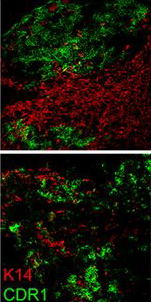
In this picture, you can observe the cortical thymic epithelial cell marker CDR1 in green and the medullary thymic epithelial cell marker keratin 14 (K14) in red. The cortex and the medulla are distinct regions of the thymus and they deteriorate during thymic involution. This results in reduced distinction between cortex and medulla as observed in the bottom picture taken in 24 months old mice. However, when foxn1 is over-expressed in the same 24 months old mice, you can observe that the clear distinction between cortex (green) and medulla (red) is restored, indicative of thymus regeneration.
In addition to the restoration of thymic architecture, the authors show that the regenerated organ has an increased T cell output and a gene expression profile similar to the juvenile thymus.
Most amazingly, apart from being able to “reverse ageing” in the thymus, they show that this regenerative process relies on the over-expression of a single factor (foxn1), making it a lot simpler than one might have anticipated! Thus, this study brings a new provocative concept that will most likely have a broad impact for regenerative biology.
Picture credit:
Bredenkamp, N., Nowell, C., & Blackburn, C. (2014). Regeneration of the aged thymus by a single transcription factor Development, 141 (8), 1627-1637 DOI: 10.1242/dev.103614
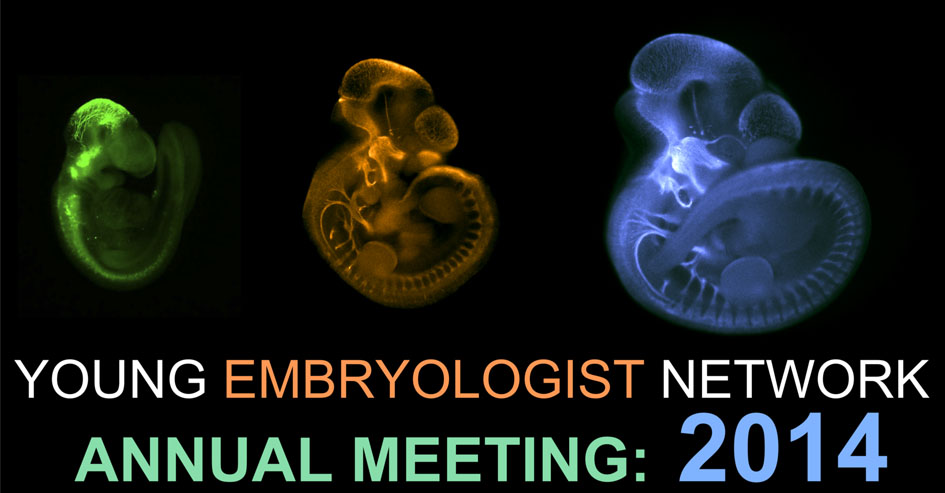
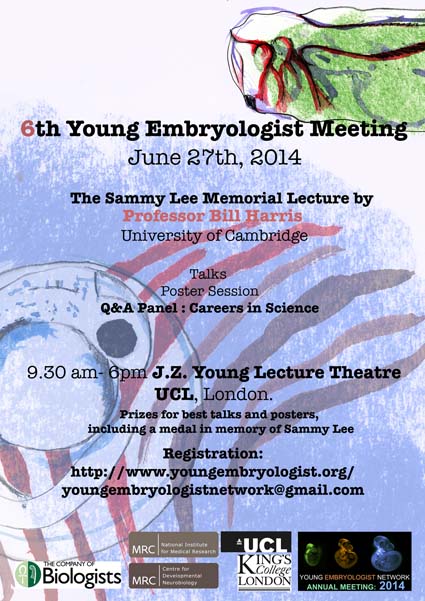
6th Young Embryologist Annual Meeting
Friday 27th June 2014 JZ Young LT, Anatomy Building, University College London
Last call for abstracts
The 6th Young Embryologist Meeting aims to bring together developmental biologists from across the UK and abroad to discuss their work at a leading UK institution by presenting a talk or a poster. This year, we are pleased to include The Sammy Lee Memorial Lecturepresented by Professor Bill Harris (University of Cambridge). We will also have a Q&A session about ‘Careers in Science’. In addition, prizes will be awarded to the best talks and posters, including a medal in memory of Sammy Lee
This unique meeting is run by PhD students and Post Docs at UCL, KCL, NIMR and Imperial and aims to create a more interactive research community. Everyone with an interest in developmental biology is welcome to attend this free meeting!
We hope the meeting will provide a platform for young researchers (preference is given to PhD and Post Docs) to present their work in a series of 20 minute talks and in the poster session. We will favour diversity of topics and models in the field of embryology.
Our main goal is to generate a space where students, postdocs and PIs can discuss a wide variety of topics in developmental biology in a relaxed setting. Ultimately, we would like to strengthen the Young Embryologist Network to enhance the research environment for embryologist, so please come!
If you want to get more out of your research, meet fellow researchers and get new ideas then join the Young Embryologist Network (YEN) by emailing: youngembryologistnetwork [at] gmail.com
Our jobs page has been particularly busy this month, with a range of job positions from research technicians to senior lectureships! Here are some of the other highlights:
Research:
– Nikos wrote about what his work in Parhyale, recently published in Science, can tell us about the evolution of regeneration.
– The undergraduates at Reed College posted their second contribution, with a journal club discussion of a 2011 paper by Sasai and colleagues on eye morphogenesis in a dish.
– And Caroline re-posted a press release on a recent Development paper in which regeneration of the aged murine thymus was achieved by expression of a single transcription factor
Outreach:
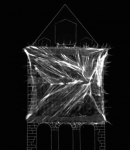
– Andreas was challenged to project cells onto buildings– cells that had been grown in micropatterns matching the buildings’ architecture. Read his post for more about this exciting outreach project in Paris!
– Lilian wrote about her favourite gene names. Share your favourite gene name by leaving a comment!
– We interviewed William Razzell, winner of this year’s Beddington medal, awarded by the British Society for Developmental Biology to the best PhD thesis. William did his PhD with Paul Martin at the University of Bristol, and worked on wound healing in Drosophila.
– Mariana wrote about her collaborative visit to Seville, where she produced the transgenic fish lines that will help her establish her new lab in Costa Rica.
– And at a recent meeting we asked the Node readers to tells us what is the most exciting scientific advance of the last few years, and what is the best scientific advice they ever received. We collated their answers in this short video.
Applications are invited for a Wellcome Trust funded Research Assistant position to join an international team in the Gurdon Institute, University of Cambridge. We are looking for a highly motivated and well-organised person who is willing to learn new techniques to join a project using CrispR-mediated homologous recombination to perform targeted genetic engineering in Drosophila . The project is a collaboration between groups in Cambridge, Yale and Oxford and is funded by a Wellcome Trust Strategic Award for 30 months. Applicants should have a degree in a relevant area of biology. Experience in molecular biology or Drosophila genetics would be an advantage.
The Gurdon Institute is a world-renowned centre in the fields of developmental, cell, and cancer biology, located in the heart of the historic city of Cambridge, and part of the University’s School of Biological Sciences. Founded in 1991, its purpose is to provide the best possible environment for research, and to foster interactions and collaborations between scientists with diverse but complementary interests. It is generously supported by core funding from the Wellcome Trust and Cancer Research UK, and benefits from state-of-the art facilities in a friendly, modern, purpose-built environment (see www.gurdon.cam.ac.uk).
Applications are invited for a Wellcome Trust funded Research Assistant position to join an international team in the Gurdon Institute, University of Cambridge. We are looking for a highly motivated and well-organised person who is willing to learn new techniques to join a project investigating polarised secretion in epithelia and how this is controlled by polarity factors. The project is a collaboration between groups in Cambridge, Yale and Oxford and will involve using new STED and PALM super-resolution microscopes to image polarized secretion in living tissues, and is funded by a Wellcome Trust Strategic Award for 30 months. Applicants should have a degree in a relevant area of biology. Experience in microscopy, molecular biology or Drosophila genetics would be an advantage.
The Gurdon Institute is a world-renowned centre in the fields of developmental, cell, and cancer biology, located in the heart of the historic city of Cambridge, and part of the University’s School of Biological Sciences. Founded in 1991, its purpose is to provide the best possible environment for research, and to foster interactions and collaborations between scientists with diverse but complementary interests. It is generously supported by core funding from the Wellcome Trust and Cancer Research UK, and benefits from state-of-the art facilities in a friendly, modern, purpose-built environment (see www.gurdon.cam.ac.uk).





 Adult stem cells play crucial roles in tissue homeostasis, giving rise to both new stem cells and differentiating daughter cells. The generation of these two cell types often involves the asymmetric distribution of cell fate determinants, but how these factors are partitioned asymmetrically has been unclear. Now (p.
  It is widely accepted that, in amniotes, WNTs secreted by the dorsal neural tube form a concentration gradient that regulates somite patterning and myotome organisation. Here, Olivier Serralbo and Christophe Marcelle challenge this assumption and uncover a novel mode of long-range WNT signalling in which WNTs are delivered to their target sites by migratory neural crest cells (p.
  Hox genes play a crucial role in assigning cellular identities along the anterior-posterior axis of animal bodies. Hox gene expression can be regulated via transcriptional mechanisms and recent studies have also uncovered a regulatory role for Hox RNA processing, yet the mechanisms underlying this regulation remain unknown. Now, Claudio Alonso and colleagues identify the neural RNA-binding protein ELAV as a key regulator of Hox RNA processing in the Drosophila embryonic central nervous system (p.
  A locus in mice known as strain-specific modifier 1 (Ssm1) has previously been shown to be responsible for the strain-dependent methylation of E. coli gpt-containing transgenic sequences. Now, Ursula Storb and co-workers identify the Ssm1b gene that underlies this phenotype and characterise its expression in early mouse embryos (p.
  Adult neurogenesis has been implicated in physiological brain function, and failing or altered neurogenesis has been associated with a number of neuropsychiatric diseases. Simon Braun and Sebastian Jessberger provide an overview of the mechanisms governing the neurogenic process in the adult brain and describe how new neurons may contribute to brain function in health and disease. See the Development at a Glance poster article on p.
 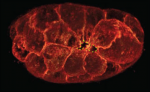 Apical constriction is a cell shape change that promotes tissue remodelling in a variety of contexts. Martin and Goldstein review the cellular machinery required for apical constriction and discuss how it can be tunedto regulate apical constriction in diverse cellular contexts. See the Review article on p.
 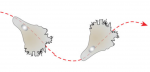 Cell migration is a fundamental process that occurs during embryo development. Here, Concha and colleagues review the guidance principles of in vitro cell locomotion and examine how they apply to examples of directed cell migration observed in vivo during development. See the Review on p.