

Neocortex evolution and human uniqueness
Posted by SteveBriscoe, on 20 October 2013
“So God created mankind in his own image, in the image of God he created them; male and female he created them. God blessed them and said to them, ‘Be fruitful and increase in number; fill the earth and subdue it. Rule over the fish in the sea and the birds in the sky and over every living creature that moves on the ground.’”
The concept of human uniqueness may be about as old as man himself. We have long regarded ourselves as somehow special and different from all of the other animals. This attitude is clearly reflected in the above creation story: there is man, crafted in the image of God, and then there is the rest, put here to be ruled over and fed upon.
The world and our understanding of it have changed quite a bit since those words were first penned, but the human uniqueness obsession remains. For one, we now attribute most of our uniquely human attributes to our highly developed neocortex. Numerous lines of evidence suggest this structure is critical for our cognitive abilities, higher order sensory processing, memory, and personality. But we are not the only creatures with a neocortex. In fact, all mammals have one. What then, sets us apart?
The Company of Biologists recently hosted a workshop, titled “Evolution of the Human Neocortex: How Unique Are We?,” in response to flourishing research on human brain evolution. Exactly what makes us special is hardly a trivial question. Thirty evolutionary neuroscientists were gathered in West Sussex, UK, cloistered for four days to discuss that which makes us human. And at the end of it, I believe we are scarcely closer to providing a satisfying answer.
A theme of the workshop was the apparent conflict between “Humans are just like the other animals” and “Humans are self-evidently special.” As biologists, we are keen to spot similarities between even distantly related animals. The very use of model organisms to study issues related to human biology depends on this. Much of our knowledge on neocortex development, for instance, comes from mouse and we extrapolate this to our own brain. We have a neocortex, but so do all mammals. Ours is elaborately folded, but so is the sheep’s. Our neocortex is huge, but it’s not a special kind of huge. As Barbara Finlay pointed out, it’s just as large as one would expect for our body size, given mathematical brain scaling models. The astonishing neocortex of dolphins and whales reminds us that we are not alone in being big brained.
On the other hand, mice don’t host conferences on brain evolution. Several speakers emphasized the obvious, and profound, gulf in cognitive abilities between humans and non-humans. So if humans are not unique in terms of gross morphological organization, we may need to closely examine the more subtle aspects of neocortex biology. Frank Polleaux brought an interesting perspective to the discussion: perhaps human cognitive abilities are not a result of neuron number or brain size, but rather of fundamental differences in neuronal properties. His lab’s work on the srGAP proteins illustrates this point nicely.
Gavin Clowry made a similar point with respect to neocortical GABAergic cells. Humans, so far as we know, are the only species to produce inhibitory interneurons locally in the cerebral cortex. We don’t know how or why this happens, and it may simply be to provide the expanded excitatory cell population with an appropriate balance of inhibitory cells. GABA cells in humans, however, may have undergone physiological innovations for coordinating oscillatory behavior across the brain. One particular class, the chandelier cell, is unusually abundant in our brain.
John Kaas discussed the tremendous proliferation of neocortical areas, a key dimension of neocortex organization, in humans. While the stem mammal likely had a tiny neocortex with an estimated 20 areas, modern man has about 183 distinct areas or more. Morphologically or physiologically differentiated areas may translate into a greater diversity of information processing. More areas may allow us to extract more useful information from finite sensory input, or provide more behavioral flexibility.
The human brain is an impressive piece of work, and while we are justifiably fixated on our uniqueness, we must not forget our place in the world. The idea that we are the pinnacle of some great chain of being is long dead. Rather, our body and mind are just as adapted to our particular circumstances as those of any other extant animal, and have been adapting for just as long. Our neocortex is big and sophisticated, but some of its key cellular components can be found in reptiles and birds and have been around for a very long time. The story of our evolution is just one of millions of such stories, and through the power of comparative biology we can infer the key details of its plot.
Edit:
There was a lot of great science presented and discussed at this meeting, and regrettably I can’t talk about all of it here. Katherine Brown posted earlier about the meeting (see comment and link below, thanks Cat!). A list of speakers and brief description of the meeting can be found here: http://workshops.biologists.com/workshop_sept_2013.html. Information on the srGAP proteins from the Polleux lab can be found here: http://www.sciencedirect.com/science/article/pii/S009286741200462X.
 (8 votes)
 Loading...

 (No Ratings Yet)


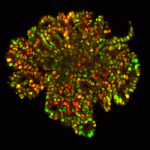 An effective cellular therapy for diabetes is dependent on the production of sufficient quantities of functional β-cells. Recent studies have enabled the production of pancreatic precursors but efforts to expand these cells and differentiate them into insulin-producing β-cells have proved a challenge. Now, Anne Grapin-Botton and colleagues establish a three-dimensional culture method that enables the efficient expansion of mouse embryonic pancreatic progenitors (
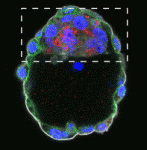 The preimplantation mouse embryo consists of three lineages: trophectoderm, primitive endoderm (PrE) and epiblast (Epi), which will become the future foetus. PrE and Epi precursors are initially present in a ‘salt and pepper’ distribution within the blastocyst and subsequently sort into two distinct layers but what controls this segregation? Here, Berenika Plusa and colleagues show that atypical protein kinase C (aPKC) couples cell sorting with cell fate progression in the mouse blastocyst (
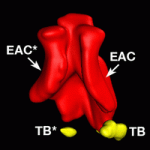 Abnormalities in the external ear, which is composed of the auricle and the external auditory canal (EAC), are frequent in newborns. However, little is known about the molecular mechanisms that govern external ear morphogenesis. Here, Filippo Rijli and colleagues report that Hoxa2 is a key transcriptional regulator that controls auricle morphogenesis in mice (
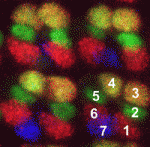 Cell fate decisions are influenced by extrinsic and intrinsic factors, but understanding how these are integrated is key for determining how cell fate is specified during development. Here, Yannis Mavromatakis and Andrew Tomlinson use developing ommatidia of the Drosophila eye as a model for exploring the logic of cell fate decisions (
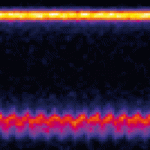 Pulsatile blood flow is driven by the heart and is a universal feature of vertebrate blood systems. However, the mechanisms controlling blood flow propagation in the embryo, while heart maturation is ongoing, are poorly understood. Here, Julien Vermot and co-workers examine vascular hydrodynamics and biomechanics in zebrafish embryos (
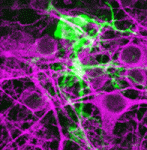 During development of the mammalian brain, cortical progenitors divide and give rise to neurons and glia. A number of signalling molecules and receptors are known to control neural progenitor fate but now (see
  The establishment of a pre-pattern or competence to form new organs is a key feature of plant development. Philip Benfey, Tom Beeckman and colleagues review the mechanisms that underlie pre-pattern formation and the earliest stages of lateral root development. See the Review article on p.
  Janet Rossant is a developmental biologist who has worked for many years on the mouse blastocyst, the derivation of stem cell lines and on investigating the mouse genome. In June 2013 she became president of the ISSCR, and she was also awarded the Harrison Medal – a prestigious prize given only once every four years. Earlier this year, Cat Vicente interviewed Janet. See the Spotlight article on p.