
Farish A. Jenkins, Jr (1940-2012)
Posted by Kim Cooper, on 14 November 2012
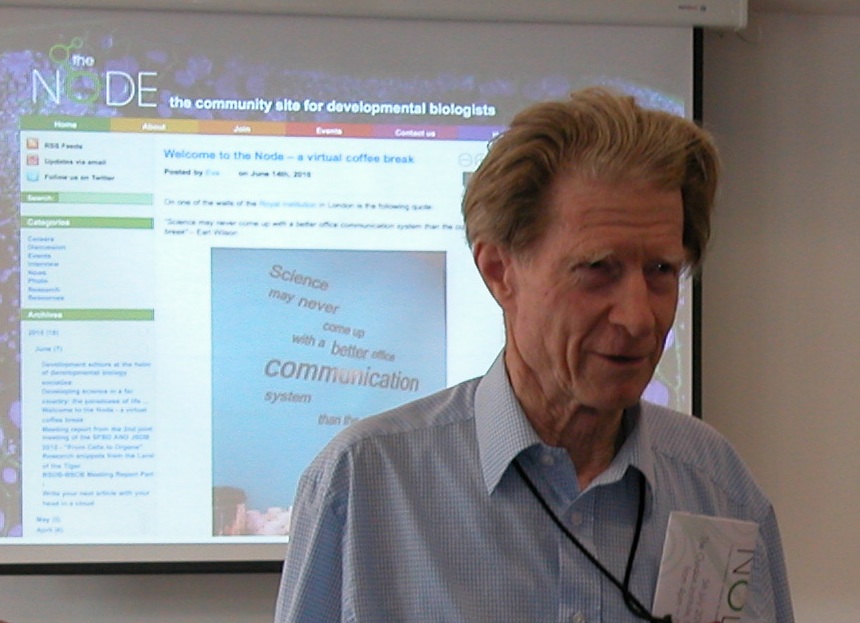
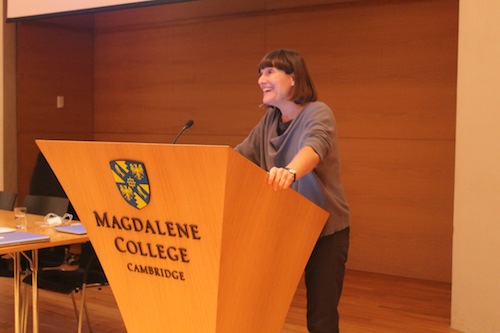
On the morning of Sunday, November 11th, the world lost a great gentleman scholar – Professor Farish A. Jenkins, Jr of the Museum of Comparative Zoology, Harvard University. Farish was an anachronism in today’s world who would have relished in lengthy discourse with the great comparative anatomists of the mid 19th century, his gold watch tucked neatly at home in the pocket of an English waistcoat. He had the admirable skill of speaking with equal measure of comfort and respect not only among the chairs of academic departments but also with his doe-eyed undergraduate advisees. But hidden only slightly beneath the surface of his genteel nature lay a delightfully off color sense of humor punctuated by a deep, hearty chuckle that was infectious in part because no one could help but be amused by how much he tickled himself.
Farish earned his PhD in Geology at Yale where he entered the great world of paleontology. Always one to look beyond his boundaries of comfort, he sought out training in anatomy at the medical school because after all, these were more than rocks. They were once living, breathing things with movement and three-dimesional form before they were crushed to a flattened and barely articulated state. From his deep understanding of anatomy sprung forth a long and fascinating career in functional morphology that spanned the full spectrum of vertebrate taxa. In his later years, through close friendships with several of us in the embryo world, he developed an additional appreciation for the embryonic origins of adult form and function. So much so that his classic vertebrate anatomy course has been merged and reformatted, along with Dr. Arkhat Abzhanov, to embrace a developmental perspective. Farish was a magnificent instructor. His teaching profoundly impacted thousands if not tens of thousands of students who passed before his colorfully chalked boards – painstakingly laid out in the hours before each class. Even beyond the walls of the classroom, I can’t imagine anyone ever crossed Farish’s path without learning something.
Farish unknowingly wrote his own tribute in his unscripted speech to the students at his recent Festschrift at Harvard: “This is for the students here, and those who would be students…you entering vertebrate biology whether with molecular systematic interests or organism interests, ecological interests, whatever your interests. You’ve got a great career. Why? Because you will take joy in two things. Here’s where the joys have come in my life. Discovery. When a discovery hits you, you’re looking at something and you don’t see it. And then all of a sudden you do see it. But you didn’t see it because you weren’t prepared to see it. You will make discoveries. Those will be days of your life’s highest elation, and it’s one of the most wonderful things that’s ever happened to me. Days of discovery…The other great happiness that is waiting for you as students is that you will become teachers…Doing something that is entirely happy and joyful. Because if you are good teachers, you will convey your enthusiasm, your love and your insight so that all of a sudden you turn out classes of people who really appreciate the natural world of organisms, and the phenomenon, the incredibly interesting phenomenon, of evolution. And this gives you great joy and gives them great joy…”
The days immediately following Farish’s “retirement” party in June were filled with meetings with all of his friend-colleagues to discuss future projects and fun left to be had. One retires from a job but not from a life’s passion. As such, Farish never really retired but continued to dig deeper and found joy in chasing that next discovery. In recent weeks he still took great satisfaction from teaching, beaming at me with pride when my confidence built to erase the carefully sculpted pencil lines of the master and replace them with my own mind’s representation of the bleached bones that we both inspected through his old dissecting microscope. His passing leaves a void but also an inspiration to carry on in his styling – even if none of us could quite pull off his style.
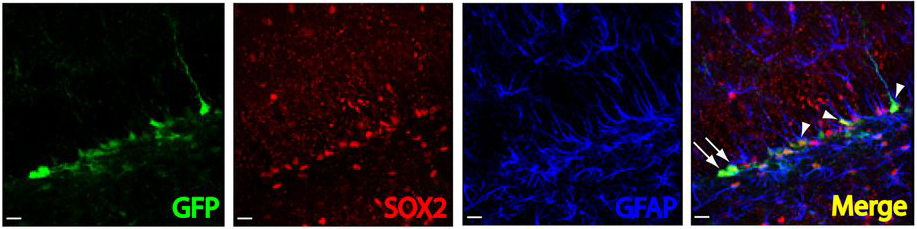

 What was your favourite paper in the fields of developmental or stem cell biology this past year?
 The Notch and Wnt signalling pathways are used during animal development to generate a diverse array of cell types. The two pathways often have opposing effects on cell-fate decisions but some cells receive inputs from both pathways simultaneously. In these circumstances, it is common for the receiving cell to exhibit a Wnt-ON/Notch-OFF response but how is this response generated? Now, on p.
 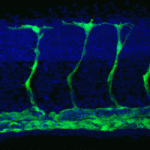 Secreted signalling molecules regulate cellular communication across tissues during development. For example, during angiogenesis in zebrafish embryos, vascular endothelial growth factor (VEGF) secreted by muscle controls the expansion and remodelling of the vascular network. The precise regulation of VEGF expression in muscle cells is therefore essential for angiogenesis but how is this regulation achieved? On p
 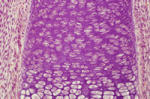 The production of collagen – a major component of the extracellular matrix – depends on hydroxylation of proline residues, a reaction that uses molecular oxygen as substrate. Cells that develop in hypoxic settings can nevertheless produce collagen during embryogenesis. Elazar Zelzer and colleagues begin to resolve this paradox on p.
 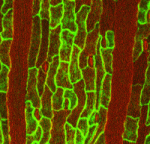 During development, cell division and cell specification must be coordinated to ensure that the tissues and organs of the adult organism are the correct size and contain the right proportions of various cell types. Here (p.
 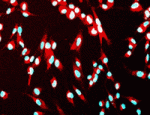 The generation of cloned embryos by somatic cell nuclear transfer (SCNT) into enucleated mature oocytes is inefficient because epigenetic reprogramming is limited in these embryos. However, treatment of somatic nuclei with a cytoplasmic extract from germinal vesicle (GV) stage oocytes before SCNT is known to improve the efficiency of cloned mouse production. Now (p.
 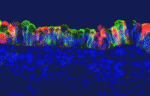 In developing mammalian lungs, the terminal buds of elongating airways contain multipotent epithelial progenitors that give rise to the three major lung epithelial cell types: Clara, ciliated and neuroendocrine (NE) cells. Now, Mitsuru Morimoto and colleagues provide new insights into how Notch signalling regulates the distribution of these epithelial cell types in the airway (see p.
 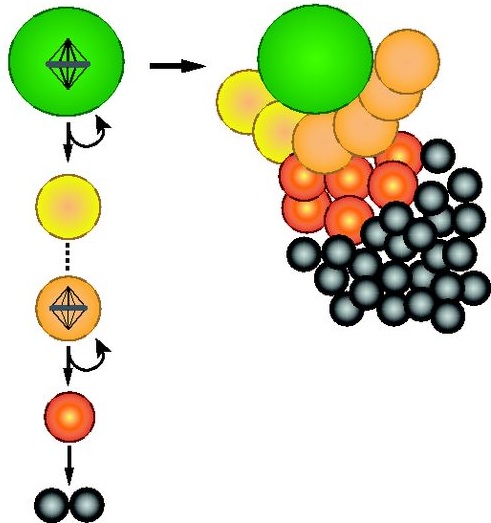 As part of the ‘
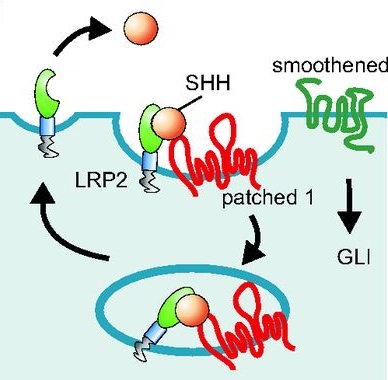 Thomas Willnow and colleaugues describe how low-density lipoprotein receptor-related proteins (LRPs) constitute central pathways that modulate morphogen presentation to target tissues and cellular signal reception, and how LRP dysfunction leads to developmental disturbances in many species. See the Primer on p.
 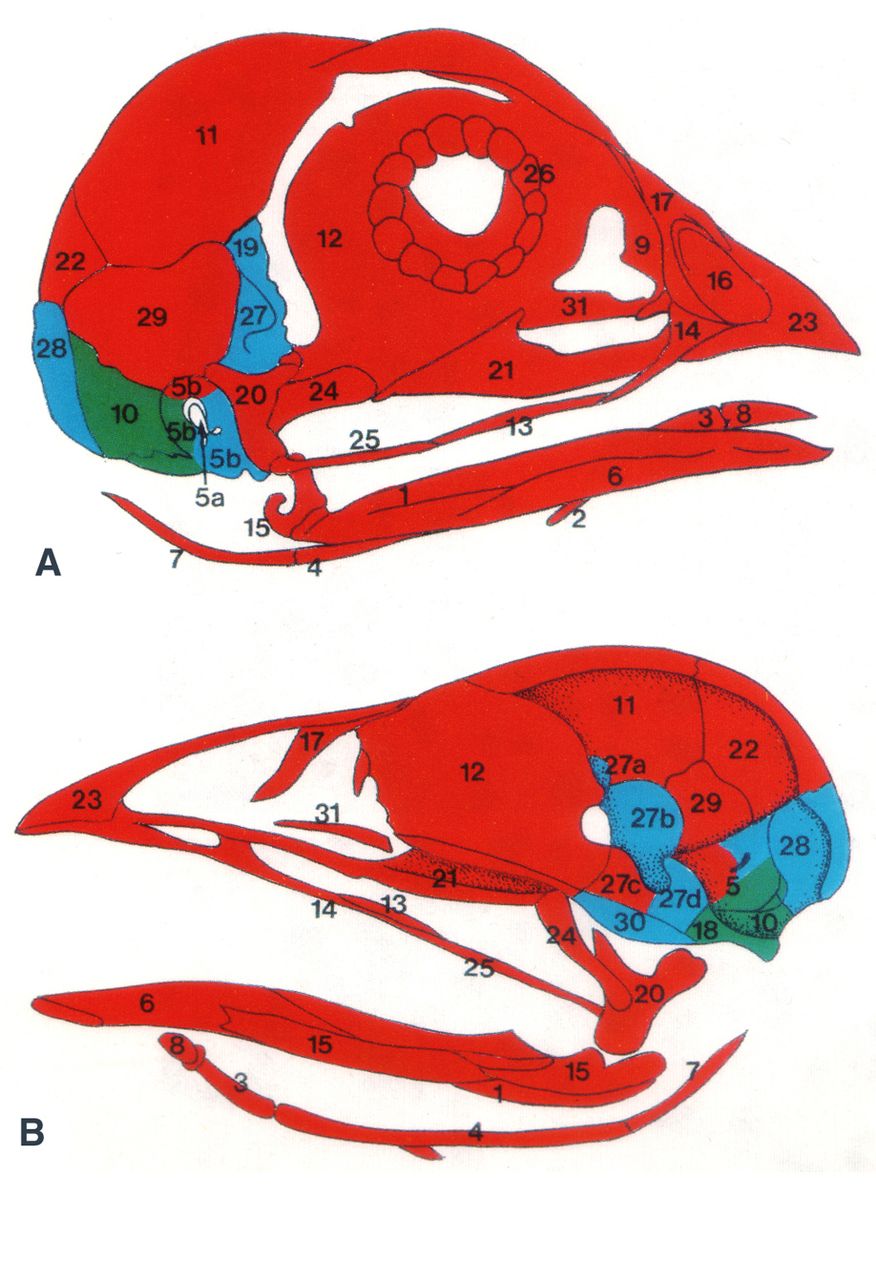 As part of the ‘Development Classics’ series, Nicole M. Le Douarin discusses her 1993 Development paper, in which she and her colleagues used the quail-chick chimera system to decipher the embryonic origin of the bones of the head skeleton of the avian embryo. See the Spotlight article on p.